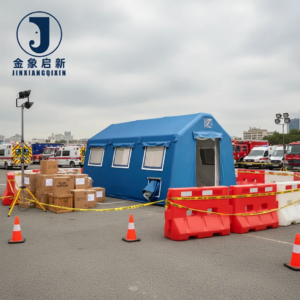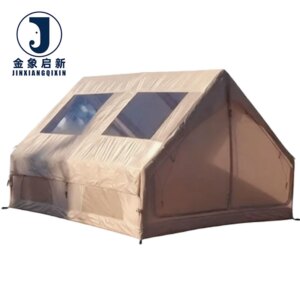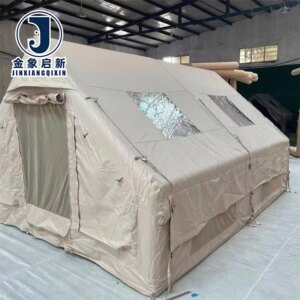
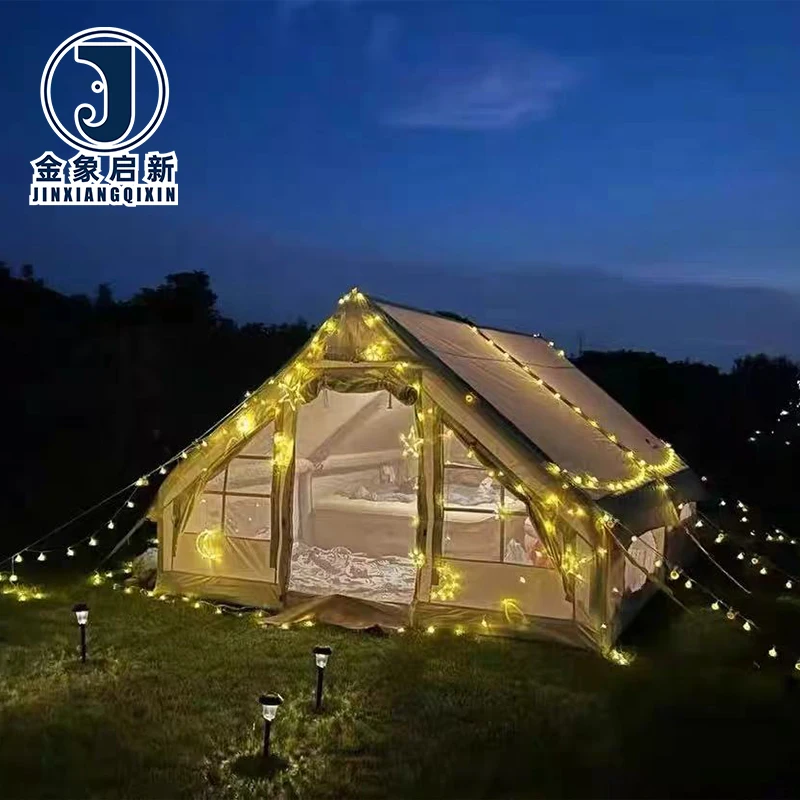
Coating Process Control — Thirty years of PVC formulation expertise ensures batch-to-batch consistency across inflatable tent fabric rolls, maintaining coating adhesion and surface finish uniformity for outdoor gear manufacturers scaling production.
Technical Specifications
| Parameter | Value |
|---|---|
| Product Type | Inflatable Tent |
| Core Material | PVC tarpaulin |
| Waterproof Performance | Fully waterproof coated construction |
| UV-Resistant Treatment | Available with UV-resistant treatment (test basis to confirm) |
| Tear-Resistant Construction | Reinforced base fabric for tear resistance (test basis to confirm) |
| Fire-Retardant Option | Available in fire-retardant grades (confirm the grade required for your market) |
| Anti-Static Option | Available with anti-static treatment (test basis to confirm) |
| Key Features | Waterproof, UV-resistant, tear-resistant, fire-retardant, anti-static |
| Customization | OEM & ODM including sample customization and pattern printing |
| Certifications | ISO9001, ISO14001, ISO45001, CE |
Application Suitability
| Application | Exposure & Requirement |
|---|---|
| Summer camping tent production | Sustained UV exposure, sudden rain, repeated inflation cycles, ground abrasion |
| Commercial inflatable shelter manufacturing | High-frequency assembly line handling, batch color matching, branding print clarity |
| Recreational outdoor gear distribution | Extended warehouse storage, varied climate shipping, retail presentation consistency |
Why Material Consistency Matters More Than Quoted Specifications
Batch variation in coating weight and color undermines production efficiency and brand credibility.
When sourcing Inflatable Tent Fabric manufacturer output for branded product lines, buyers frequently receive rolls where GSM deviates from the quotation, where color shifts visibly between batches once inflated side by side, or where UV treatment claims lack supporting test documentation. These issues surface only after cutting, welding, and printing — when remediation costs multiply. [NEED_CITE: coating weight tolerance standards for PVC tarpaulin per ISO 2286]
Coating Uniformity Across Production Runs
Maintaining consistent coating thickness across a multi-roll order requires continuous process monitoring at the coating head. Our production lines track coating weight in real time, adjusting knife gap and line speed to hold the target specification within tolerance. This discipline prevents thin spots that compromise waterproofing and thick zones that create stiffness variations during automated tent inflation.
Pattern Printing and Color Matching at Scale
For branded inflatable camping tents, color drift between rolls causes visible seams once panels are welded together. Our R&D team develops color formulations validated against reference standards, then monitors pigment dispersion during compounding. Pattern printing registrations are verified on press before full-run commitment, ensuring logo placement and graphic clarity remain sharp across the entire Inflatable Tent Fabric manufacturer order.
Understanding the Base Fabric and Coating Relationship
The tensile and tear performance of PVC tarpaulin depends on both the base fabric construction and the coating formulation. A high-denier polyester weave provides the structural backbone — warp and weft density determine how well the fabric resists tear propagation once punctured. The PVC coating contributes waterproofing and UV protection but cannot compensate for a weak base fabric. Knife-over-roll coating produces higher adhesion than laminating methods, which matters when welded seams face repeated inflation pressure cycles. [NEED_CITE: adhesion strength test methods for coated fabrics per ISO 2411]
Specification Gaps That Cause Downstream Failures
When fire-retardant grades are specified without confirming the test standard, fabric may pass one market’s compliance check and fail another’s — resulting in rejected shipments at the destination port. Similarly, UV treatment without documented test basis leaves manufacturers exposed to premature fading complaints from end users. Weld failures often trace back to coating chemistry mismatches rather than operator error, particularly when high-frequency welding parameters are set for a different plasticizer system. [NEED_CITE: high-frequency welding compatibility for PVC coated fabrics]
Why Manufacturers Choose This Supply Source
Three full production lines and 36 sets of processing equipment support bulk roll orders without sacrificing lead time reliability. The 10-person R&D team develops pre-production samples for custom widths, colors, and printed patterns within days rather than weeks. Dedicated QA and QC staff inspect every production stage — from raw base fabric incoming checks through coating weight verification to final roll packing — ensuring the Inflatable Tent Fabric manufacturer delivers material that matches the approved sample. ISO and CE certification documentation accompanies each shipment to support customs clearance and buyer compliance audits.
Documentation & Verification
- Material specification sheet stating coating composition and color reference per roll
- Test report documentation for UV and fire-retardant grades where specified
- Pre-shipment inspection record confirming waterproof integrity and material thickness
- ISO and CE certificates included for customs clearance and B2B compliance
- Roll packing list detailing quantity, dimensions, and batch identification
Fabrication, Handling & Storage
- High-frequency welding parameters must match the PVC plasticizer system for consistent seam strength
- Store rolls horizontally on pallets to prevent coating crease marks that telegraph through printed graphics
- Allow material to acclimate to workshop temperature before unrolling to avoid stress cracking in cold conditions
- Clean welded seams with mild solvent compatible with PVC coating to maintain surface finish integrity
- Inflate test each cut panel before final assembly to verify dimensional accuracy against pattern templates
Initiating Your Material Specification
To receive an accurate quotation, provide your target tent dimensions, annual volume requirement, and the fire-retardant or safety standard applicable in your destination market. Specify whether you need full roll stock or pre-cut panels, and indicate any custom color or printed branding requirements. Our team will prepare a pre-production sample reflecting your exact material and finish specifications for engineering validation before mass production commitment.
Frequently Asked Questions
Q: What customization options are available for inflatable tent fabric orders?
A: We support OEM and ODM requirements including custom width adjustments, color matching to Pantone or RAL references, pattern printing for branded graphics, and material thickness selection. Our R&D team develops samples for approval before production begins, ensuring the final rolls match your engineering specifications exactly.
Q: Can you provide batch-specific test data for UV resistance and fire-retardant performance?
A: Yes. Test reports documenting UV exposure results and fire-retardant grades are supplied with applicable orders. Confirm your target market’s specific safety standards during inquiry so we align testing protocols correctly and provide documentation that satisfies compliance audits at destination.
Q: How do you verify GSM and coating weight before shipment?
A: Every roll undergoes weight verification against the stated specification during final inspection. Our QA team samples across the production batch, recording coating thickness and total GSM values. Pre-shipment inspection records documenting these measurements accompany your shipment documentation.
Q: What is the process for confirming specifications before mass production?
A: We produce a pre-production sample reflecting your exact material weight, color, treatment, and printing requirements. Your engineering team evaluates this sample for welding compatibility, inflation behavior, and finish quality. Production proceeds only after written sample approval, eliminating specification misalignment.
Q: What documentation accompanies each shipment for customs and compliance?
A: Each order ships with a material specification sheet, applicable test reports, ISO and CE certificates, pre-shipment inspection records, and a detailed roll packing list. Certificate of origin and additional customs documentation are available upon request to support clearance in your destination market.