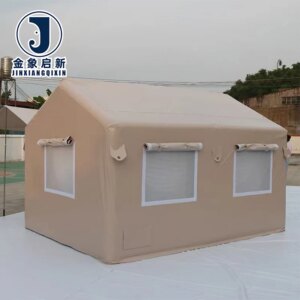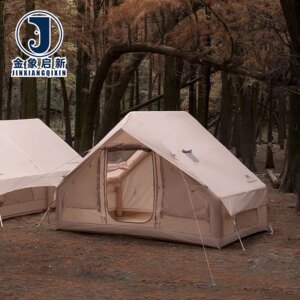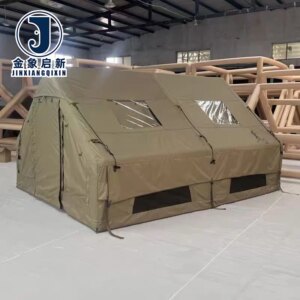
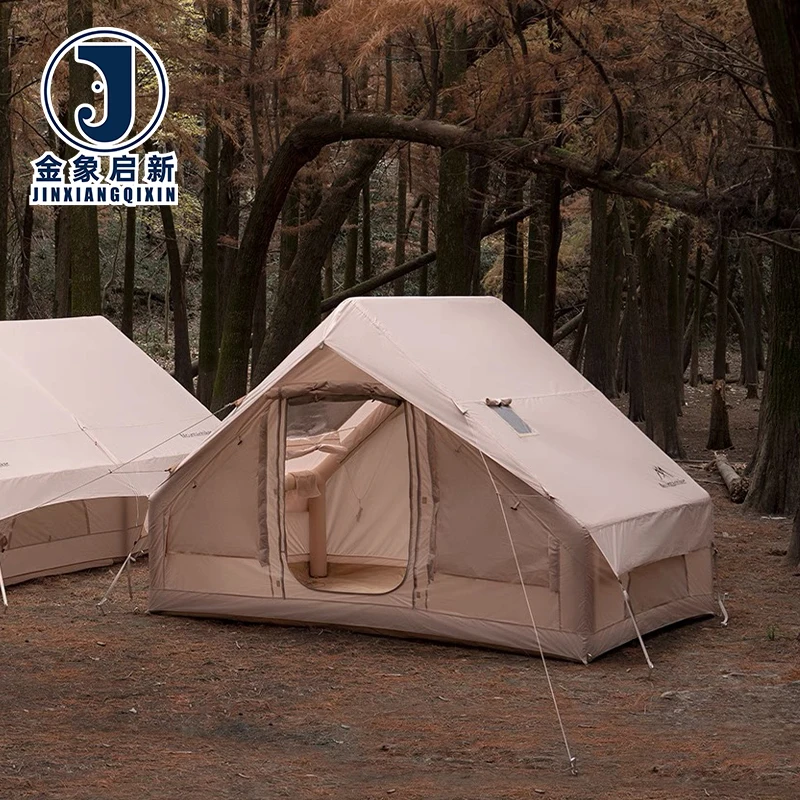
Coating Process Mastery — Nearly 30 years of focused development in PVC coated fabric gives us deep control over adhesion uniformity and knife-coat weight distribution for inflatable tent applications.
Technical Specifications
| Parameter | Value |
|---|---|
| Product Type | Inflatable tent |
| Core Material | PVC knife-coated fabric |
| Key Performance | Waterproof, tear-resistant; UV-resistant and fire-retardant grades available — confirm the grade required for your market |
| Anti-static Option | Surface treatment available — specify compliance standard at inquiry |
| Customization Service | OEM & ODM: sample customization, pattern printing, custom dimensions, material thickness adjustment |
| Quality Control | Full-process QA/QC with digital batch tracking, 100% pre-shipment inspection |
| R&D Capability | 10-technician team for sample development and thickness tuning |
| Production Capacity | 3 full production lines, 36 sets of processing equipment |
| Standards | ISO 9001, ISO 14001, ISO 45001, CE |
Application Suitability
| Application | Exposure & Requirement |
|---|---|
| 4–6 person inflatable camping tents | Cyclic inflation pressure, UV exposure, abrasion from ground contact, seam weld integrity under flex |
| Commercial adventure tourism structures | Repeated assembly cycles, weather variability, transport abrasion, structural rigidity under wind load |
| Professional field operation shelters | Extended outdoor deployment, moisture ingress prevention, thermal stress from sun exposure |
| OEM tent and inflatable product lines | Batch colour matching across production runs, pattern printing clarity, weld compatibility with automated cut-and-seal lines |
Why Material Specification Without Test Data Is a Procurement Risk
A datasheet claim means nothing without the test report that backs it up.
When sourcing PVC inflatable tent fabric manufacturer options, buyers often receive quotations stating "fire-retardant" or "UV-stabilised" without any reference to the test method or grade achieved. The consequence is a finished tent that passes your factory inspection but fails the compliance audit at the destination port. We have seen inflatable tent material orders rejected at customs because the stated flame performance did not match the local building or camping equipment standard — and the supplier had no documentation to defend the claim. The cost of a rejected container is not just the material; it is the production schedule disruption, the customer chargeback, and the loss of the next season’s contract [NEED_CITE: fire safety compliance standards for temporary structures by region].
How Knife-Coat Adhesion Determines Weld Integrity
The bonding between the PVC coating and the polyester base fabric directly controls how well heat-welded seams hold under inflation pressure. A poorly adhered coating layer will delaminate at the weld zone before the base fabric reaches its tensile limit. This is why a PVC inflatable tent fabric manufacturer with controlled knife-coat application offers a structural advantage — the coating penetrates the weave rather than sitting on the surface, creating mechanical interlock that survives repeated inflation cycles.
Coating Weight Control and Air-Beam Rigidity
The rigidity of an inflatable tent’s air beam depends on the combined stiffness of the base fabric and the coating mass applied to it. Too little coating and the fabric folds under internal pressure, creating stress points at every crease. Too much and the material becomes brittle at lower temperatures, cracking at the fold lines during packing. Our R&D team works with tent OEMs to tune the coating weight against the base fabric denier, achieving the balance needed for reliable inflation in the target climate [NEED_CITE: relationship between coating weight and flex fatigue resistance in PVC tarpaulin].
Reading the Base Fabric Construction
The denier of the yarn and the weave density of the base fabric determine tear propagation behaviour. A higher denier yarn resists initial puncture, but it is the weave density — the number of threads per centimetre in warp and weft — that stops a small tear from running across the panel. For inflatable camping tents, where a ground-stone puncture can compromise an entire air beam, this balance is critical. Coating weight alone does not compensate for a loosely woven base; the PVC layer provides waterproofing and surface protection, while the structural strength lives in the textile underneath. Surface finish — available in glossy or matte — also affects how well dirt and abrasion particles are released during cleaning, which matters for tents deployed in dusty or sandy environments over multiple seasons.
What Happens When Roll-to-Roll Colour Consistency Fails
Colour variation between rolls in the same order becomes immediately visible when tent panels are sewn or welded side by side on the production floor. A buyer specifying a single colour code for a commercial tent line expects uniform appearance across every unit, yet inconsistent pigment dispersion at the coating stage produces noticeable shade shifts. The result is a production halt while rolls are sorted, or worse, a customer complaint after installation when sunlight reveals the mismatch across adjacent panels [NEED_CITE: pigment dispersion tolerance standards for coated fabric batches].
Sourcing From a Specialist Coating Facility
Our operation runs three dedicated production lines with 36 sets of processing equipment, all configured for PVC coated fabric rather than general-purpose tarpaulin. The 10-technician R&D team handles material thickness tuning and pattern printing development specific to inflatable tent requirements, producing pre-production samples for your approval before mass coating begins. Full-process QA/QC with digital batch tracking means every roll carries traceable coating parameters, and 100% pre-shipment inspection catches weight or colour deviation before the material leaves the warehouse. Climate-controlled storage prevents surface blocking and coating tackiness that can occur when PVC rolls are held in unregulated conditions.
Documentation & Verification
- Batch inspection report stating waterproof rating, tensile strength, and flame resistance for each production run
- MSDS documentation supplied for PVC coating compound used on your order
- ISO 9001, ISO 14001, ISO 45001 and CE certificates included in shipment documentation
- Pre-shipment inspection record with roll-by-roll weight verification
- Certificate of origin and customs support documents prepared per destination market
Fabrication, Handling & Storage
- Heat-weld parameters must be calibrated to the specific PVC coating thickness — request our weld temperature guide for the grade ordered
- Store rolls vertically on padded racks to prevent flat-spot deformation of the coating surface
- Allow cold-transported rolls to acclimatise before unrolling to avoid cracking the PVC layer at low temperature
- Use compatible PVC adhesive for field repair patches, matching the coating formulation of the inflatable tent fabric
- Cut panels with rotary blades rather than shears to maintain clean edges for reliable heat-seal bonding
Preparing Your Inquiry
To get an accurate specification recommendation, share the inflation pressure your tent design operates at, the climate range it will be deployed in, and any fire-retardant or anti-static compliance standard your target market requires. Let us know whether you need the material supplied by the roll in standard widths or cut to panel dimensions, and whether pattern printing or custom colour matching is part of the project. Sample development is available to validate thickness, finish, and weld compatibility before you commit to a production order.
Frequently Asked Questions
Q: How is GSM verified on arrival and what does your batch inspection report cover?
A: Every roll is weighed and measured during pre-shipment inspection, with the actual GSM recorded against the specified value. The batch inspection report shipped with your order includes waterproof rating, tensile strength, and flame resistance data from that specific production run, so you can verify material performance matches your purchase specification.
Q: What fire-retardant grade does the inflatable tent fabric meet and how do I specify my target market standard?
A: Fire-retardant formulations are available across multiple grade levels. Because camping equipment fire standards differ by country and region, tell us the exact standard your destination market requires — such as CPAI-84, BS 7837, or a local equivalent — and we will formulate and test to that grade, supplying the test report with your shipment.
Q: How do you control colour consistency across multiple rolls in a single order?
A: Pigment batches are mixed to a single formula for your entire order, and digital batch tracking monitors coating parameters across every roll on the production line. Pre-shipment inspection includes side-by-side visual comparison under controlled lighting to confirm shade uniformity before dispatch.
Q: What customisation is available and what is the sample lead time?
A: We offer material thickness adjustment, custom dimensions, pattern printing, and OEM colour matching. Our 10-technician R&D team produces pre-production samples for your approval on thickness, texture, and finish before mass coating begins, with sample turnaround typically completed within days rather than weeks.
Q: How is the PVC coated fabric packed and protected during container shipment?
A: Rolls are wound on reinforced cores with protective outer wrapping to prevent surface abrasion and edge damage. Climate-controlled warehouse storage before loading prevents coating tackiness, and container loading plans account for roll weight distribution to avoid compression damage during transit.