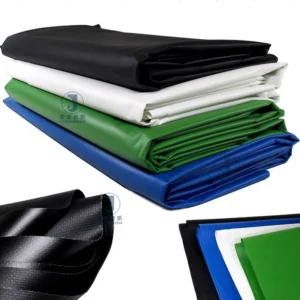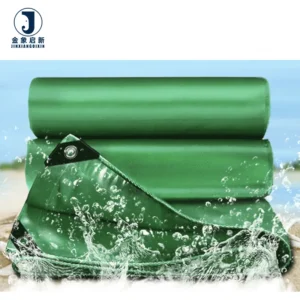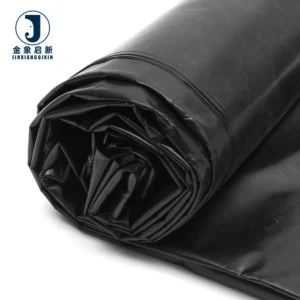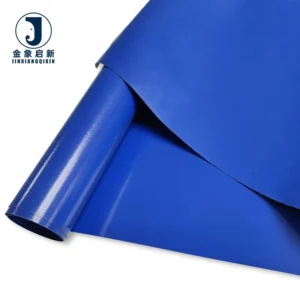
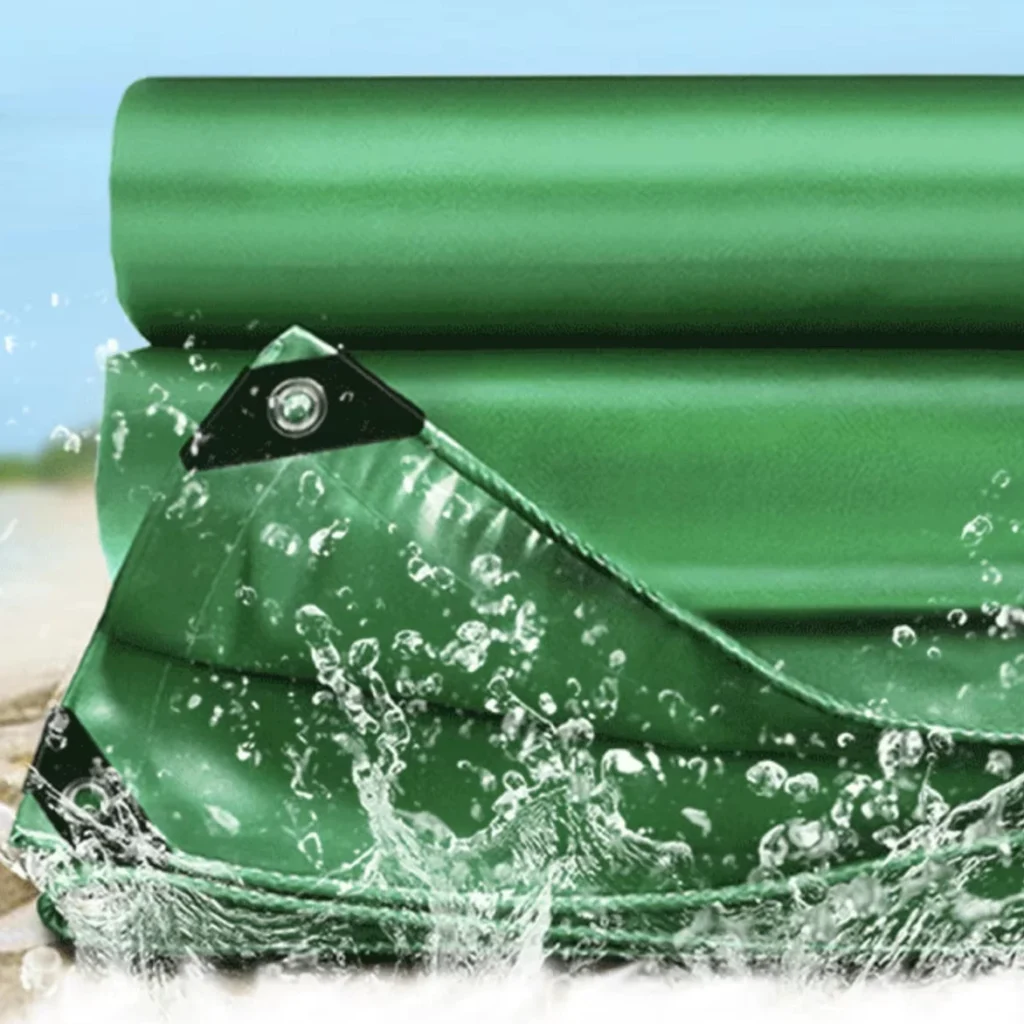
Coating Weight Control — Every roll of 0.3mm 400g PVC coated tarpaulin undergoes GSM verification at multiple production stages, ensuring the coating weight stated on the specification sheet matches the material delivered to your facility.
Technical Specifications
| Parameter | Value |
|---|---|
| Product Type | PVC Coated Tarpaulin |
| Specification | 0.3mm 400g |
| Total Thickness | 0.3mm |
| Base Fabric Denier | 500D × 500D Polyester |
| Coating Material | PVC (Polyvinyl Chloride) |
| Coating Method | Knife Coated |
| Key Features | Water Resistant, Waterproof, Flame Retardant (grade not stated in source), Anti-UV (test basis not stated in source) |
| Blackout Capability | Available |
| Standards | ISO, CE |
Application Suitability
| Application | Exposure & Requirement |
|---|---|
| Tent and awning fabrication | Prolonged UV exposure, wind loading, repeated assembly and disassembly, light-blocking performance |
| Truck and trailer side curtains | Constant flexing at hinge points, road debris abrasion, weather exposure during transit |
| Machine and equipment covers | Dust ingress prevention, moisture contact, handling abrasion from repeated removal |
| Wood and timber covers | Moisture protection for stored stock, wind uplift resistance, UV degradation resistance |
| Inflatable and membrane structures | Air retention under tension, seam integrity at welded joints, dimensional stability |
Why Coating Adhesion Matters More Than GSM Alone for PVC Coated Tarpaulin
A 400gsm fabric with poor coating adhesion will delaminate at the weld long before the base fabric reaches its tensile limit.
Technical buyers evaluating PVC coated tarpaulin rolls often focus on GSM as the primary quality indicator, yet coating weight alone does not predict how the material behaves under fabrication and field stress. When the PVC coating separates from the 500D × 500D polyester base at a welded seam, the joint fails regardless of how heavy the fabric feels in hand. This failure mode appears most frequently at flex points where truck side curtains fold repeatedly or where tent structures experience cyclic wind loading. [NEED_CITE: coating adhesion test methods for PVC coated polyester fabrics]
Base Fabric Architecture and Tensile Behaviour
The 500D × 500D polyester base construction provides a balanced warp and weft denier that distributes tensile loads evenly across both directions. For PVC coated tarpaulin applications where the fabric is tensioned across frames — such as awning structures or trailer side curtains — this balanced weave prevents directional bias that causes distortion under load. The denier count determines how individual yarns resist breaking, while the weave density governs how loads transfer between adjacent yarns when one is stressed.
Coating Weight and Penetration Control
At 0.3mm total thickness and 400gsm, the PVC coating must penetrate the polyester base sufficiently to lock into the yarn structure without over-saturating the fabric. Knife coating allows precise metering of PVC paste onto the moving substrate, controlling how deeply the coating flows between yarns. Insufficient penetration leaves the coating sitting on the surface where it can peel away during hot-air welding or mechanical flexing. Excessive penetration stiffens the fabric beyond what the application requires, reducing drape and making fabrication more difficult. [NEED_CITE: knife coating penetration depth and adhesion correlation for PVC tarpaulin]
Understanding the Specification String: What 500D and 400gsm Mean Together
The relationship between base fabric denier and total GSM determines the mechanical character of PVC coated tarpaulin fabric. A 500D × 500D base at 400gsm total weight means the coating accounts for a specific proportion of the combined structure — enough PVC to provide waterproofing and surface protection without overwhelming the tensile contribution of the polyester yarns. Heavier coatings on lighter base fabrics create materials that feel substantial but tear more easily because the yarns carrying the structural load are finer. The 0.3mm thickness sits in a range where the fabric remains flexible enough for folding and roll-up applications while maintaining enough body for tensioned installations. Surface finish — whether glossy or matte — affects how the material handles dirt accumulation and how well printed graphics adhere, though this specification does not designate a fixed finish. Flame retardant and anti-UV treatments are available in various grades, and buyers should confirm the specific grade required for their target market before approving production.
The Cost of Specification Mismatch in Roll Stock Purchasing
When rolls arrive with coating weight below the quoted GSM, fabricators discover the problem only after cutting and welding — the seams fail during installation because there is insufficient PVC material to form a proper weld pool. Colour variation between rolls in the same shipment forces fabricators to sort and match panels manually, delaying production and creating visible inconsistency in the finished installation. Flame retardant treatment claimed without supporting test documentation exposes the buyer to compliance rejection at the job site, where inspectors require certificate-level evidence rather than supplier declarations. [NEED_CITE: common failure modes in PVC coated fabric specifications for industrial covers]
Why Source This PVC Coated Tarpaulin From Jinxiang
Three full production lines with 36 sets of professional equipment allow simultaneous processing of multiple roll orders without sacrificing coating consistency across batches. The 10-person R&D team develops custom formulations and sample rolls within days, enabling technical buyers to test weld parameters and fabrication behaviour before committing to volume. Dedicated QA and QC inspection at every production stage — from base fabric incoming check through coating weight measurement to final roll inspection — catches GSM deviation before the material leaves the facility. ISO and CE certification underpins the documentation package, providing traceable quality records rather than unverified claims. Nearly 30 years of focused coated fabric production has refined process control over coating adhesion and weight distribution, the two variables that most directly affect fabrication success.
Documentation & Verification
- Material specification sheet stating exact GSM, 500D × 500D base fabric denier, and 0.3mm thickness
- Weight verification per roll against the stated 400gsm before dispatch
- Test report for UV and flame retardant grades where applicable to your market
- ISO and CE certificates included with shipment documentation
- Pre-shipment inspection record with measured coating weight values
- Roll packing list with individual roll identification for traceability
Fabrication, Handling & Storage
- Hot-air welding at temperatures suited to 0.3mm PVC coating — test weld samples first to confirm seam strength exceeds fabric tensile values
- Store 400gsm rolls upright on pallets to prevent flat-spot deformation that affects unrolling and tensioning
- Allow cold-stored rolls to reach ambient temperature before unrolling to avoid coating micro-cracking at 0.3mm thickness
- Use compatible PVC adhesive for field repairs on the knife-coated surface to maintain waterproofing continuity
- Plan cutting layouts to maximise yield from roll width and minimise transverse weld seams on tensioned panels
What We Need to Quote Your PVC Coated Tarpaulin Order
Provide your target GSM tolerance, required roll width, and annual volume so we can confirm production line allocation and batch consistency planning. Specify any flame retardant or anti-UV grade your end market mandates, along with the test standard your customers require for compliance documentation. Indicate whether you need blackout coating for light-blocking applications or standard colour rolls, and confirm if pre-production sample approval is required before full order release.
Frequently Asked Questions
Q: How is GSM verified on each roll before shipment?
A: Every roll of 0.3mm 400g PVC coated tarpaulin is sampled at multiple points along its length during production. Coating weight is measured and recorded against the stated 400gsm specification. Rolls that fall outside the agreed tolerance are flagged and held before dispatch. Pre-shipment inspection records with measured values accompany the documentation package.
Q: Can you supply test reports for UV and flame retardant treatment?
A: Test reports are available for flame retardant and anti-UV grades when specified at the inquiry stage. Because grade requirements vary by market — some regions require DIN 4102, others NFPA 701 or local building codes — confirm the exact standard your application demands so the correct treatment level and corresponding test documentation are prepared.
Q: How do you ensure colour consistency across multiple rolls in one order?
A: Batch colour matching is controlled through standardised pigment formulation and inline monitoring during the coating process. For orders spanning multiple rolls, pre-shipment sample comparison across the batch verifies visual consistency. If your application places panels side by side where colour shift would be visible, request a colour approval sample before full production begins.
Q: What weld method and temperature do you recommend for this fabric?
A: Hot-air welding is the standard method for 0.3mm knife-coated PVC tarpaulin on a 500D × 500D polyester base. Optimal temperature and speed settings depend on your specific welding equipment and ambient conditions. We recommend running test welds on sample material to establish parameters that produce seam strength matching or exceeding the base fabric tensile values.
Q: Can I get a sample roll to test before committing to a bulk order?
A: Sample rolls are developed within days for evaluation of coating weight, weld behaviour, and fabrication compatibility. The 10-person R&D team handles sample requests including custom colour, treatment grade, or width requirements. Testing sample material on your own equipment confirms that the 400gsm specification performs as expected in your specific fabrication process.