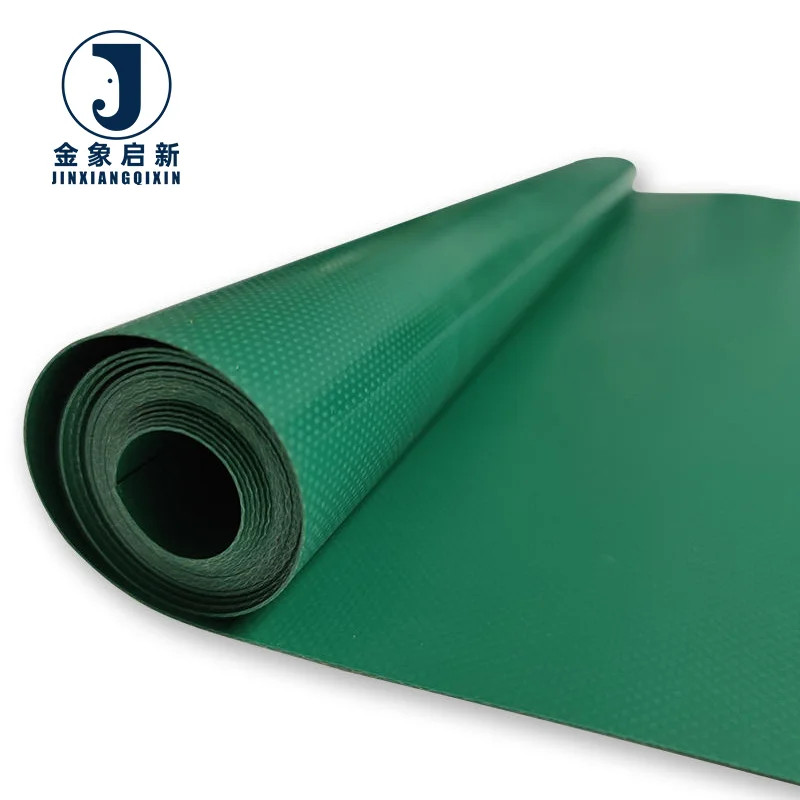
Deep Process Control Over Coating Weight — Every roll of knife coated PVC tarpaulin is produced on dedicated lines where GSM, base fabric denier and mesh count are held to the stated specification from first metre to last.
Technical Specifications
| Parameter | Value |
|---|---|
| Product Type | PVC Coated Tarpaulin Roll |
| Base Fabric Denier | 500D840D / 500D1000D / 1000D1000D / 1000D1300D / 1300D1300D / 1000D2000D |
| Weight Range | 350 g/m² to 900 g/m² |
| Total Thickness | 0.29 mm (350 grade) to 0.65 mm (900 grade) |
| Mesh Count (Density) | 30×19 (350–500 grades) / 20×20 (600–750 grades) / 30×15 (900 grade) |
| Tensile Strength — Warp | 1,650 N (350) to 3,900 N (900) |
| Tensile Strength — Weft | 1,600 N (350) to 3,500 N (900) |
| Coating Material | PVC |
| Base Fabric Material | Polyester |
| Key Features | Water resistant, flame retardant grades available, anti-UV treatment available (confirm the grade and test standard required for your market) |
| Surface Finish | Double-sided PVC coating |
| Edge Finish | High temperature heat sealed seamless edge wrapping |
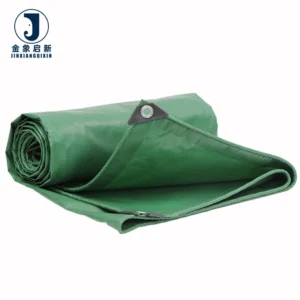
| Eyelet Specification | 3 cm enlarged aluminium alloy buttonhole |
| Corner Reinforcement | Reinforced corners on all sides |
| Rope | 5 mm thick rope without splicing |
| Standards | ISO, CE |
Application Suitability
| Application | Exposure & Requirement |
|---|---|
| Truck and trailer side curtains | Constant flexing at load points, road debris abrasion, UV exposure across seasons — requires high warp tensile strength and flexible coating adhesion |
| Tent and awning structures | Sustained wind load, rain pooling, repeated fold-unfold cycles — demands consistent mesh count and tear propagation resistance |
| Machine and equipment covers | Contact with lubricants and coolants, abrasion from vibration — calls for chemical-resistant PVC coating and adequate GSM for puncture defence |
| Balcony and pergola rain covers | Continuous outdoor UV and thermal cycling, visual appearance on residential façades — needs verified anti-UV treatment and colour stability roll to roll |
| Inflatable and membrane structures | Internal air pressure stress, seam integrity under tension — requires strong base fabric denier and reliable heat-sealed weld behaviour |
Why the PVC Coated Tarpaulin Base Fabric Denier Matters More Than GSM Alone
GSM tells you what the fabric weighs — denier and mesh count tell you what it can withstand.
When buyers receive PVC coated tarpaulin rolls lighter than the quoted weight, the failure is rarely random. It traces back to a specification that listed GSM without tying it to a base fabric denier, mesh count or thickness. Without those three anchors, a supplier can hit the target weight by overloading the coating on a lighter base cloth — a roll that passes the scale test but fails at the weld seam or tears under load. [NEED_CITE: tensile and tear test methods for coated fabrics per ISO 1421]
Coating Weight Versus Structural Integrity in Knife Coated Fabric
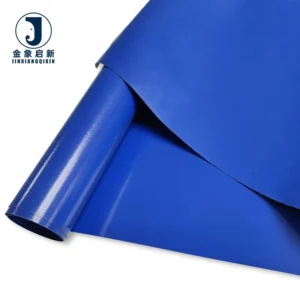
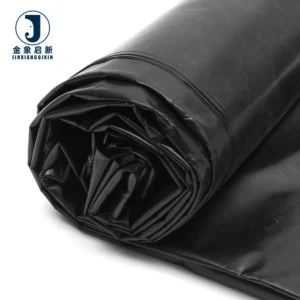
PVC coated tarpaulin roll stock made by knife coating forces PVC paste through a precision blade gap onto the polyester base fabric. This method builds a thicker, more uniform coating layer than lamination or calendering, which directly affects peel strength and weldability. The base fabric denier — whether 500D×840D or 1000D×2000D — determines how much tensile load the woven skeleton carries before the coating itself becomes the structural element. A 650 g/m² roll with a 1000D×1000D base will behave differently under tension than a 650 g/m² roll padded to weight on a lighter weave. Technical buyers specifying PVC tarpaulin by tensile and tear performance should request the denier, mesh count and thickness together, not GSM in isolation.
Mesh Count and Its Effect on Coating Adhesion and Tear Propagation
The mesh count — the number of warp and weft yarns per unit area — controls how much PVC paste penetrates between the yarns during knife coating. A tighter mesh like 30×19 found in the lighter grades allows thorough paste penetration and strong coating-to-yarn bonding, which resists delamination at cut edges and weld lines. A more open mesh like 20×20 in the heavier grades accommodates thicker yarns but leaves larger inter-yarn gaps that rely on coating thickness for structural continuity. When a tear starts at an eyelet or corner, the mesh count determines whether the tear arrests at the next yarn intersection or propagates freely across the weave. [NEED_CITE: tear propagation behaviour in woven coated textiles] Specifiers selecting base fabric denier and coating weight for welding and seam behaviour should evaluate mesh count alongside denier to predict how the fabric performs after fabrication.
Thickness-to-Weight Correlation Across the Specification Grades
Across this product family, total thickness progresses from 0.29 mm at the 350 g/m² grade to 0.65 mm at the 900 g/m² grade. This correlation exists because knife coating builds thickness by adding PVC paste layers rather than compressing them — heavier grades are genuinely thicker, not just denser. Thickness directly affects abrasion resistance at contact points such as truck load edges, machine frame corners and tent pole caps. It also determines how much material is available for a heat-sealed weld: a thicker coating provides a deeper fusion zone and a stronger seam. However, thickness also increases roll weight and stiffness, which influences handling on the fabrication table and the minimum bend radius during installation. The right grade balances protection with practical deployability.
Tensile Strength Progression and What It Means for Fabricated Covers
Warp tensile strength ranges from 1,650 N at the lightest grade to 3,900 N at the heaviest, while weft strength follows a parallel curve from 1,600 N to 3,500 N. This progression is driven by the combined effect of base fabric denier and mesh count rather than coating weight alone. For fabricated truck covers, the warp direction typically carries the greater load because panels are oriented so that warp runs along the length of the vehicle. Tent and awning fabricators, by contrast, often see more balanced biaxial loading and should pay equal attention to both warp and weft figures. When comparing PVC against PE tarpaulin on material composition and service life, the polyester base fabric in PVC coated rolls delivers substantially higher tensile and tear resistance than the woven polyethylene used in PE alternatives.
The Hidden Cost of Specifying PVC Tarpaulin by Weight Without Material Data
A roll that arrives lighter than quoted is the obvious problem, but the less visible failure is a roll that meets the GSM target through coating over-application on an underweight base fabric. This material passes the weight check but shows poor adhesion at heat-sealed seams because the excess PVC lacks yarn anchorage. Under load, the weld line parts before the fabric body reaches its rated tensile capacity. [NEED_CITE: heat-sealed seam failure modes in PVC coated polyester] In projects where flame retardant compliance is required, a roll supplied without the correct test standard documentation can halt a building inspection or delay a mining site audit. And when colour varies between rolls in the same order, the mismatch becomes visible once panels are installed side by side on a truck curtain or pergola cover — forcing selective re-cutting or a full reorder.
Why Technical Buyers Source This PVC Coated Tarpaulin Here
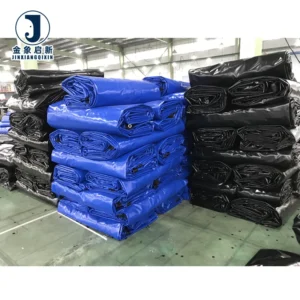
Nearly three decades of focused coated fabric production means the coating weight and adhesion parameters for each denier and mesh count are established through long production history, not trial runs. Three full production lines and 36 sets of professional equipment provide the capacity to hold batch consistency across multiple rolls in a single order. A 10-person R&D team handles material selection and sample development, so custom width or specification requests are validated before production starts. Dedicated QA and QC at every production stage with full pre-shipment inspection catches GSM deviations, colour drift and coating defects before dispatch. Samples for custom requirements are developed within days, giving specifiers a physical reference to approve before committing to bulk volume.
Documentation & Verification
- Material specification sheet stating GSM, base fabric denier, mesh count and coating weight for each roll
- Test report for UV and flame retardant grades where applicable — request the specific standard before ordering
- Pre-shipment inspection record confirming thickness and density spot-check against the quoted specification
- ISO and CE certificates included in the documentation package with every shipment
- Roll packing list and certificate of origin provided for customs clearance
Fabrication, Handling & Storage
- Heat-seal parameters should be adjusted per GSM grade — the 900 g/m² material requires higher dwell time than 350 g/m² to achieve full coating fusion at the weld
- The 3 cm enlarged aluminium alloy eyelets distribute tie-down load across a wider area, reducing tear initiation at grommet holes
- Store rolls upright on end-caps to prevent flat-spot deformation of the double-sided PVC coating surface
- Reinforced corners on all sides add material at the highest-stress fabrication points, reducing the need for additional patching
- Cut panels with a minimum seam allowance that accounts for the coating thickness — heavier grades need wider margins for reliable weld penetration
Request a Specification Match for Your Application
To specify the right PVC coated tarpaulin base fabric denier coating weight GSM tensile strength grade for your project, share the intended application, the environmental exposure conditions and the fire safety standard your market requires. If you need roll stock in a custom width or colour, provide your annual volume estimate so lead time and batch consistency can be confirmed before sampling. Let us know whether you require raw roll stock or fabricated panels with heat-sealed edges and eyelets — this determines the production routing and documentation package.
Frequently Asked Questions
Q: How is actual GSM verified against the quotation before shipment?
A: Each roll is weighed and measured to calculate grams per square metre, and the result is recorded on the pre-shipment inspection report. This is cross-referenced against the base fabric denier, mesh count and thickness stated on the material specification sheet so you can confirm the weight is achieved through the correct construction rather than coating over-application.
Q: What test standard supports the flame retardant claim?
A: Flame retardant grades are available — confirm the specific grade required for your market, such as B1 per DIN 4102, M2 or NFPA 701, before ordering. A test report referencing the applicable standard is supplied with the batch documentation so that site inspectors and compliance auditors have verifiable evidence.
Q: How does PVC coated polyester compare to PE tarpaulin on performance?
A: PVC coated polyester delivers substantially higher tensile and tear resistance than woven PE tarpaulin due to the stronger polyester base fabric and the knife coating bond. PVC coated rolls also offer better heat-seal weld behaviour and longer service life under UV exposure, making them the preferred material for fabricated truck covers and permanent structures.
Q: Can UV treatment be supplied with a documented test basis?
A: Anti-UV treatment is available across the specification range — request the test standard and exposure duration documentation required for your application before production. The test report is then tied to your specific batch so the UV performance claim is verifiable on arrival rather than an unsupported quotation-line statement.
Q: How do you ensure colour consistency across multiple rolls in one order?
A: All rolls in a single order are produced in one continuous run on the same coating line using the same PVC paste batch. Pre-shipment inspection includes a side-by-side colour comparison under controlled lighting, and any roll showing visible deviation is removed before packing and dispatch.