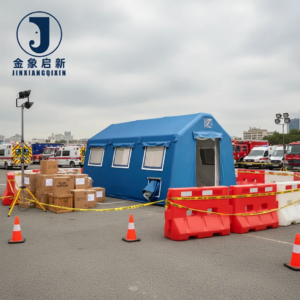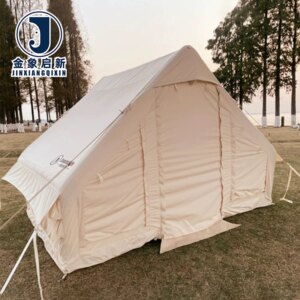
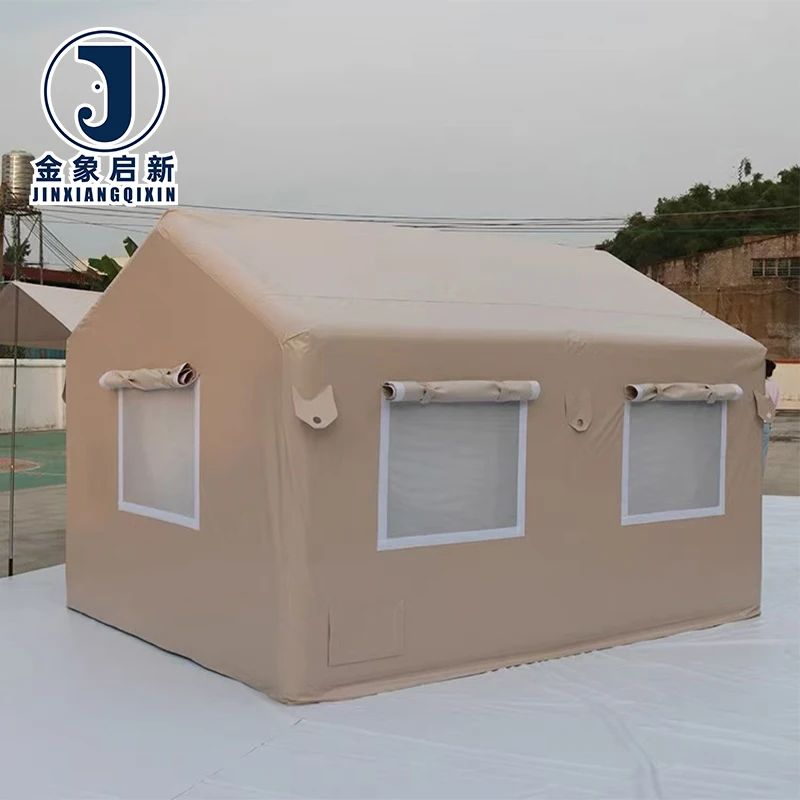
Process-Controlled Coating — Three dedicated production lines handle PVC tarpaulin for inflatable structures with batch-specific adhesion and weight verification before dispatch.
Technical Specifications
| Parameter | Value |
|---|---|
| Product Type | Inflatable Tent |
| Core Material | PVC tarpaulin |
| Key Performance | Waterproof, tear-resistant |
| Fire-Retardant Option | Available in flame retardant grades — confirm the grade required for your market |
| Anti-Static Option | Available in anti-static grades — confirm the standard required for your site |
| UV-Resistant Treatment | Available with UV treatment — test basis to be confirmed per order |
| Season Rating | Four-Season |
| Deployment Feature | Quick automatic opening |
| Customization | OEM & ODM, sample customization, pattern printing |
| Facility | 9,180 m² with 3 full production lines and 36 sets of professional equipment |
| R&D Capability | 10-technician team for material selection and sample development |
| Standards | ISO 9001, ISO 14001, ISO 45001, CE |
Application Suitability
| Application | Exposure & Requirement |
|---|---|
| Temporary site offices at construction zones | Wind loading on inflated walls, dust ingress, daily thermal cycling across seasons |
| Equipment storage shelters on industrial sites | Prolonged UV exposure, rain pooling on roof panels, ground moisture contact at skirt edges |
| Emergency response command centers | Rapid deployment under time pressure, repeated inflation-deflation cycles, transport abrasion |
| Temporary event venues and trade show installations | Crowd proximity requiring fire compliance, frequent assembly and breakdown, visual consistency across units |
| Four-season outdoor industrial shelter | Sub-zero flexibility demands, summer heat softening risk, snow load on inflated roof spans |
What "Flame Retardant" Means Without a Test Report to Back It Up
A fire classification is only meaningful when the certificate names the exact product, batch, and test standard.
When sourcing PVC inflatable tent fabric for commercial or industrial deployment, many quotations state "flame retardant" without specifying which standard applies. This becomes a problem at the inspection stage, where site safety officers ask for documentation that matches the installed material — not a generic claim. Inflatable structures concentrate large surface areas of coated fabric in enclosed spaces, making verifiable fire performance a compliance requirement rather than an optional upgrade. [NEED_CITE: fire classification standards for temporary membrane structures]
Coating Adhesion and Air-Holding Performance
Inflatable tent walls rely on continuous internal air pressure, which places sustained stress on every welded seam and coated surface. The PVC tarpaulin used here is produced on dedicated coating lines where adhesion between the base fabric and the PVC layer is controlled during the curing stage. When adhesion is insufficient, the coating delaminates at seam edges under inflation pressure — a failure mode that shows up after the structure has been standing for hours rather than minutes. This is why PVC inflatable tent fabric manufacturer custom specifications must address peel strength alongside tensile values.
Batch Consistency Across Multiple Tent Units
Large-scale project deployments — whether for a mining camp or a multi-day outdoor event — often require dozens of inflatable shelters erected side by side. Colour variation between rolls becomes visible once the units stand adjacent under the same light conditions. Our production process controls pigment dosing and coating weight per batch, so rolls cut from the same production run maintain visual uniformity. [NEED_CITE: colour consistency measurement methods for PVC coated fabrics]
How Base Fabric Density Interacts with Coating Weight
The tear resistance of an inflatable tent wall is not determined by the PVC coating alone. The base fabric denier and weave density carry the structural load, while the coating provides waterproofing and surface protection. A heavier coating applied over a loosely woven base will still tear easily under point stress — for instance where an anchoring strap pulls against an inflated wall. Conversely, a tightly woven base with a thin coating may resist tearing but fail at the weld line when heat-seamed. The R&D team selects base fabric and coating weight together, matching the combination to the inflation pressure and panel dimensions of the intended structure.
The Cost of Specifying on Weight Alone
Buyers who compare PVC tarpaulin for inflatable tents using GSM as the sole criterion often encounter two problems after delivery. First, the stated weight may not be verified on arrival — the material arrives lighter than quoted, with thinner coating that compromises waterproofing at seam overlap zones. Second, even when weight is accurate, a fabric that is heavy due to excessive coating but weak base fabric will split at stress concentration points during inflation. [NEED_CITE: tensile and tear test methods for coated fabrics per ISO 1421] Weld failures and mid-panel tears on site then force emergency replacements, delaying the project timeline that the inflatable shelter was meant to protect.
Why Source Inflatable Tent Fabric Here
The 10-person R&D team develops custom inflatable tent material samples within days, allowing you to verify weight, hand feel, and weld behaviour before committing to bulk production. Three full production lines provide capacity for large-volume orders while maintaining in-process quality checks at each coating stage. Every roll undergoes inspection against the material specification sheet before packing, with batch quality reports traceable by order number. Pattern printing and branding are handled in-house, so colour matching between printed panels and plain stock is controlled under one roof. The facility holds ISO 9001, ISO 14001, ISO 45001, and CE certifications, with documentation packages assembled per shipment.
Documentation & Verification
- Material specification sheet stating base fabric denier, coating type, and confirmed GSM for the ordered batch
- Test reports for UV and flame-retardant grades where applicable, matched to the specific production run
- Batch quality inspection record with order number traceability covering weight and visual checks
- ISO 9001, ISO 14001, ISO 45001, and CE certificates included in the shipment documentation package
- Pre-shipment inspection record confirming roll count, width, and surface condition before dispatch
- Certificate of origin and customs documentation prepared per destination country requirements
Fabrication, Handling & Storage
- Heat-seal temperature and dwell time must be matched to the specific PVC tarpaulin coating weight to avoid seam delamination under inflation
- Store rolls upright on pallets in shaded, ventilated areas to prevent flat-spot deformation of the coated surface
- Unroll and allow PVC inflatable tent fabric to acclimatise before welding in cold conditions to avoid coating crack at fold lines
- Use compatible PVC-based adhesive for field repairs on inflatable wall panels to maintain coating-to-patch bond integrity
- Avoid stacking heavy objects on stored rolls to prevent permanent crease marks that show through on inflated surfaces
- Pattern-printed panels should be cut and aligned using registration marks to ensure branding continuity across tent seams
What to Include in Your Enquiry
To provide an accurate specification recommendation for your PVC inflatable tent fabric project, we need the intended application and deployment environment — including expected wind exposure and temperature range. Please confirm the fire classification or anti-static standard required by your local regulations or site safety policy. Let us know the panel dimensions, annual volume, and whether you require rolls for your own fabrication or finished cut-to-size panels with pattern printing.
Frequently Asked Questions
Q: How do I confirm the fire-retardant grade matches my market requirements?
A: Different regions enforce different fire standards for temporary membrane structures. Specify the classification your local authority or site safety officer requires — such as B1, M2, or NFPA 701 — and we will supply the corresponding test report with your batch. If you are unsure which standard applies, share your project location and application type, and our technical team will advise on the appropriate grade before sampling begins.
Q: What test basis supports the UV-resistance claim?
A: UV treatment is applied during coating and its performance depends on the specific formulation and exposure conditions. We supply a test report for the UV treatment used on your production batch when requested. Share your expected deployment duration and climate zone so the R&D team can recommend the treatment level suited to your project and confirm the testing method that applies.
Q: What is the minimum order for custom sizes or printed panels?
A: Minimum quantities depend on the width, colour, and printing complexity of your specification. Standard-width rolls in stock colours have lower minimums, while custom widths or pattern-printed panels require longer production runs. Send your panel dimensions and colour references, and we will confirm the minimum order along with lead time and sample availability before production.
Q: How is colour consistency controlled across multiple rolls in one order?
A: Pigment dosing is calibrated per production batch, and rolls from the same run are inspected side by side before packing. For orders spanning multiple batches, we retain a colour reference sample from the first approved batch and match subsequent runs against it. Request a physical sample if your project demands panels installed adjacent to each other under uniform lighting.
Q: Can I approve a sample before committing to full production?
A: Yes. The R&D team produces samples based on your specification — including material weight, colour, and any pattern printing — typically within days of receiving confirmed requirements. Once you approve the sample, bulk production follows the same material selection and coating parameters, with the approved sample serving as the quality benchmark for pre-shipment inspection.