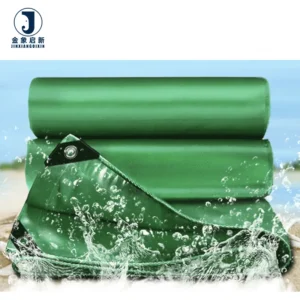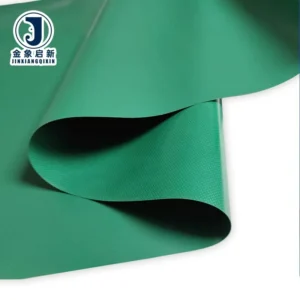
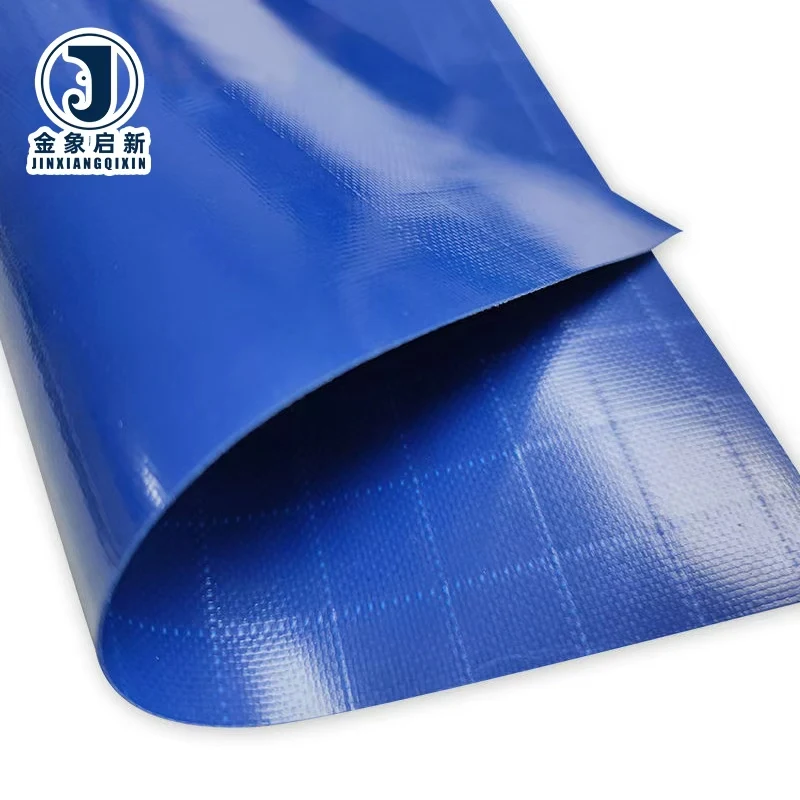
Deep Process Control Over Coating — every roll leaves the line with verified GSM and batch-matched colour, confirmed by in-process QA and full pre-shipment inspection before dispatch.
Technical Specifications
| Parameter | Value |
|---|---|
| Product Type | PVC Tarpaulin Roll |
| Material | HDPE weaving with LDPE lamination on both sides |
| GSM Range | 50g/m² ~ 300g/m² |
| Total Thickness | 0.2–0.4 mm / 8–16 mil / Custom |
| Weave Density Options | 6×6, 6×7, 7×7, 7×8, 8×8, 9×9, 8×10, 10×10, 12×12, 14×14, 14×16 |
| Available Widths | 6 ft, 8 ft, 10 ft, 12 ft, 2 m, 4 m, 6 m |
| Roll Length | 100 yards, 100 meters, or custom |
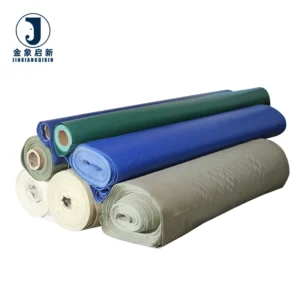
| Colour Options | Blue, Blue/Orange, Green, Grey, Black, Clear, Grey/Green, Orange, or custom |
| Key Features | Waterproof, washable, tear resistant, weather proof, mildew proof, anti-aging |
| UV Treatment | Available — confirm the UV grade required for your market |
| Flame Retardant Grade | Available — confirm the grade required for your market |
| Anti-Static | Available — confirm the grade required for your market |
| Roll Packing | Hard paper tubes, wrapped by tarpaulin sheet |
Application Suitability
| Application | Exposure & Requirement |
|---|---|
| Tent and canopy construction | Continuous UV exposure, wind load, repeated assembly and teardown flex |
| Truck and trailer side curtains | Road abrasion, constant flexing at load points, weather and spray |
| Construction site enclosures | Scaffold contact, puncture risk, dust and debris containment |
| Agricultural crop and timber covers | Ground moisture, biological growth, seasonal temperature cycling |
| Boat and container covers | Salt spray, standing water, UV and thermal expansion |
| Swimming pool and reservoir covers | Permanent water contact, chemical exposure from treatment agents |
| Gazebo and dining canopies | Direct sunlight, guest-facing aesthetics, wind uplift resistance |
| Roof and road repair wraps | Temporary weather barrier, substrate contact, puncture from tools |
Why Stated GSM Does Not Guarantee Real-World Strength in PE Laminated Tarpaulin Roll Material
Coating weight and base fabric weave density must both be specified and verified — one without the other leaves a critical gap in performance prediction.
Buyers routinely compare quotations based on a single GSM figure, only to find the material behaves differently on-site from what was expected. A 14×14 weave carrying a thin lamination can show the same scale weight as a 7×7 weave with a heavier coating, yet the tensile and tear behaviour diverges sharply under load. When the specification sheet lists only a total GSM without breaking down the base fabric contribution and the lamination contribution separately, the fabricator is guessing at how the roll will handle during cutting, welding, and installation [NEED_CITE: tensile and tear test methods for coated fabrics per ISO 1421]. This PE Tarpaulin Roll Material Coating Technology page maps weave density directly to structural behaviour so that specification decisions rest on verifiable data rather than a single headline number.
How Weave Density Drives Structural Behaviour in Laminated Fabric
The base fabric is where mechanical strength originates. HDPE tapes woven at higher mesh counts — such as 12×12 or 14×14 — produce a denser grid that distributes point loads across more yarn intersections, delaying tear propagation. Lower mesh counts like 6×6 or 7×7 leave longer float spans between intersections, making the fabric more flexible but more vulnerable to tear extension once a puncture occurs. When you specify PE Tarpaulin Roll Material Coating Technology for a project, the weave density should be selected based on the mechanical demands of the end use, not merely as a path to a target GSM.
Lamination Weight and Adhesion — The Coating Side of the Equation
LDPE lamination applied to both faces of the woven HDPE substrate provides the waterproof barrier, surface finish, and UV stabiliser carrier. The lamination weight contributes to total GSM but does not add proportional tensile strength; its primary role is environmental protection and surface integrity. Poor adhesion between the LDPE film and the HDPE weave manifests as delamination at fold lines or weld seams, a failure mode that appears after the roll has been fabricated and installed [NEED_CITE: adhesion test methods for laminated polyolefin fabrics]. Verifying lamination bond quality at the sample stage prevents field failures that GSM alone would never predict.
Reading the Mesh-to-GSM Map for Specification Accuracy
Each weave density range corresponds to a typical GSM band: 6×6 and 6×7 weaves fall in the 50–60 g/m² zone, 8×8 and 9×9 around 80–90 g/m², 10×10 between 100–120 g/m², and 14×16 at the upper end around 250–300 g/m². Understanding this mapping lets a technical buyer cross-check whether a quoted GSM is physically consistent with the stated weave density, or whether the lamination layer is being overloaded to inflate the number. A 10×10 weave quoted at 250 g/m² should prompt questions about lamination thickness and its effect on flexibility and weld performance. Thickness values between 0.2 mm and 0.4 mm track with this progression — lighter weaves produce thinner caliper, while heavier weaves with full lamination reach the upper range. Selecting the correct combination of mesh count and total thickness ensures the roll stock performs as expected during fabrication and in service.
The Hidden Cost of Specifying GSM Without Weave Context
When a distributor orders multiple rolls at the same quoted GSM but the supplier substitutes different weave densities across the batch, the rolls arrive with inconsistent hand feel, stiffness, and weld behaviour. Fabricators running heat-weld equipment calibrated for one weave find that seams peel on the alternate construction, even though the scale weight reads the same. On a construction site, a lighter-weave roll with heavy lamination may pass initial inspection but puncture under scaffold contact far earlier than a denser weave at identical GSM would tolerate [NEED_CITE: puncture resistance testing for laminated tarpaulin fabrics]. Colour variation compounds the problem — rolls from different production runs may shift in shade once installed side by side, forcing rework or rejection of an otherwise functional installation.
Why Procurement Verification Matters at Every Stage
The production process for this laminated tarpaulin roll involves dedicated QA/QC at each stage, from yarn extrusion through weaving, lamination, and winding. A 10-person R&D team handles material selection and sample development, producing sample rolls within days so that buyers can verify weave density, lamination adhesion, and colour match before committing to bulk volumes. Three full production lines and 36 sets of professional equipment support consistent roll-to-roll output, reducing the batch variation that causes field complaints. Pre-shipment inspection covers 100% of rolls, confirming GSM and mesh count against the purchase specification rather than relying on spot checks.
Documentation & Verification
- Material specification sheet stating exact GSM, base fabric weave density, and LDPE lamination type per roll
- UV treatment test report provided where UV stabiliser grade is part of the confirmed specification
- Pre-shipment inspection record verifying roll count, weight per roll, and colour reference against order
- Roll packing list with container loading plan showing total roll count and shipment weight
- ISO and CE certificates available as part of the documentation package
Fabrication, Handling & Storage
- Heat-weld temperature settings must be adjusted to match the LDPE lamination thickness — heavier lamination requires higher dwell time
- Store rolls upright on hard paper tubes to prevent flat-spot deformation of the HDPE woven core
- Cut with sharp blades to avoid pulling HDPE tapes at the weave intersection, which weakens the seam zone
- Avoid dragging rolls on abrasive surfaces — the LDPE lamination face scratches more readily than PVC coatings
- For outdoor storage before fabrication, keep rolls wrapped to prevent UV degradation of the outer lamination layer
What to Include in Your Enquiry
To receive an accurate specification and sample, share the end-use application, the mechanical and environmental exposure conditions, and the target market compliance requirements for flame retardancy or anti-static performance. Specify your preferred width, roll length, colour, and whether you need the material supplied as roll stock only or as finished cut sizes with edge reinforcement. If batch colour consistency across multiple rolls is critical to your project, request a sample roll first to verify shade and lamination adhesion before placing the full order.
Frequently Asked Questions
Q: How is GSM determined by mesh count in HDPE woven LDPE laminated tarpaulin?
A: GSM is the combined weight of the HDPE woven base fabric and the LDPE lamination on both sides. Higher mesh counts like 14×14 use more yarn per square metre, contributing more base weight, while lamination thickness adds the remainder. A given GSM can therefore be achieved through different weave-and-coat combinations, each with distinct strength and flexibility characteristics.
Q: What is the difference between PE laminated and PVC coated tarpaulin in tensile and tear behaviour?
A: PE laminated tarpaulin relies on the HDPE woven tape for tensile strength, with LDPE lamination providing waterproofing but limited additional structural contribution. PVC coated tarpaulin uses a liquid coating that penetrates the base fabric, creating a stronger bond and generally higher tear resistance at equivalent GSM. The choice depends on the mechanical demands of the application.
Q: How can I verify lamination adhesion and coating weight on arrival?
A: Request a pre-shipment inspection record that documents GSM and mesh count per roll. On receipt, a peel test at the cut edge reveals lamination bond quality — the LDPE film should resist separation from the HDPE weave under moderate force. GSM can be confirmed by cutting a measured sample and weighing it against the specification sheet.
Q: What UV treatment basis should be specified for extended outdoor exposure?
A: UV stabiliser is added to the LDPE lamination during extrusion. The effective grade depends on the end-use climate and exposure duration. Specify the UV treatment level required for your market and request a test report confirming the stabiliser package. General "UV treated" claims without documented test basis do not guarantee field performance.
Q: How does weave density affect weld and seam performance?
A: Denser weaves like 12×12 or 14×14 provide more yarn intersections per unit area, creating a more uniform thermal mass across the weld zone. Lower mesh counts leave thicker lamination gaps between tapes, which can cause uneven heat transfer and inconsistent seam peel strength. Matching weld parameters to the specific weave density is essential for reliable fabrication.