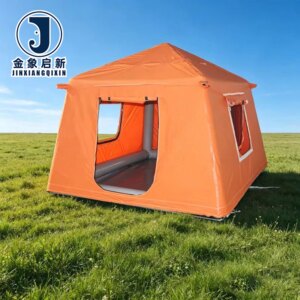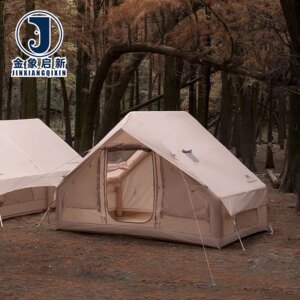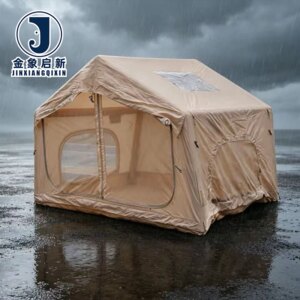
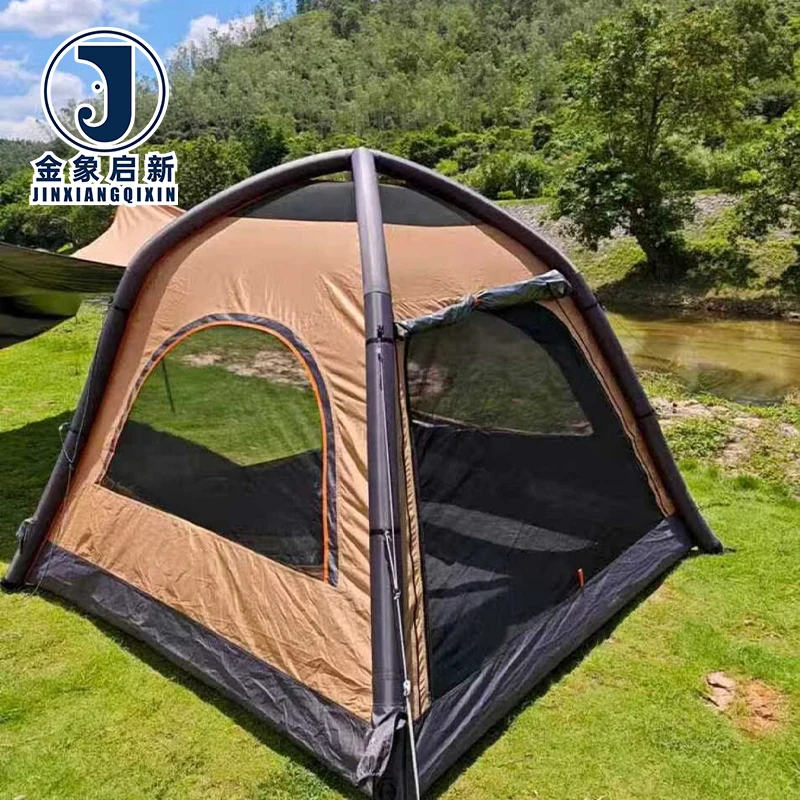
Three-Line Coating Control — Every roll of PVC inflatable tent fabric passes in-line thickness monitoring across our dedicated coating lines, holding the film within ±0.1 mm to keep airtight seams predictable under field inflation cycles.
Technical Specifications
| Parameter | Value |
|---|---|
| Product Type | Inflatable Tent |
| Core Material | PVC Tarpaulin |
| Waterproof Rating | Hydrostatic head ≥ 5000 mm |
| Tensile Strength | ≥ 3000 N/5cm |
| Fire Retardant Standard | EN 13501-1 |
| Anti-Static | Stated (surface resistance / test standard not confirmed) |
| UV Treatment | Stated (test basis not confirmed) |
| Tear-Resistant | Stated (test standard not confirmed) |
| Fabric Thickness Tolerance | ±0.1 mm |
| Season Rating | 4 Season |
| Pressure Test | 24-hour airtightness before shipment |
| Customization | OEM & ODM (sample customization, pattern printing) |
| Management Standards | ISO 9001, ISO 14001, ISO 45001, CE |
Application Suitability
| Application | Exposure & Requirement |
|---|---|
| Disaster relief emergency shelter | Rapid deployment, wind load on inflatable tubes, sustained rain and ground moisture |
| Temporary workspace for disaster recovery | Continuous inflation, interior climate control, personnel traffic at entry points |
| Equipment storage during infrastructure projects | UV exposure on outdoor panels, dust and debris abrasion, secure enclosure of high-value assets |
| Mobile command centers for logistics coordination | Reliable static dissipation for electronics, repeated inflation/deflation cycles, transport between sites |
| Temporary personnel accommodation | Four-season temperature variance, condensation management, fire safety in occupied spaces |
What "Fire-Retardant Inflatable Shelter" Means Without a Verified Grade
PVC inflatable tent fabric must carry a test-backed classification, not just a marketing claim, when personnel sleep or work inside the structure.
Procurement teams sourcing inflatable emergency shelters often receive a data sheet that says "flame retardant" without naming the standard or the issuing laboratory. In occupied temporary accommodation or mobile command centers, that gap becomes a compliance blocker at the site safety audit [NEED_CITE: EN 13501-1 fire classification for construction products and building elements]. Our PVC inflatable tent fabric is classified to EN 13501-1, with the additive package integrated into the coating compound rather than applied as a topical finish that can wear off after repeated flexing and deflation cycles.
Coating Formulation Purpose-Built for Inflatable Tube Construction
Inflatable tent frames demand a PVC compound that heat-welds cleanly and holds peel strength at the seam equal to or above the base fabric tensile rating. Our Inflatable Tent Fabric manufacturer formulates the coating with plasticiser and adhesion profiles matched to RF and hot-air welding, reducing the trial-and-error that fabricators face when switching from generic tarpaulin stocks.
Batch-Tested Waterproofing for Four-Season Field Use
A hydrostatic head rating only matters if it is consistent from the first metre to the last metre of the roll. We verify the ≥ 5000 mm rating per batch through controlled coating weight and uniform film thickness, ensuring that PVC Inflatable Shelter Fabric custom orders meet the same waterproof benchmark whether the order is a single sample roll or a full container [NEED_CITE: hydrostatic head test methods for coated fabrics per ISO 1421].
Thickness Consistency as an Airtightness Predictor
Inflatable structures fail at the point where the fabric is thinnest and the inflation stress is highest. By holding fabric thickness to ±0.1 mm across three dedicated production lines, we eliminate the weak zones that cause slow leaks and force field repair crews to carry patch kits for routine top-ups.
Specification Breakdown for Technical Buyers
The hydrostatic head of ≥ 5000 mm reflects a coating weight and film continuity that keeps water out even when the shelter sits on saturated ground during extended disaster-relief operations. Tensile strength at ≥ 3000 N/5cm indicates the base fabric denier and weave density are sufficient to resist the hoop stress inside inflated tubes without stretching or distorting the panel geometry. Fire-retardant classification to EN 13501-1 aligns with European construction-product requirements, giving safety officers a recognised reference when approving occupied temporary accommodation. Thickness tolerance of ±0.1 mm is a production-control parameter that directly supports the 24-hour airtightness pressure test every unit undergoes before dispatch. Anti-static and UV treatments are stated in the formulation, though the specific test basis for each should be confirmed against your local compliance framework before full-roll commitment.
The Hidden Cost of Unverified Material Claims
A shelter that passes the factory air test but leaks within days on site usually traces back to coating inconsistency or weld-seam degradation, not a puncture in the field. When flame-retardant grades are claimed without a certificate tied to the batch, the entire shelter can be rejected at the safety inspection, delaying occupancy and triggering a full replacement order under emergency timelines [NEED_CITE: site safety compliance audits for temporary occupied structures]. Colour variation between rolls in the same shipment also forces installers to rearrange panels or accept a patchwork appearance that undermines the professional image of a logistics command centre or corporate disaster-response hub.
Why Procurement Teams Specify This Fabric
Deep process control over PVC coating weight and adhesion comes from nearly 30 years focused exclusively on coated fabric, not from a trading catalogue. Three full production lines and 36 sets of professional equipment give us the capacity to deliver container-volume orders on time while maintaining the ±0.1 mm thickness tolerance that inflatable structures require. A dedicated 10-person R&D team develops pre-production samples with your specified GSM, colour, and treatment package, validating weld parameters before the main run begins. Every roll undergoes 100 percent inspection, including the 24-hour airtightness pressure test, so that dispatch documentation matches the physical product. ISO 9001, ISO 14001, ISO 45001, and CE certifications are maintained and available for audit, supporting compliance across European and global procurement frameworks.
Documentation & Verification
- Material specification sheet detailing base fabric denier, coating composition, and EN 13501-1 classification for traceability.
- Batch-specific test report covering waterproof rating, tensile strength, and flame retardancy tied to roll numbers.
- Pre-shipment inspection record confirming ±0.1 mm thickness tolerance and 24-hour airtightness test result.
- ISO 9001, ISO 14001, ISO 45001, and CE certificate package supporting European and global market audits.
- Certificate of origin and customs documentation for smooth cross-border clearance.
Fabrication, Handling & Storage
- Use RF or hot-air welding; adjust temperature to match PVC coating formulation for optimum seam peel strength.
- Store rolls upright in a dry, shaded area to prevent surface marking on the coated face.
- Allow fabric to acclimatise before welding in cold conditions to avoid brittle fracture at the seam.
- Clean with mild detergent only; avoid solvents that may degrade the fire-retardant additive package.
- Plan panel nesting patterns to maximise roll-width utilisation and minimise offcut waste.
Planning Your Inflatable Shelter Fabric Order
Share the inflation pressure range, expected deployment climate, and any site-specific fire or anti-static compliance targets so we can match the coating formula to your needs. Confirm whether you require stock roll widths or a custom width to reduce cutting waste on your panel patterns, and whether pattern printing or branding is part of the finished shelter design. If the application is new to your product line, request a pre-production sample with your specified treatment package to validate weld settings before committing to full-roll volumes.
Frequently Asked Questions
Q: How is the flame-retardant grade EN 13501-1 verified, and can third-party lab reports be arranged for specific markets?
A: EN 13501-1 classification is achieved through integrated coating additives and verified by internal testing aligned with the standard. For market-specific third-party lab reports, we coordinate with accredited laboratories and can arrange testing against additional regional requirements when you provide the target compliance framework at the inquiry stage.
Q: What test basis supports the UV-resistance claim, and how does it translate to outdoor service life in different climates?
A: UV treatment is stated in the coating formulation to address extended outdoor exposure. The specific test method and accelerated weathering hours depend on the additive package selected. We recommend confirming the target climate zone and service expectation so we can supply the matching UV data or arrange a custom weathering test.
Q: How do you control batch-to-batch colour and coating consistency across large-volume inflatable tent orders?
A: In-line QA monitoring holds fabric thickness to ±0.1 mm across all three production lines, and coating weight is verified per batch. Colour is matched against approved reference standards before the run begins, and pre-shipment inspection records confirm consistency roll by roll.
Q: What custom dimensions, fabric thickness adjustments, and printing options are available under OEM/ODM?
A: OEM and ODM cover custom roll widths, colour matching, pattern printing, and branding. Our 10-person R&D team develops pre-production samples with your specified GSM and treatment package, validating weld parameters and visual appearance before full-scale manufacturing begins.
Q: What documentation ships with each order for industrial procurement audits?
A: Every shipment includes a material specification sheet, batch-specific test reports for waterproof rating and flame retardancy, a pre-shipment inspection record, ISO and CE certificates, certificate of origin, and customs support documents. Additional compliance statements can be prepared when you specify the audit framework at order placement.