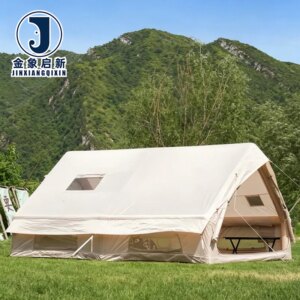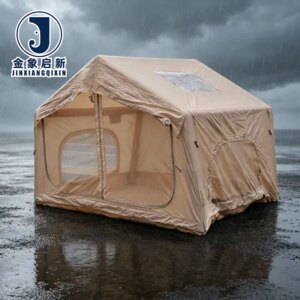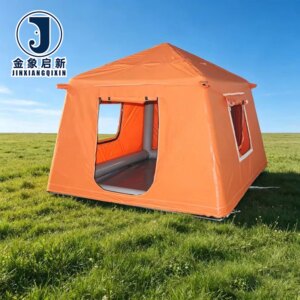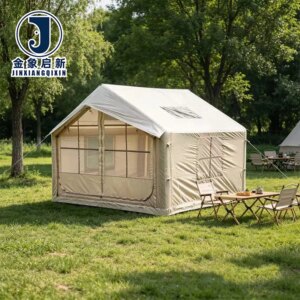
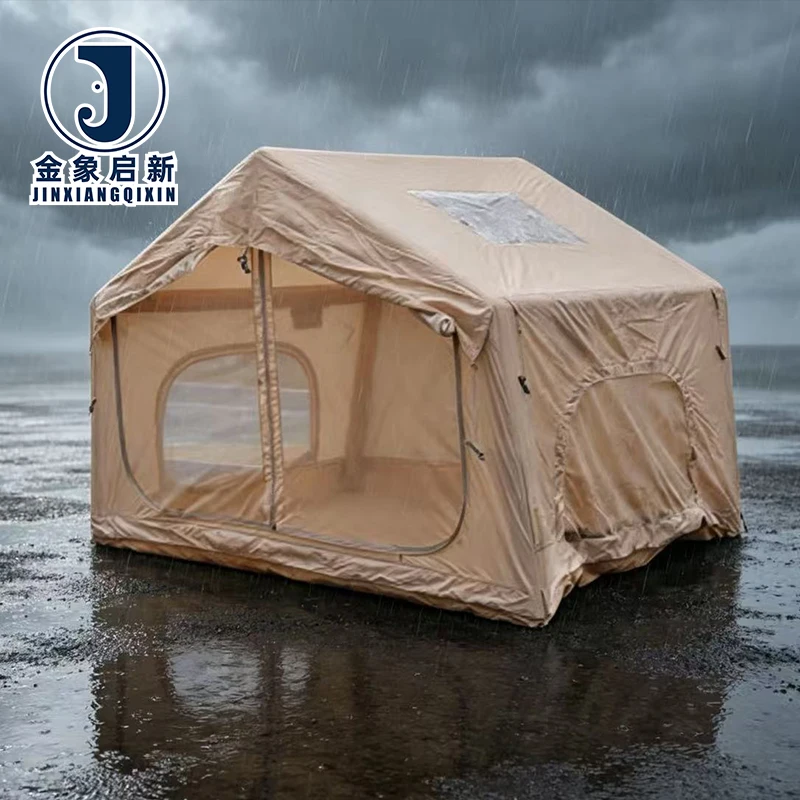
Coated Fabric Process Control — Every roll of inflatable tent PVC fabric undergoes incoming yarn inspection, coating weight verification, and 100% pre-shipment QA across our three dedicated production lines.
Technical Specifications
| Parameter | Value |
|---|---|
| Product Type | Inflatable Tent |
| Core Material | UV-Resistant PVC |
| Construction | Single-layer coated fabric |
| Hydrostatic Head Rating | Exceeding 5000mm |
| UV Resistance | 5000+ hours sunlight exposure (test basis not stated in source) |
| Tensile Strength Retention | Maintains 85% after 2 years outdoor exposure (test standard not stated in source) |
| Temperature Tolerance | -30°C to 70°C |
| Deployment Mechanism | Quick auto-opening, under 60 seconds |
| Inflation System | Industrial-grade inflation valves with rapid pressure retention |
| Seam Integrity | Ultrasonic verification |
| Pressure Retention | 24-hour test per unit |
| Customization Options | Size adjustments, color customization, logo printing, structural design modifications |
| Production Lead Time | 15–20 working days after sample approval |
| Standards | ISO 9001, ISO 14001, ISO 45001, CE |
Application Suitability
| Application | Exposure & Requirement |
|---|---|
| Temporary storage shelters for construction sites | Continuous UV exposure, wind loading, abrasion from stored materials, rapid deployment and relocation |
| Mobile equipment enclosures for logistics operations | Frequent inflation-deflation cycles, transport vibration, dust and moisture ingress prevention |
| Weather-protected workspaces for outdoor events | Public safety compliance, high visibility, sustained inflation under variable weather |
| Emergency relief shelters | Extreme temperature variance, rapid field deployment, transportability under austere conditions |
| Equipment maintenance areas | Chemical splash resistance, thermal stability, repeated access through zippered or welded openings |
| Remote field deployments | Extended unattended inflation, wildlife and terrain abrasion, limited repair resources |
Why Coating Adhesion Matters More Than Fabric Weight for Inflatable Tent PVC Fabric
Inflatable structures fail at the weld line long before the fabric body tears — coating adhesion determines structural survival.
When sourcing PVC-coated fabric for inflatable shelters, procurement teams often fixate on GSM as the single indicator of durability. Yet field failure analysis consistently shows that delamination at heat-welded seams accounts for the majority of premature inflation losses. A heavy-grade coated roll with poor coating-to-substrate bonding will separate at the weld under cyclic pressure loading, while a lighter fabric with proper knife-coat penetration and polymer bonding maintains seam integrity through thousands of inflation cycles. The Inflatable Tent PVC Fabric manufacturer must control coating formulation and application parameters with the same rigor applied to base fabric selection. [NEED_CITE: tensile and tear test methods for coated fabrics per ISO 1421]
PVC Compound Formulation for Sustained Inflation Loads
The PVC compound used in inflatable tent membrane fabric requires specific plasticizer ratios and stabilizer packages that differ from standard tarpaulin grades. Inflation creates continuous biaxial tension across the entire structure, meaning the coating must resist creep deformation under constant load rather than intermittent stress. Our formulation prioritizes dimensional stability and coating adhesion to the polyester base fabric, ensuring that the Inflatable Tent PVC Fabric maintains pressure retention across temperature swings from -30°C to 70°C.
UV-Stabilized Coating with Documented Retention Data
UV degradation in PVC-coated fabric manifests as surface chalking, plasticizer migration, and progressive loss of tensile strength. Our UV-resistant compound is tested to over 5000 hours of sunlight exposure with documented tensile strength retention of 85% after two years of outdoor deployment. This matters for inflatable shelters that remain deployed for weeks or months in direct sun — the coating must retain flexibility and weld integrity, not merely resist surface discoloration. Available in flame retardant grades — confirm the grade required for your market before specifying. [NEED_CITE: UV weathering test protocols for PVC-coated textiles]
Decoding the Specification Sheet for Inflatable Membrane Applications
Hydrostatic head exceeding 5000mm indicates that the PVC coating achieves full pore penetration and uniform film thickness across the base fabric, eliminating moisture pathways that compromise inflatable shelter interiors. The single-layer construction reduces overall weight while concentrating coating mass on the exposure face, optimizing the balance between inflation pressure retention and packed transport weight. Temperature tolerance validated from -30°C to 70°C through cycling tests confirms that the plasticizer system resists cold-crack embrittlement and high-temperature softening — both critical when inflatable structures deploy in desert days and alpine nights within the same operational season.
The Hidden Cost of Specifying Inflatable Fabric Without Weld Testing
Fabricators who validate material strength through grab tensile tests alone often discover that heat-welded seams fail at loads well below the fabric body rating. When coating adhesion is insufficient, the weld zone delaminates under inflation pressure cycling, creating progressive air loss that field repair kits cannot reliably seal. Batch-to-batch inconsistency in coating weight compounds this problem — weld parameters calibrated on one roll produce cold joints or burn-through on the next. For inflatable tent manufacturers producing at scale, this means rejected production runs, warranty claims, and reputational damage that far exceed the unit cost difference between verified and unverified fabric sources. [NEED_CITE: DIN 4102 fire classification for building materials]
Why Technical Buyers Source Inflatable Tent PVC Fabric Here
Three full production lines with 36 sets of professional coating equipment support bulk roll orders with consistent delivery scheduling for inflatable structure manufacturers. A 10-person R&D team handles custom PVC compound formulation, color matching, and sample development within days rather than weeks. Every roll undergoes dedicated QA/QC inspection including coating weight verification and adhesion testing before shipment approval. Nearly 30 years of coated fabric process control means our coating formulation data and production parameters are built on documented production history, not trial-and-error. Custom width, length, color, and logo printing are handled in-house without outsourcing to third-party converters. ISO 9001, ISO 14001, ISO 45001, and CE certification support compliance documentation for international inflatable structure projects.
Documentation & Verification
- Material specification sheet stating PVC compound type, base fabric denier, coating weight, and color reference per roll
- UV resistance test report with documented exposure hours and tensile retention results for your project records
- ISO 9001, ISO 14001, ISO 45001, and CE certificates included with every shipment for market compliance
- Pre-shipment inspection record confirming coating adhesion and hydrostatic head verification per production batch
- Certificate of origin and customs documentation prepared for cross-border inflatable fabric shipments
Fabrication, Handling & Storage
- Heat-weld parameters must be calibrated per roll batch to match the specific PVC coating weight and plasticizer content
- Ultrasonic seam verification confirms weld integrity matches the single-layer coated fabric body strength
- Store rolls vertically on core supports to prevent flat-spot deformation that affects inflation panel cutting accuracy
- Allow cold-stored rolls to acclimate to workshop temperature before unrolling to avoid coating crack damage
- Use PVC-compatible cleaners only — solvent-based products may extract plasticizers from the UV-resistant coating surface
- Repair field punctures with compatible PVC patch material heat-bonded at manufacturer-recommended temperature settings
Requesting a Technical Quotation
To specify the correct Inflatable Tent PVC Fabric for your application, share your target inflation pressure range, expected deployment duration per cycle, and the environmental conditions your structures will face. Let us know your required roll width, annual volume, and whether you need flame retardant certification for your destination market. Color references, logo printing files, and structural design modifications should be submitted early so sample development and approval can proceed before production scheduling.
Frequently Asked Questions
Q: What is the relationship between GSM and tensile strength in inflatable tent PVC fabric?
A: GSM indicates total coated weight but does not alone determine strength. Base fabric denier, weave density, and coating adhesion all contribute to tensile and tear performance. A lighter fabric with high-density polyester yarn and proper knife-coat penetration can outperform a heavier roll with loose weave and surface-only coating. Request the full material specification sheet to evaluate all parameters together.
Q: Can you provide third-party test reports for UV resistance and flame retardant grades?
A: UV resistance test documentation with exposure hours and tensile retention data is available with sample shipments. Flame retardant grades are available — confirm the specific grade and test standard required for your market, and we will supply the corresponding test report. Different regions mandate different classifications, so early specification avoids compliance delays.
Q: How do you ensure color consistency across multiple rolls in a single order?
A: Coating color is matched against approved reference standards with spectrophotometric verification during production. All rolls within one order are produced from the same compound batch to eliminate inter-batch variation. Pre-shipment inspection includes side-by-side color comparison before packing, and any roll falling outside tolerance is replaced before dispatch.
Q: What customization options are available for inflatable tent fabric orders?
A: Width, length, color, logo printing, and structural design modifications are all handled in-house. Custom PVC compound formulation is available for specific temperature ranges or environmental requirements. Sample development typically completes within days, and production lead time runs 15–20 working days after sample approval depending on order volume and customization scope.
Q: How is weld strength tested on inflatable tent PVC fabric before shipment?
A: Seam integrity is verified using ultrasonic testing technology that detects voids, delamination, and incomplete bonding at welded joints. Each production unit also undergoes a 24-hour pressure retention test confirming that the inflation system and all welded seams hold pressure under sustained load. Test parameters and results are documented in the pre-shipment inspection record.