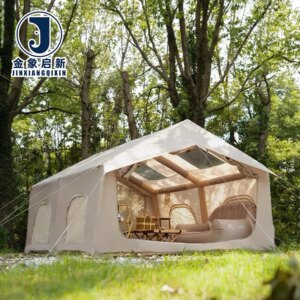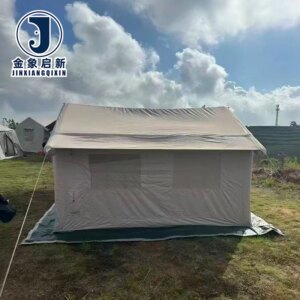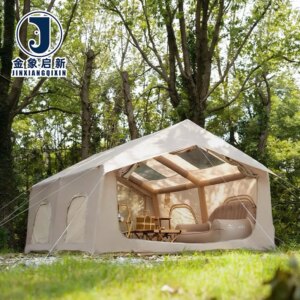
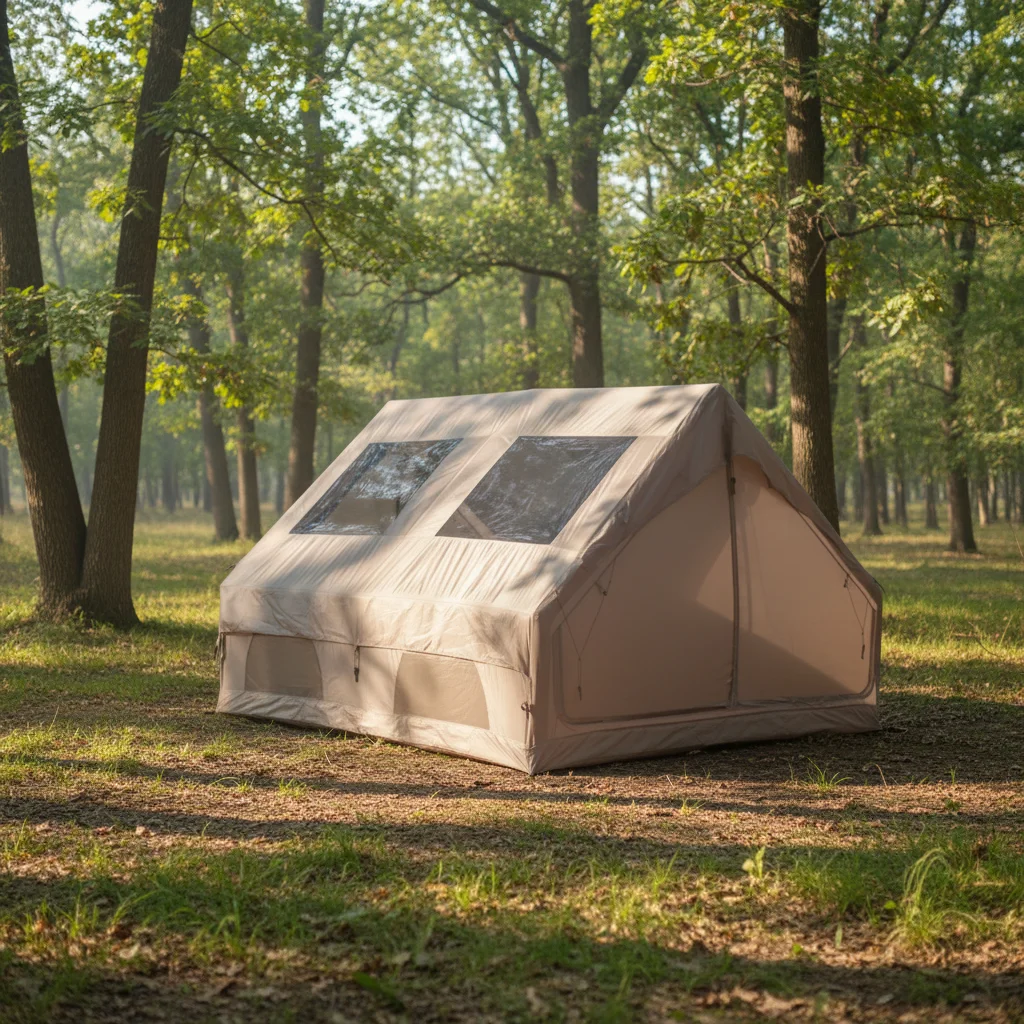
Coated fabric expertise — nearly three decades of PVC coating process control ensures every roll of inflatable tent fabric leaves the line with verified weight, adhesion and waterproof performance.
Technical Specifications
| Parameter | Value |
|---|---|
| Product Type | Inflatable Tent Fabric |
| Core Material | PVC tarpaulin |
| Waterproof Rating | 3000mm |
| UV Protection | UV-resistant (test basis not stated in source) |
| Fire Performance | Fire-retardant (grade not stated in source) |
| Tear Resistance | Tear-resistant (test standard not stated in source) |
| Coating Method | Knife coated |
| Season Rating | 4-season |
| Deployment Type | Quick automatic opening |
| Customization | OEM & ODM, sample customization, pattern printing |
| Quality Control | Full-process inspection with dedicated QA & QC staff |
| Standards | ISO 9001, ISO 14001, ISO 45001, CE |
Application Suitability
| Application | Exposure & Requirement |
|---|---|
| Disaster recovery temporary site offices | Continuous weather exposure, rapid inflation cycles, fire code compliance for occupied structures |
| Equipment storage shelters in emergency response | Abrasion from stored machinery, prolonged UV exposure, waterproof integrity under wind load |
| Mobile command centers for infrastructure projects | High foot traffic, frequent relocation, multi-season temperature swings |
| Remote industrial site workspace solutions | Dust and chemical exposure, limited maintenance access, extended outdoor deployment |
What "Flame Retardant" Really Means When No Grade Is on the Certificate
A flame-retardant claim without a named grade is a compliance gap waiting to surface at the job-site inspection.
Technical buyers sourcing inflatable tent fabric for mining camps, aviation hangars or disaster-relief command posts routinely receive material described simply as "fire-retardant." Site safety officers then ask which standard was applied — DIN 4102 B1, NFPA 701, M2 — and the conversation stalls. Without a grade, the fabric cannot be matched to local fire codes, and entire shelter deployments risk rejection at the commissioning stage [NEED_CITE: DIN 4102 fire classification for building materials]. Jinan Jinxiang supplies this PVC-coated inflatable tent fabric with fire-retardant treatment available in multiple grades; confirm the grade required for your market before placing a production order.
Coating Adhesion Under Inflation Stress
Inflatable structures place unusual demands on coated fabric. Each air-beam joint undergoes repeated flex cycles as internal pressure fluctuates with temperature and altitude. The knife-coated PVC layer on this inflatable tent fabric is applied with controlled weight across three dedicated production lines, building a coating-to-base bond that resists delamination when the beam expands and contracts. Process engineers monitor adhesion at every stage, catching separation risk before the roll reaches the cutting table.
Waterproof Consistency Across a Multi-Unit Deployment
A single shelter failing at 2500mm while its neighbour holds at 3000mm undermines confidence in the entire relief operation. Batch-to-batch waterproof consistency starts with raw-material traceability and continues through coating-weight checkpoints on the line. Every roll of this inflatable tent fabric carries a batch-specific inspection record, so procurement teams deploying dozens of units across a disaster zone can verify that hydrostatic resistance is uniform from first roll to last [NEED_CITE: tensile and tear test methods for coated fabrics per ISO 1421].
Reading the Spec Sheet Beyond the GSM Number
GSM alone tells you how much material is on the roll, not how that material will behave under load. The base fabric denier and weave density determine how force distributes when a seam is stressed during inflation, while the PVC coating weight governs hydrostatic resistance and surface durability. A lighter base fabric with a heavy coating may show high GSM yet tear more easily than a balanced construction. Knife coating, as used here, pushes PVC into the weave interstices, creating a mechanical lock that improves peel strength compared to simple lamination — a factor that matters every time an air-beam joint flexes in high winds.
The Hidden Cost of Undocumented Treatment Claims
When UV or fire-retardant treatments are claimed without a supporting test report, the buyer absorbs the risk. Shelters deployed in high-altitude or equatorial sites face accelerated UV degradation; if the treatment level is unknown, the fabric may embrittle mid-season, forcing an unplanned replacement cycle. Similarly, fire-retardant grades that do not match the site’s safety code can halt operations during an audit. These are not theoretical issues — they are recurring pain points in industrial shelter procurement [NEED_CITE: ISO 1421 test methods for coated fabric tensile and tear properties]. Request test documentation for UV resistance and flame-retardant grade before finalising any order for inflatable tent fabric destined for regulated environments.
Why Procurement Teams Source This Fabric Here
Three full production lines and 36 sets of professional processing equipment give the facility the capacity to fulfil multi-container orders without sacrificing lead-time reliability. A 10-technician R&D team handles material selection, colour matching and sample development, turning around custom inflatable tent fabric samples within days rather than weeks. Dedicated QA and QC staff inspect every production stage, and a 100-percent pre-shipment inspection catches weight deviations, colour shifts and coating defects before the roll leaves the 9,180 m² facility. Nearly 30 years of focus on PVC-coated fabric means the process controls behind coating weight, adhesion and surface finish are embedded in daily production routines, not bolted on as an afterthought.
Documentation & Verification
- Material specification sheet stating GSM, base fabric denier, coating type and weight, colour reference
- Test reports for UV resistance and flame-retardant grades provided where applicable — no unsupported claims
- ISO 9001, ISO 14001, ISO 45001 and CE certificates available for cross-border compliance verification
- Pre-shipment inspection record with batch-specific waterproof and dimensional data retained for five years
- Certificate of origin and customs documentation prepared per destination-country requirements
Fabrication, Handling & Storage
- Heat-weld air-beam joints using temperature and dwell settings matched to the PVC coating weight for full penetration
- Reinforce tie-down and valve-cutout points with additional PVC patches to distribute stress across the base fabric weave
- Store rolls upright on pallets in a dry, shaded area to prevent flat-spot creasing on the coated surface
- Allow cold-stored rolls to reach ambient temperature before unrolling to avoid coating micro-cracking
- Clean deployed fabric with mild detergent only; solvents can degrade the PVC coating layer and UV treatment
Preparing Your Inquiry
Specify the deployment environment — altitude, temperature range, expected wind load and any fire-code references your site requires. Indicate the roll width and length you need, along with colour or print requirements, and whether you want raw roll stock or pre-cut panels. If your application demands a particular fire-retardant grade, name the standard so the correct formulation can be quoted from the outset.
Frequently Asked Questions
Q: What fire-retardant grade is the PVC tent fabric tested to, and does it meet site-specific safety codes?
A: The fabric is treated with fire-retardant compounds, but the specific grade depends on your target market’s requirements. Available grades can be matched to standards such as DIN 4102, NFPA 701 or M2. Confirm the applicable code with your site safety officer and request the corresponding test report before production begins.
Q: What test basis supports the UV-resistant claim, and what service life can be expected under continuous sun exposure?
A: UV-resistant additives are compounded into the PVC coating to extend outdoor service life across multi-season deployments. The exact test basis and expected lifespan vary with formulation and exposure intensity. Request the UV test documentation and discuss your site’s solar exposure profile to align expectations before ordering.
Q: How is PVC coating weight verified during production and what documentation accompanies shipment?
A: Coating weight is monitored at multiple points on the production line through gravimetric sampling. Each roll ships with a batch-specific inspection record showing measured GSM and coating thickness. Pre-shipment inspection data is retained for five years, giving buyers a verifiable audit trail for incoming quality checks.
Q: What welding parameters and seam construction methods are recommended for inflatable tent air-beam joints?
A: Heat-welding temperature, pressure and dwell time should be calibrated to the specific PVC coating weight and base fabric construction. Over-welding can weaken the base yarns, while under-welding leaves incomplete fusion. Request the manufacturer’s welding guideline sheet and run test welds on sample pieces before committing to full production.
Q: What are the minimum order quantities and lead times for custom-colour or custom-print inflatable tent fabric?
A: Custom colours and printed patterns carry minimum order quantities that vary by roll width and print complexity. Standard lead times apply to stock grades, while custom formulations require additional time for sample approval and line setup. Submit your colour reference and estimated annual volume for a precise quotation.