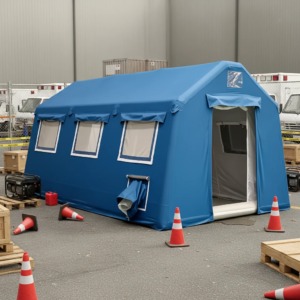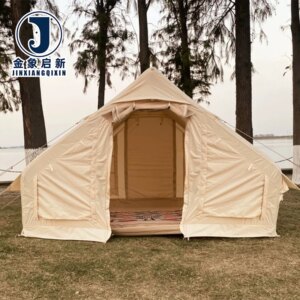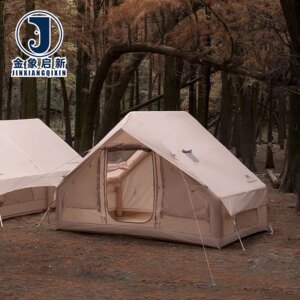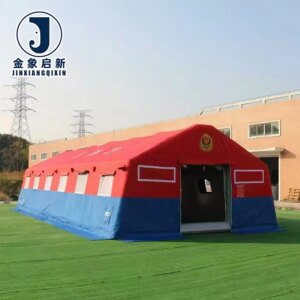
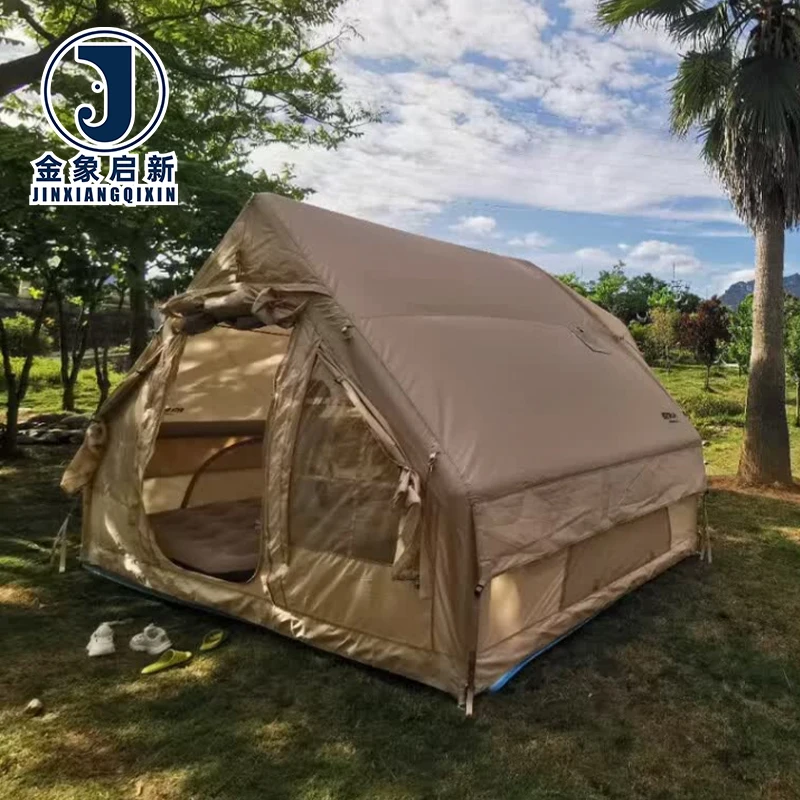
Coating Weight Control — nearly 30 years of PVC coating process mastery ensures every roll of inflatable tent fabric holds the same water resistance and structural behaviour from start to finish of a production run.
Technical Specifications
| Parameter | Value |
|---|---|
| Product Type | Inflatable Tent Fabric |
| Core Material | PVC tarpaulin |
| Construction | Single layer |
| Waterproof Rating | ≥2000mm water column (source value — verify against manufacturer catalog) |
| Tear Resistance | ≥300N (source value — verify against manufacturer catalog, test standard not stated) |
| UV Stability | 500 hours exposure (source value — verify against manufacturer catalog, test basis not stated) |
| Fire-Retardant | Available in flame-retardant grades — confirm the grade required for your market |
| Anti-Static | Available in anti-static grades — confirm the standard required for your site |
| Customization | OEM & ODM: sample customization, pattern printing, material selection, product design |
| Prototype Lead Time | 7–10 business days |
| Production Lead Time | 15–20 days for standard orders |
| Certifications | ISO9001, ISO14001, ISO45001, CE |
Application Suitability
| Application | Exposure & Requirement |
|---|---|
| Commercial-grade inflatable camping tent shells | Repeated inflation cycles, sustained internal air pressure, field abrasion from ground contact |
| Family-sized 4-season camping shelters | Rain, wind-driven moisture, prolonged UV exposure across multiple seasons |
| Outdoor gear wholesale and distribution | Batch-consistent roll stock for large-volume tent assembly lines, colour matching across production runs |
| OEM brand product lines | Custom pattern printing, material thickness adjustments, brand-specific colour references |
Why Batch Consistency Matters More Than a Spec Sheet for Inflatable Tent Fabric
A waterproof rating printed on a datasheet means nothing if the next roll delivers a different result.
Outdoor gear manufacturers scaling inflatable tent production lines face a recurring problem: the first sample passes hydrostatic testing, but mid-run rolls allow moisture through at the seams. This inconsistency forces warranty claims, damages brand reputation, and disrupts assembly schedules. The root cause is often uncontrolled coating weight variation between batches — a problem that hides behind a single quoted GSM figure. [NEED_CITE: hydrostatic pressure test methods for coated fabrics per ISO 1421]
As someone who has reviewed failed inflatable tent returns, I can confirm that batch-to-batch coating inconsistency is the most common reason commercial camping operators switch fabric suppliers. The Inflatable Tent Fabric manufacturer you choose must demonstrate process control, not just publish a number.
Coating Process Control and Waterproof Reliability
The waterproof performance of inflatable tent fabric depends on uniform coating thickness across the entire roll width. A knife-over-edge coating process deposits PVC compound at a controlled rate, producing a continuous film that resists hydrostatic pressure without weak spots. For an Inflatable Tent Fabric manufacturer, maintaining this consistency across hundreds of linear meters is the difference between reliable field performance and early product failure.
Single-Layer Construction and Weight Efficiency
Single-layer PVC tarpaulin construction removes the bonded second layer that adds weight and reduces pack size. For camping equipment manufacturers, this translates to lower shipping costs per unit and a more compact folded product. The trade-off is that all mechanical and weathering performance must come from one coated structure — making base fabric selection and coating adhesion critical to the finished tent’s lifespan. [NEED_CITE: single vs multi-layer coated fabric tear propagation behaviour]
Reading the Numbers Behind Inflatable Tent Fabric Performance
A tear resistance figure only becomes meaningful when you understand the base fabric’s denier and weave density. A high-denier yarn in a tight ripstop weave arrests tear propagation at the crossover points, while a loosely woven scrim allows a nick to spread rapidly under inflation pressure. The stated ≥300N tear value should be evaluated alongside the yarn count and weave pattern to predict real-world behaviour. Coating adhesion — the bond strength between the PVC film and the base fabric — determines whether the coating delaminates when the tent flexes under wind load. A knife-coated single-layer construction typically achieves stronger adhesion than laminated alternatives because the PVC compound penetrates the scrim during the coating pass. Surface finish also plays a role: a matte surface reduces glare and accepts printed branding more effectively, while a glossy finish sheds dirt and simplifies field cleaning. [NEED_CITE: coating adhesion test methods per DIN 53354]
The Hidden Cost of Overlooking Fire-Retardant and Anti-Static Compliance
Camping equipment sold into regulated markets requires documented fire-retardant performance. A tent fabric that lacks the correct grade will fail compliance inspection at the border or be rejected by a commercial campsite operator during their annual safety audit. Anti-static treatment matters in environments where fine dust or fuel vapour is present — without it, static discharge during inflation or deflation poses an ignition risk. When these treatments are claimed without a supporting test certificate, the manufacturer of the finished tent absorbs all liability. [NEED_CITE: fire safety standards for temporary accommodation structures]
Why Source Inflatable Tent Fabric Through This Facility
Deep process control over PVC coating weight and adhesion comes from nearly 30 years of continuous coated fabric production — not from a specification sheet. Three full production lines with 36 sets of professional equipment give the capacity to fulfil large-volume roll orders while maintaining batch-to-batch consistency. A dedicated 10-person R&D team handles material selection, pattern printing development, and custom sizing for OEM clients who need differentiated product ranges. Every roll undergoes 100% pre-shipment inspection with documented findings before dispatch, eliminating the surprise of off-spec material arriving at your assembly line. Prototype samples are developed within 7–10 business days, allowing design validation before committing to bulk production. ISO9001, ISO14001, ISO45001, and CE certifications are maintained to support market access across regulated regions.
Documentation & Verification
- Material specification sheet stating GSM, base fabric type, and coating compound for each roll
- Batch-specific test report covering waterproof performance and tear resistance values
- Fire-retardant and anti-static test certificates where applicable to the ordered grade
- Pre-shipment inspection record with coating weight verification per roll
- Roll packing list with individual roll identification for traceability
- Certificate of origin and customs documentation for cross-border shipment
Fabrication, Handling & Storage
- Set heat-sealing temperature to match the single-layer PVC coating to avoid scorching or weak bonds
- Allow rolls to acclimatise to workshop temperature before unrolling to prevent coating crease marks
- Store rolls horizontally on racking to avoid permanent compression damage to the PVC surface
- Use compatible PVC adhesive for field repairs on single-layer construction to maintain waterproof integrity
- Clean finished tent surfaces with mild detergent only — solvent-based cleaners degrade the coating film
- Plan cutting layouts to minimise off-cuts from roll width, reducing material waste per tent shell
Before You Request a Quote
Provide your target market’s fire safety and anti-static requirements so the correct treatment grade is quoted from the start. Share your annual volume and preferred roll width to receive accurate lead-time and pricing guidance. If your tent design requires custom pattern printing or specific colour references, send artwork files and Pantone codes with your enquiry for sample development.
Frequently Asked Questions
Q: How is batch-to-batch waterproof consistency verified before shipment?
A: Every production run of inflatable tent fabric undergoes hydrostatic pressure testing at multiple points across the roll width. Results are recorded in a batch-specific inspection report that accompanies your shipment, showing the measured water column value against the agreed specification. Rolls that fall outside tolerance are rejected before packing.
Q: What fire-retardant and anti-static certifications are available for target market compliance?
A: Fire-retardant grades are available to match the regulatory requirements of your destination market. Anti-static treatment can be applied where site safety rules demand it. Confirm the specific standard or test method your market requires so the correct grade is produced and documented for your compliance file.
Q: How does UV treatment testing translate to real-world outdoor lifespan expectations?
A: UV stability is measured through controlled exposure testing, which indicates how the coating resists degradation under accelerated ultraviolet light. Real-world lifespan depends on geographic latitude, seasonal intensity, and whether the tent is stored between uses. Request the test report to compare performance across fabric options for your product line.
Q: What OEM customization options are available for pattern printing and material thickness?
A: The R&D team develops custom samples covering pattern printing, colour matching, and material thickness adjustments to suit your tent design. Prototypes are produced within 7–10 business days for your approval. Once validated, bulk production runs replicate the approved sample specification across the full order quantity.
Q: What documentation is included to support CE market access for finished camping products?
A: Shipments include material specification sheets, ISO and CE certification copies, and batch-specific test reports that your compliance team can reference during product certification. Certificate of origin and customs documentation are provided to support smooth import clearance into regulated markets.