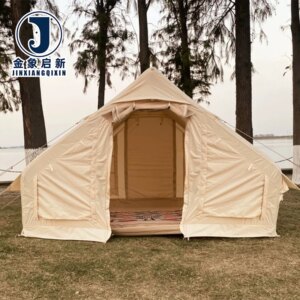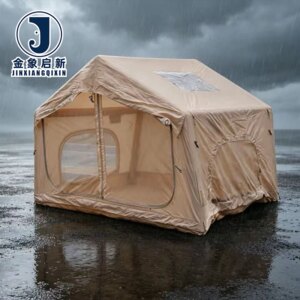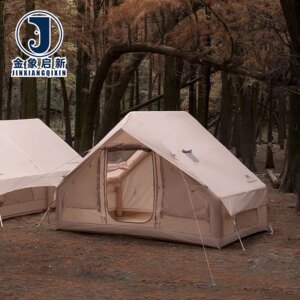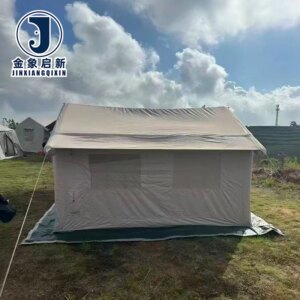
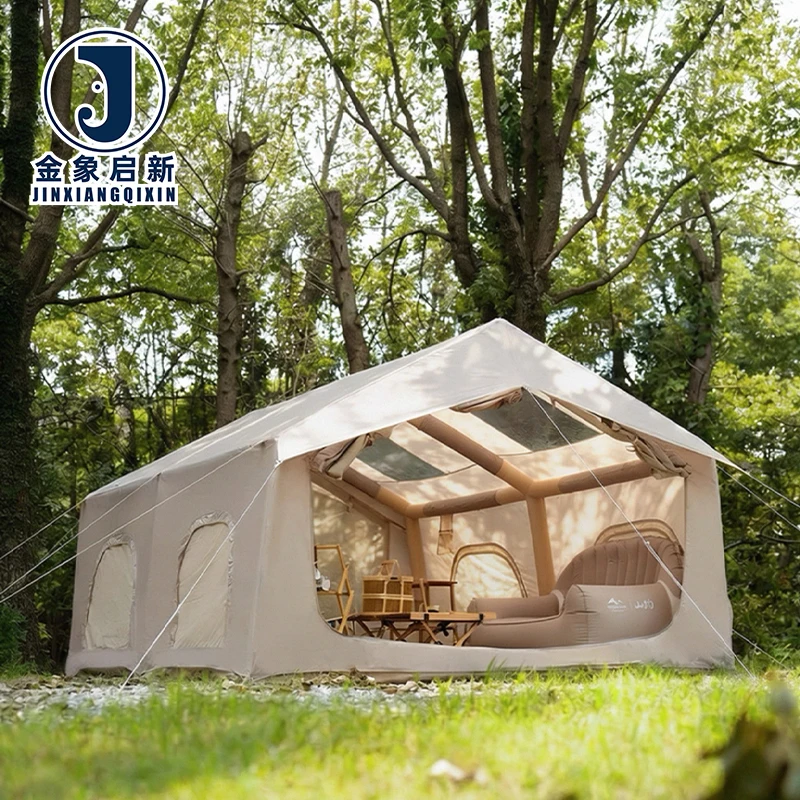
Coating weight control — Every roll of PVC inflatable tent fabric undergoes in-process GSM verification at the coating head, ensuring the material you receive matches the specification sheet before it leaves the line.
Technical Specifications
| Parameter | Value |
|---|---|
| Product Type | PVC Inflatable Camping Tent |
| Core Material | PVC Tarpaulin |
| Product Form | Inflatable structure with quick automatic opening |
| Capacity | 2-3 person |
| Season Rating | Four-season |
| Waterproof | Yes (test basis not stated) |
| UV-resistant | Yes (test basis not stated) |
| Tear-resistant | Yes (test basis not stated) |
| Fire-retardant | Yes (grade not stated) |
| Anti-static | Yes (surface resistance or standard not stated) |
| Customization | OEM & ODM (sample customization, pattern printing) |
| Certifications | ISO 9001, ISO 14001, ISO 45001, CE |
| Production Facility | 9,180 m² with 3 full production lines and 36 sets of professional processing equipment |
| R&D Team | 10 technicians |
| Quality Control | Full-process quality inspection with dedicated QA & QC staff |
Application Suitability
| Application | Exposure & Requirement |
|---|---|
| Disaster relief rapid-deployment shelters | Repeated inflation cycles, field abrasion, urgent deployment timelines |
| Temporary construction site workspaces | Dust, mechanical impact, continuous weather exposure, fire safety compliance |
| Outdoor event logistics enclosures | UV exposure, wind loading on membrane surfaces, crowd proximity |
| Mining and tunnelling temporary structures | Anti-static requirement, fire-retardant compliance, confined ventilation environments |
| Emergency supply storage covers | Waterproof integrity, prolonged outdoor standing, resistance to ground moisture |
Why a Fire-Retardant Certificate Without a Grade Is Worthless for Inflatable Tent Fabric
A test report only protects your project if the grade on paper matches the batch that arrives on site.
Inflatable structures concentrate stress at welded seams, and when the fire-retardant treatment is claimed but not tied to a verifiable standard, the entire shelter fails the safety inspection before it is ever inflated. Procurement teams routinely receive PVC inflatable tent fabric with a generic certificate that does not reference the specific batch or the regulation enforced at the installation site [NEED_CITE: fire classification standards for temporary membrane structures]. The consequence is a rejected delivery, a delayed project, and a contractor left searching for replacement material under deadline pressure. We supply fire-retardant grades with test reports available on request — confirm the grade required for your market before placing the order.
Coating Adhesion and Welded Seam Integrity
The performance of PVC inflatable tent fabric depends as much on the bond between coating and base fabric as on the membrane itself. During heat welding, the coating layers fuse to form the structural seam. If coating adhesion is weak, the weld line delaminates under inflation pressure long before the fabric body reaches its tensile limit. Our production process controls coating weight and adhesion at every stage, which is why seam failure at flex points — a common field complaint with inflatable structures — is addressed through process discipline rather than after-production patching.
Base Fabric Construction Under Inflation Cycles
An inflatable tent membrane experiences continuous internal pressure, placing the base fabric under sustained biaxial tension. The denier of the yarn and the weave density of the base fabric determine how that load distributes across the membrane surface. PVC inflatable tent fabric built on a loosely woven base will show accelerated fatigue at repeated inflation and deflation cycles, particularly at panel junctions and valve surrounds. Our R&D team evaluates base fabric construction against the intended inflation pressure profile before confirming material selection for each custom order [NEED_CITE: tensile and tear test methods for coated fabrics per ISO 1421].
How Treatment Grades Map to Market Compliance
Fire-retardant, anti-static, and UV-resistant treatments are not universal specifications — they correspond to specific regulatory frameworks that vary by country and application sector. A mining shelter in one jurisdiction may demand a different anti-static surface resistance than a disaster-relief tent in another. When PVC inflatable tent fabric is specified for regulated environments, the treatment grade must be stated with its test standard, not described in general terms. We provide treatment options across these performance categories and supply test reports matched to the applicable standard — verify which grade your project requires during the inquiry stage.
The Specification Mismatch That Fails in the Field
When PVC inflatable tent fabric is ordered on generic descriptions rather than verified specifications, the failures are predictable. A material claimed to be flame retardant without a batch-specific test report will not satisfy a site safety officer who cross-references documentation against delivery. A coating weight that measures lighter than quoted reduces tear resistance at the exact points where inflation stress concentrates. Colour drift between rolls forces visible panel mismatches on assembled structures [NEED_CITE: colour consistency standards in coated fabric batches]. These are not manufacturing defects — they are specification gaps that surface only after the material has been cut, welded, and deployed.
Why Technical Buyers Source Inflatable Tent Fabric Here
Our coating process controls weight and adhesion from the first pass to the final roll, eliminating the GSM discrepancy that plagues generic tarpaulin supply. The 10-person R&D team handles material selection and sample development for inflatable structures, so you evaluate a representative sample before committing to production volume. Three full production lines with 36 sets of equipment support bulk orders without compressing lead times. Every roll undergoes dedicated QA and QC inspection at each production stage, with 100% pre-shipment verification. Fire-retardant and anti-static treatments are supplied with test reports tied to the specific batch, not a generic certificate covering the product family.
Documentation & Verification
- Material specification sheet stating base fabric, coating weight, colour reference, and treatment grades for each inflatable tent fabric order
- Fire-retardant and anti-static test reports matched to batch number where applicable
- ISO 9001, ISO 14001, ISO 45001, and CE certificates supporting regulatory submissions
- Pre-shipment inspection record confirming GSM, colour consistency, and coating adhesion before dispatch
- Roll packing list with net weight and dimensions for container loading planning
Fabrication, Handling & Storage
- Heat-weld PVC inflatable tent fabric at temperatures calibrated to the specific coating weight to avoid delamination at seam junctions
- Store rolls horizontally on pallets to prevent permanent creasing across the coated membrane surface
- Avoid dragging cut panels over abrasive ground during field deployment of inflatable structures
- Clean PVC tarpaulin surfaces with mild detergent only — solvent-based cleaners compromise coating adhesion
- Repair minor punctures with compatible PVC patching compound applied to a clean, dry membrane surface
- Confirm inflation valve cutout dimensions against the valve hardware before welding the collar flange
What to Include in Your Inquiry
Specify the intended application environment and the regulatory framework governing your installation site — this determines the fire-retardant grade and anti-static treatment level required. Confirm whether you need roll stock for your own fabrication or finished cut-to-size panels with valve openings and welded seams. Provide your target colour reference, pattern printing requirements if any, and estimated annual volume so we can align production scheduling and batch consistency across your order history.
Frequently Asked Questions
Q: What fire-retardant grade is available for inflatable tent fabric, and does it satisfy building authority requirements?
A: Fire-retardant treatment is available in multiple grades. The specific grade required depends on the regulation enforced at your installation site — some jurisdictions reference DIN 4102, others NFPA 701 or local equivalents. Confirm the standard applicable to your project during the inquiry stage so the correct test report accompanies your shipment.
Q: How is anti-static performance verified for mining or tunnelling shelter applications?
A: Anti-static treatment is available with surface resistance properties suited to confined industrial environments. The required grade depends on the ventilation and safety standards enforced at your site. We supply test reports matched to the applicable standard — specify your compliance framework when requesting a quotation.
Q: Can I order custom widths, colours, and pattern printing for inflatable tent fabric?
A: OEM and ODM customisation covers material selection, size adjustment, and pattern printing. Our R&D team develops samples for approval before production begins. Batch-to-batch colour consistency is maintained through controlled coating processes, and pre-shipment inspection confirms visual match across all rolls in the same order.
Q: How do you ensure welded seam strength matches the membrane tensile strength?
A: Coating adhesion is controlled throughout production so that heat-welded seams bond through the full coating layer. Process parameters are set according to the specific coating weight and base fabric construction. Pre-shipment inspection includes weld seam integrity checks at stress points relevant to inflatable structure geometry.
Q: What is the recommended approach for field repair of inflatable PVC tent membranes?
A: Minor punctures and abrasion damage can be repaired using compatible PVC patching compound on a clean, dry surface. For structural seam failures, we recommend returning the panel for professional re-welding rather than field patching, as the inflation pressure load demands full coating-to-coating fusion at the repair point.