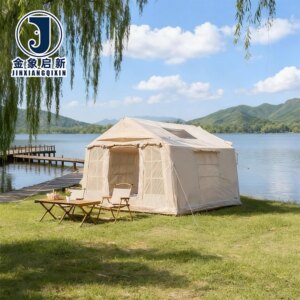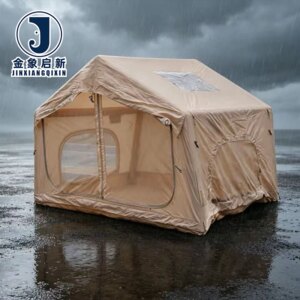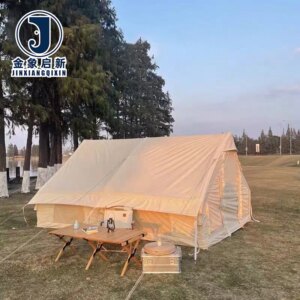
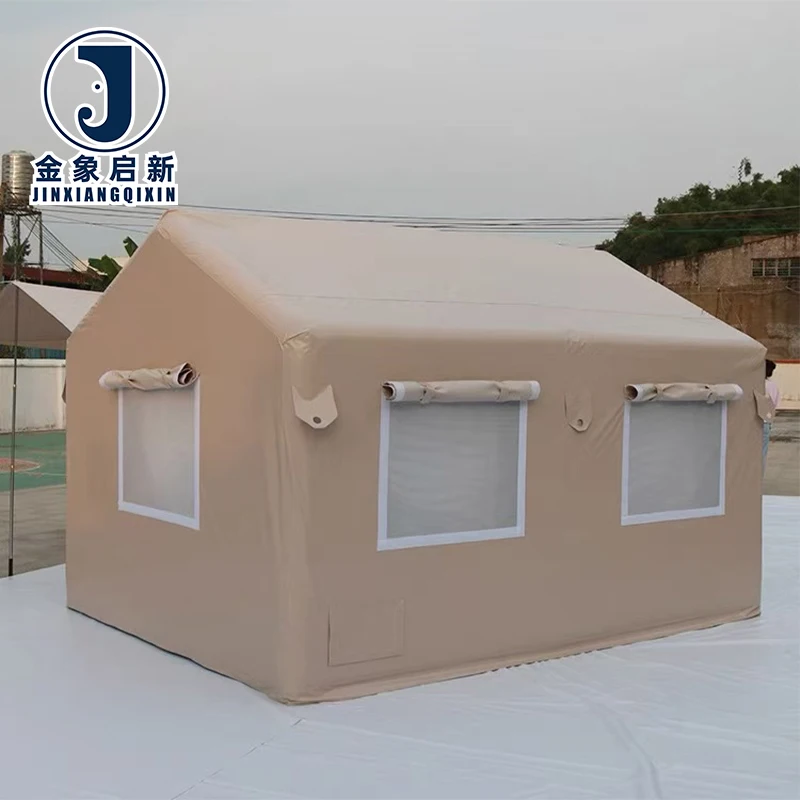
Process Control — We manage coating adhesion and seam integrity from the base fabric upward, ensuring the PVC inflatable tent you deploy meets the performance criteria your project demands, verified at every stage before dispatch.
Technical Specifications
| Parameter | Value |
|---|---|
| Product Type | Inflatable Tent |
| Core Material | PVC tarpaulin |
| Material Thickness Range | 0.4mm – 1.2mm (available grades — confirm required thickness for your deployment) |
| Waterproof | Yes — fully coated construction |
| UV Resistance | Available with UV treatment — confirm the test basis required for your market |
| Tear Resistance | Available in tear-resistant grades — confirm the standard applicable to your region |
| Flame Retardant | Available in flame retardant grades — confirm the grade required for your market |
| Anti-Static | Available with anti-static treatment — confirm surface resistance or standard before ordering |
| Capacity | 3–4 Person (customizable from 2 to 8 persons) |
| Opening Mechanism | Quick automatic opening via air inflation |
| Construction | Single layer |
| Design | Extended type |
| Season Rating | Four-Season |
| Customization Options | Size, material thickness, color, pattern printing, reinforced stress points, extended awnings |
| Standards & Certification | ISO 9001, ISO 14001, ISO 45001, CE |
Application Suitability
| Application | Exposure & Requirement |
|---|---|
| Disaster relief & emergency response | Rapid deployment under severe weather, continuous UV and rain exposure, multi-season temperature swings |
| Construction site temporary offices | Daily worker traffic, abrasion from tools and equipment, fire-retardant compliance required by site safety regulations |
| Logistics & field warehousing | Constant inflation pressure, wind loading, forklift and pallet contact near ground-level fabric |
| Agricultural field operations | Prolonged sun exposure, chemical contact from fertilizers or feed, relocation between sites |
| Outdoor equipment storage | Long-term static inflation, moisture ingress risk at ground seams, UV degradation over extended seasons |
What "Flame Retardant" Means When No Grade Backs the Claim
Request the test report before you sign the purchase order, not after the tent arrives on site.
Inflatable tents deployed at construction sites, disaster relief zones, and temporary event venues sit under constant scrutiny from safety inspectors. A fabric labelled "flame retardant" without a verifiable grade or test standard creates a documentation gap that can halt your operation. [NEED_CITE: fire classification standards for temporary structures vary by jurisdiction and project type] Buyers who accept a generic claim often discover during site audit that the certificate does not match the jurisdiction’s building code or event permit requirement. The PVC inflatable tent material you specify must carry a test report that names the standard, the laboratory, and the batch — otherwise the compliance burden falls entirely on you as the procurer.
Coating Formulation Determines More Than Surface Protection
The PVC tarpaulin used in this inflatable tent is coated to integrate waterproof, UV-resistant, tear-resistant, and fire-retardant properties at the material level rather than as a secondary treatment. This means performance is built into the coating formulation itself, reducing the risk of delamination or property loss after repeated inflation cycles. As a PVC Inflatable Tent Material manufacturer, we control the coating process in-house, which allows adjustment of formulation chemistry to match specific deployment environments. The single-layer construction relies entirely on this coating for environmental protection, making formulation consistency critical across every production run.
Rapid Inflation Architecture for Time-Critical Deployments
The quick automatic opening mechanism is engineered to reduce setup time substantially compared to traditional frame tent assembly — a decisive factor in disaster relief and emergency response where minutes matter. Inflation pressure endurance is verified as part of the five-step quality inspection, confirming that air chambers hold pressure under sustained load without fabric creep at welded seams. [NEED_CITE: inflation pressure testing standards for pneumatic membrane structures] For construction and logistics operators, this translates to a shelter that can be erected by a small crew without specialized tools, then relocated to the next site with minimal teardown effort. The extended-type design adds usable interior volume without increasing the structural complexity of the air beam layout.
Reading the Thickness Range Against Your Deployment Scenario
Material thickness between 0.4mm and 1.2mm covers a broad spectrum of deployment scenarios, and selecting the correct grade directly determines field performance and service life. Thinner grades reduce weight and packed volume — an advantage for emergency stockpiles and rapid airlift — but sacrifice puncture resistance in rocky or debris-laden terrain. Thicker grades withstand forklift contact, tool abrasion, and wind-driven particulate impact common on construction and logistics sites, at the cost of higher transport weight. [NEED_CITE: coated fabric thickness and puncture resistance correlation per industry test methods] Base fabric denier and weave density work alongside coating thickness to determine tear propagation behaviour; a heavy coating on a low-density base will crack rather than flex under repeated inflation. Specify thickness in combination with the anticipated mechanical load profile, not as a standalone figure.
The Cost of Underspecifying Inflatable Tent Fabric
When material thickness is selected below what the deployment environment demands, the first failure typically appears at welded seams where inflation pressure concentrates stress cyclically. A tent that deflates overnight in a disaster relief zone compromises occupant safety and erodes trust in the supplying organisation. Colour inconsistency between production batches forces on-site visual patchwork when multiple units are deployed in a row — a problem that surfaces only after installation and cannot be corrected without full replacement. [NEED_CITE: batch-to-batch colour variation tolerance in coated fabric production] Fire-retardant claims unsupported by a test report lead to failed site inspections, project delays, and in some jurisdictions, regulatory penalties that far exceed the original material cost.
Why Source This PVC Inflatable Tent From Jinxiang
Three full production lines and 36 sets of processing equipment give us the capacity to fulfil bulk orders for disaster relief stockpiles or multi-site construction deployments without compressing lead times. Our 10-person R&D team handles material formulation adjustments, custom sizing, pattern printing, and structural reinforcement design in-house, eliminating the coordination delays of outsourcing sample development. The five-step quality check — covering material certification review, fabric strength testing, waterproof verification, inflation pressure endurance, and dimensional accuracy — is applied to every unit before dispatch, not as a sampling exercise. As a PVC Inflatable Tent Material manufacturer with nearly 30 years of coated fabric process control, we manage coating weight and adhesion at a level that generic assemblers cannot replicate. Samples for custom requirements are developed within days, allowing you to verify material hand, seam strength, and inflation behaviour before committing to production volume.
Documentation & Verification
- Material specification sheet stating PVC tarpaulin composition, coating thickness, and weight for your selected inflatable tent grade
- Test reports for UV resistance, flame retardancy, and tear strength issued per batch — request before order confirmation
- ISO 9001, ISO 14001, ISO 45001, and CE certificates included with every shipment documentation package
- Pre-shipment inspection record detailing waterproof rating, inflation pressure test results, and dimensional accuracy confirmation
- Roll packing list and certificate of origin provided for customs clearance on international shipments
Fabrication, Handling & Storage
- Heat-weld seams using temperature and dwell time parameters matched to the selected PVC tarpaulin thickness grade to prevent adhesion failure at flex points
- Reinforce air chamber junctions and stress concentration zones with additional PVC patches during fabrication to extend inflation cycle life
- Store rolled tent fabric on pallets in a dry, shaded environment to prevent compression marks and UV exposure before deployment
- Avoid folding at the same crease line repeatedly — alternate fold patterns to prevent coating micro-cracking in cold conditions
- Clean with mild detergent only; solvent-based cleaners can degrade the PVC coating surface and compromise waterproof integrity
- Field-repair punctures using compatible PVC adhesive patches from the same coating formulation family to maintain seam consistency
What to Include in Your Enquiry
Provide your intended deployment scenario — disaster relief, construction, agricultural, or logistics — along with the expected environmental exposure profile including wind load, UV intensity, and temperature range. Specify the fire-retardant grade or safety standard your project jurisdiction requires, as this determines coating formulation and test documentation. Confirm whether you need finished tents in custom dimensions or roll stock for your own fabrication line, and indicate your annual volume so we can align production scheduling.
Frequently Asked Questions
Q: What fire-retardant grade does the inflatable tent fabric meet, and can you supply the test report?
A: Our PVC tarpaulin is available in flame retardant grades suited to different market requirements. We supply a test report that names the applicable standard, the testing laboratory, and the production batch. Confirm the fire classification your project jurisdiction mandates before ordering, and we will match the formulation and documentation accordingly.
Q: How do you verify coating thickness and material consistency before shipment?
A: Every production batch undergoes our five-step quality inspection, which includes material certification review, fabric strength testing, and dimensional accuracy confirmation. You may request a pre-shipment sample from your specific production run to verify thickness, coating adhesion, and colour match before the full order is dispatched.
Q: What UV treatment is applied, and what test basis supports outdoor exposure claims?
A: UV-resistant additives are integrated into the PVC coating formulation during production. The specific treatment level and test basis depend on the grade selected for your deployment environment. Request the UV test report matching your market’s exposure standard, and we will provide documentation tied to your batch.
Q: What customization options exist for size, color, printing, and structural reinforcement?
A: We offer custom sizing from 2 to 8 persons, material thickness selection across the available range, color matching, pattern printing for branding, and reinforcement at high-stress points such as air chamber junctions. Extended awnings and custom entry configurations are also available. Provide your dimensional drawings and we will develop a sample within days.
Q: How do you control batch-to-batch color consistency across large orders?
A: Color formulation is managed in-house by our R&D team using controlled pigment dosing and coating process parameters. Each production run is checked against the approved color reference before dispatch. For multi-batch orders, we retain production samples from each run to verify consistency visually and instrumentally prior to shipment.