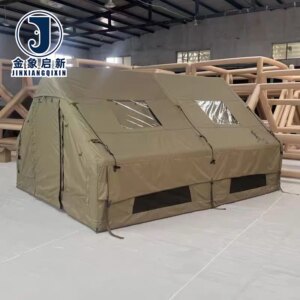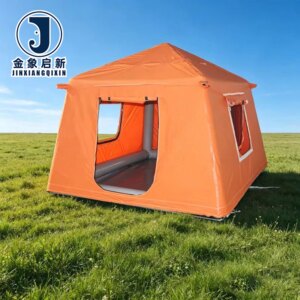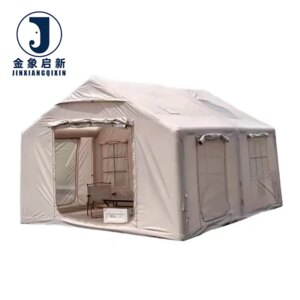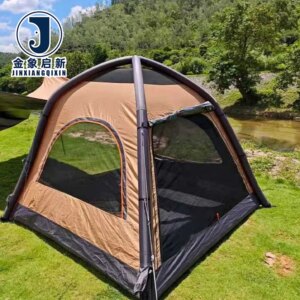
Material Process Mastery — Nearly 30 years focused on PVC coating weight and adhesion control, applied to every roll of inflatable tent fabric we produce.
Technical Specifications
| Parameter | Value |
|---|---|
| Product Type | Inflatable Tent Fabric |
| Core Material | PVC Tarpaulin |
| Product Forms | Single Layer Construction, Extended Type |
| Key Features | Waterproof, UV-resistant (test basis not stated), Tear-resistant, Fire-retardant (grade not stated), Anti-static (standard not stated) |
| Customization | OEM & ODM, sample customization, pattern printing |
| Standards | ISO9001, ISO14001, ISO45001, CE |
Application Suitability
| Application | Exposure & Requirement |
|---|---|
| Commercial Glamping Sites | Continuous outdoor weathering, seasonal deployment cycles, guest-facing aesthetics |
| Large-Scale Event Accommodations | Rapid inflation and deflation, frequent transport, high foot traffic |
| Industrial Temporary Shelters | Exposure to dust and chemicals, fire safety compliance on regulated sites |
| Four-Season Camping Facilities | Low-temperature flexibility, sustained wind load on inflated structure, snow load |
Why Fire-Retardant Claims Fail at the Campsite Gate
Many PVC inflatable tent fabric shipments arrive with a fire-retardant label but no test report matching the destination market’s fire code. The only way to ensure compliance is to specify the exact grade your local authority requires before production begins.
Operators who assume "fire-retardant" is a universal standard often discover at the installation inspection that the material lacks the classification needed for commercial hospitality permits. A tent deployed in a European glamping site may need classification to a different standard than one installed in North America or the Middle East. Without batch-specific documentation, the entire deployment can be delayed or rejected [NEED_CITE: regional fire classification standards for temporary membrane structures].
How Coating Weight and Base Fabric Define Inflatable Structure Performance
An inflatable tent relies on internal air pressure to maintain its shape, which places constant tensile stress on the PVC inflatable tent fabric at every curved panel and seam junction. The relationship between the PVC coating weight and the denier of the base fabric determines how well the material resists these sustained forces without stretching or creeping over time. A heavier coating applied over a low-denier base will add weight without proportional strength gain, while a high-denier base with insufficient coating will leave yarns exposed to abrasion and moisture ingress.
Welded Seam Integrity Under Repeated Inflation Cycles
Every inflation and deflation cycle flexes the welded seams of an inflatable tent at the points where panels meet and where the structure bends most sharply. The PVC coating must bond to the base fabric with sufficient peel strength so that the weld line does not delaminate before the fabric itself reaches its service limit. This bond quality is a direct result of the coating method and the thermal compatibility between the coating compound and the base yarn finish [NEED_CITE: peel strength test methods for coated fabrics per ISO 2411]. When multiple tents are deployed side by side at a commercial site, seam consistency across every unit ensures uniform structural behaviour under wind load.
Reading the Specification Sheet Beyond the GSM Number
The stated GSM of a PVC tarpaulin tells you the combined weight of the base fabric and the coating, but it does not reveal how that weight is distributed. A 650 GSM material could be a heavy base with a thin coating or a light base with a thick coating, and each configuration behaves differently under stress. The base fabric denier and the thread count in both warp and weft directions determine tear propagation resistance — how far a puncture or cut will spread before stopping. The coating method, whether knife coated, laminated, or calendered, affects both the surface finish and the internal adhesion between layers. Knife coating typically pushes PVC paste into the fabric interstices, creating a stronger mechanical bond that supports cleaner hot-air welding. Surface finish — glossy or matte — influences how the material sheds dirt and how well printed branding adheres over extended outdoor exposure. Available in fire-retardant grades — confirm the grade required for your market before sampling.
The Cost of Specifying on Price Per Square Metre Alone
When procurement decisions focus primarily on unit cost, the first compromise is usually coating weight. A roll that arrives lighter than the GSM stated on the quotation will inflate correctly on day one but may show stress whitening at high-load seams within the first season. Fire-retardant treatment added without a verifiable test report creates liability exposure the moment a commercial insurance auditor requests documentation. Colour variation between rolls ordered for the same site becomes immediately visible when tents are installed in a row, forcing selective panel replacement or a full respray [NEED_CITE: batch-to-batch colour consistency standards for architectural membrane fabrics].
What Our Production Lines Bring to Your Inflatable Tent Fabric Order
Three full production lines and 36 sets of professional processing equipment give us the capacity to deliver consistent PVC inflatable tent fabric across container-volume orders without splitting production across different machines. Our 10-person R&D team develops material samples matched to your specific inflation pressure, panel geometry, and surface finish requirements within days of inquiry. Dedicated QA and QC staff inspect every production stage — from base fabric incoming check through coating weight verification to final roll inspection — so that the material you approve at sampling is the material that ships. Full customization from width and colour to pattern printing and finished panel cutting is handled in-house, eliminating the coordination gaps that arise when multiple suppliers are involved.
Documentation & Verification
- Material specification sheet confirming GSM, base fabric denier, and coating type for each roll
- Fire-retardant and UV test reports issued per batch when applicable grades are specified
- Pre-shipment inspection record with weight and visual check before dispatch
- ISO and CE certificates covering production system and product compliance
- Certificate of origin and customs documentation for cross-border shipment
Fabrication, Handling & Storage
- Hot-air weld temperature and speed must match the specific PVC coating compound to avoid seam delamination
- Store rolls upright on pallets to prevent flat-spot deformation of the PVC tarpaulin surface
- Allow cold-stored rolls to acclimatise before unrolling to avoid coating crack at low temperatures
- Use mild detergent and soft brush for cleaning; avoid solvents that soften the PVC coating layer
- Plan panel cutting layout to minimise waste, especially on custom-width rolls with pattern printing
Before You Request a Quote
Tell us the internal operating pressure your inflatable structure requires, the lowest and highest ambient temperatures at the installation site, and the fire classification your local authority mandates. Specify whether you need fabric by the roll in stock widths or custom widths cut to your panel dimensions, and indicate if pattern printing or branded panels are part of the project scope. If you are comparing material options, request a sample produced on the same production line that will fulfil your bulk order.
Frequently Asked Questions
Q: What fire-retardant grades are available for PVC inflatable tent fabric?
A: We supply PVC inflatable tent fabric in fire-retardant grades — confirm the specific classification your market requires, such as M2, B1, or NFPA 701, and we will match the formulation and provide a batch test report with your shipment.
Q: How do you verify the GSM matches the quotation?
A: Every roll undergoes a weight check against the stated GSM during pre-shipment inspection. The inspection record is included in your documentation package so you can verify the coating weight and base fabric specification upon receipt.
Q: Can you match colour across multiple rolls for one campsite deployment?
A: Colour consistency is controlled through batch-level pigment dosing and in-line visual inspection. For large site deployments, we recommend confirming a signed sample before production and scheduling all rolls for one order in a single production run.
Q: What is the lead time for custom-colour inflatable tent fabric?
A: Custom colour and printed samples are typically developed within days for approval. Bulk production lead time depends on order volume and specification complexity, and we confirm the schedule at the quotation stage before you commit.
Q: Is the fabric suitable for hot-air welding into inflatable panels?
A: Yes. Our PVC tarpaulin is formulated for hot-air and high-frequency welding. We recommend sharing your welding equipment parameters so we can adjust the coating surface finish to match your fabrication process and ensure consistent seam strength.