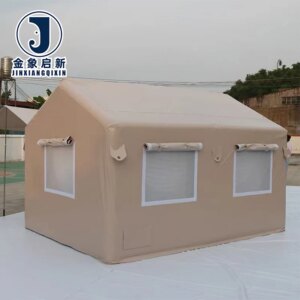
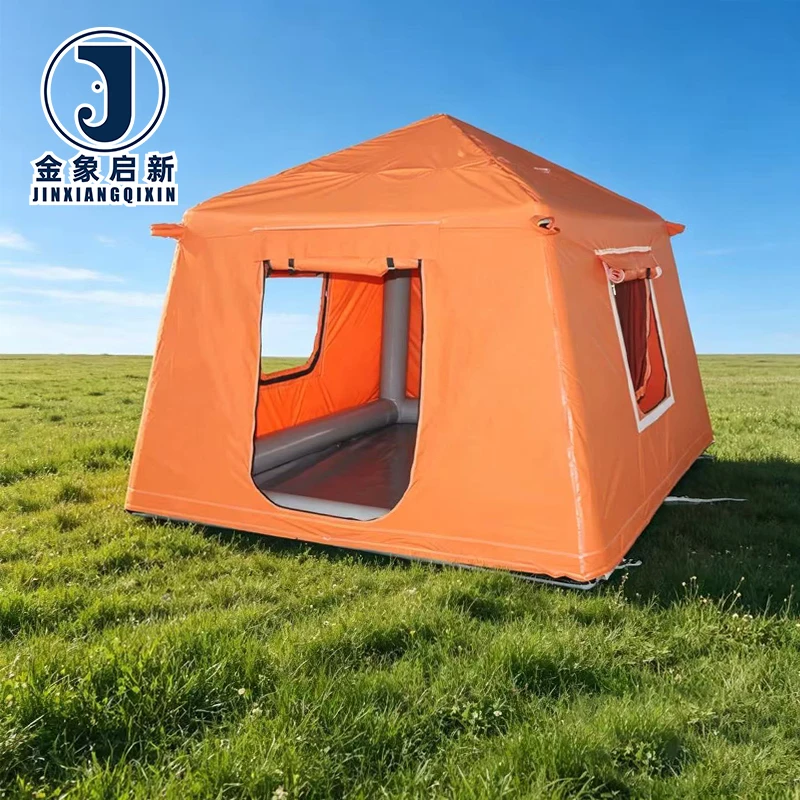
Coated Fabric Specialisation — nearly three decades of process control over coating weight, adhesion, and base fabric integration give technical buyers verified material data rather than untested claims when specifying Inflatable Tent Fabric material coating technology for membrane structures.
Technical Specifications
| Parameter | Value |
|---|---|
| Product Type | Inflatable Tent Fabric |
| Core Material | 420D Oxford |
| Capacity | 5-8 Person |
| Season Suitability | 4-Season |
| Opening Mechanism | Quick Automatic Opening |
| Construction Type | Single Layer |
| Design Type | Extended Type |
| Customization Service | OEM & ODM (Sample customization, pattern printing) |
| Flame Retardant Grade | (grade not stated in source) |
| UV Treatment | (test basis not stated in source) |
| Anti-Static | (not confirmed in source) |
| Standards | ISO9001, ISO14001, ISO45001, CE |
Application Suitability
| Application | Exposure & Requirement |
|---|---|
| Temporary site shelters for construction projects | Wind loading on inflated frame, abrasion from ground anchoring, UV exposure across multi-month deployment |
| Mobile storage units for logistics operations | Repeated inflation and deflation cycles, flex stress at seam junctions, forklift and pallet contact |
| Emergency response facilities for disaster relief | Rapid deployment under adverse weather, transport damage risk, variable terrain anchoring |
| Industrial camping scenarios | Extended occupancy load, temperature fluctuation across seasons, interior humidity from occupant use |
What "Flame Retardant" Means Without a Grade Behind It
Specifying Inflatable Tent Fabric material coating technology requires a test standard attached to every fire performance claim, not a marketing adjective standing alone.
I have reviewed procurement files where inflatable membrane structures arrived on site with "flame retardant" printed on the invoice but no test report matching the batch number. When the site safety officer requested documentation for building code compliance, the project stalled until replacement fabric with a verified grade was sourced. [NEED_CITE: fire classification standards for temporary membrane structures and inflatable shelters] For technical buyers specifying shelter fabric for mining camps, aviation hangars, or disaster relief staging, the absence of a stated grade means the material must be treated as untreated until proven otherwise. Available in flame retardant grades — confirm the grade required for your market before placing the order.
Base Fabric Denier and Its Role in Structural Integrity
The 420D Oxford base fabric provides the tensile backbone for this Inflatable Tent Fabric material coating technology. Denier defines the linear mass density of the yarn — a 420D yarn carries more mass per unit length than lighter deniers, contributing directly to tear initiation resistance. For inflatable structures, the frame tubes bear continuous internal pressure, and the base fabric must resist micro-tears propagating from anchor points or crease lines formed during packing and transport. The weave structure of Oxford fabric, with its basket-weave interlacing, distributes point loads across multiple yarn crossings rather than concentrating stress on a single thread. This matters when an inflated shelter is subjected to gusting wind loads that flex the membrane unevenly.
Coating Adhesion and Weld Line Behaviour Under Inflation Load
Coating adhesion to the base fabric determines whether welded seams hold under the continuous stress of internal air pressure. [NEED_CITE: peel strength and weld integrity test methods for coated technical textiles] When an inflatable tent frame is pressurised, the seam at the tube junction experiences circumferential tension that pulls the coating away from the substrate if adhesion is insufficient. Delamination at the weld line is a failure mode that begins invisibly — the fabric surface appears intact while the coating separates internally, until the next inflation cycle pushes the weakened zone past its limit. The single-layer construction of this 420D Oxford fabric places the entire structural demand on one coated surface, making coating-to-substrate bond strength the critical variable in long-term air-holding performance for industrial shelter applications.
Reading the Specification Sheet Beyond Stated Denier
The 420D denier value tells you the yarn weight, but the finished fabric performance depends on how that yarn is woven, coated, and finished. Weave density — the count of warp and weft yarns per centimetre — determines how much coating compound penetrates between yarns versus sitting on the surface. A tighter weave with the same denier yields higher tensile strength but may reduce coating penetration, affecting peel strength at heat-welded seams. Coating method influences the balance: knife-over-roll application forces compound into the weave for stronger adhesion, while dip coating produces a more uniform surface film. For Inflatable Tent Fabric material coating technology, the relationship between base fabric construction and coating application defines whether the material performs as an integrated composite or as two independent layers prone to separation. Surface finish — whether glossy or matte — affects cleanability in field conditions and the adhesion of printed branding for OEM identification. [NEED_CITE: coating application methods and their effect on coated fabric mechanical properties]
The Cost of Specifying on Incomplete Data
When a buyer orders coated fabric based on denier alone, without verifying coating weight or adhesion values, the material may pass visual inspection but fail under operational stress. I have encountered cases where inflatable shelter tubes lost pressure within days of deployment because the weld seam peeled under continuous inflation load — the base fabric itself showed no damage, only the coating bond failed. [NEED_CITE: weld seam failure analysis in pressurised membrane structures] Batch-to-batch variation in coating weight compounds this risk: if the coating is lighter on a subsequent roll, heat-welding parameters calibrated for the previous batch will burn through or under-fuse the seam. For procurement teams managing multi-site deployments, inconsistent material properties mean recalibrating fabrication settings for every shipment, adding labour cost and delay that no quotation discount can offset. UV treatment claimed without a test basis creates a parallel exposure — fabric that degrades under solar radiation loses tensile strength progressively, with the failure appearing months after installation when warranty recourse is complicated.
Why Source Inflatable Shelter Fabric Through This Supply Chain
Deep process control over coating formulation and application gives technical buyers access to material specification sheets that state base fabric denier, coating compound type, and measured GSM rather than generic product descriptions. Three full production lines with 36 sets of processing equipment support volume consistency across rolls, reducing the batch variation that causes weld calibration problems downstream. A 10-person R&D team handles custom sizing, pattern printing, and sample development within days, allowing fabricators to validate material behaviour on their own welding equipment before committing to bulk orders. Dedicated QA/QC inspection at every production stage with full pre-shipment coverage catches coating weight deviations and colour drift before material leaves the facility. ISO9001, ISO14001, ISO45001, and CE certification provides the compliance framework that industrial procurement departments require for vendor qualification in regulated sectors.
Documentation & Verification
- Material specification sheet stating 420D Oxford base fabric denier, coating compound, and measured GSM per roll
- Test reports for UV and flame retardant treatment tied to specific batch numbers where applicable
- Pre-shipment inspection record with full QA/QC coverage of coating adhesion and surface consistency
- ISO and CE certificates available for compliance documentation in regulated procurement channels
- Roll packing list with net weight, gross weight, and dimensions for container loading planning
- Certificate of origin and customs documentation for cross-border shipment clearance
Fabrication, Handling & Storage
- Heat-weld temperature and dwell time must be calibrated to the 420D Oxford coating thickness to avoid burn-through or under-fusion at tube seams
- Seam allowance at inflation stress points should exceed minimum width to distribute circumferential tension across the coated bond area
- Store rolls horizontally on racking to prevent permanent creasing that weakens the coating at fold lines
- Allow cold-stored rolls to reach ambient temperature before unrolling to prevent coating micro-cracking in the 420D Oxford substrate
- Clean coated surfaces with neutral pH detergent only — alkaline cleaners attack the plasticiser in the coating compound
- Field repairs on single-layer inflatable tubes require compatible coating compound for patch adhesion to the 420D Oxford base
Request a Material Sample for Weld Testing
Provide your intended inflation pressure range, operating temperature envelope, and the fire classification required by your site safety regulations so we can recommend the appropriate coating formulation and treatment grade. Specify whether you require roll stock for in-house fabrication or finished panels cut to your tube diameter and length pattern. Confirm your annual volume and colour requirements to determine production scheduling and batch consistency parameters.
Frequently Asked Questions
Q: How is GSM verified on arrival and what documentation supports the quoted weight?
A: Each roll is inspected against the stated GSM before dispatch, with results recorded in the pre-shipment inspection report. The material specification sheet accompanying your shipment states the measured coating weight and base fabric denier for every roll. If your receiving inspection finds a discrepancy, the batch documentation provides the traceability to investigate the deviation.
Q: What test basis supports UV treatment claims and how does it relate to outdoor exposure?
A: UV treatment is available in multiple grades depending on your deployment duration and geographic exposure conditions. Confirm the test standard required for your market — different regions reference different accelerated weathering protocols. We provide test reports tied to the specific batch when UV treatment is specified in your order.
Q: What flame retardant grades are available and which test standards do they meet?
A: Flame retardant treatment is available in grades aligned with regional fire safety regulations for temporary structures and membrane buildings. Specify the classification required by your site safety authority — common frameworks include DIN 4102, NFPA 701, and local building code references. We confirm the applicable grade and provide the corresponding test report before production.
Q: How does weld strength compare to base fabric tear strength under inflation load?
A: Weld integrity depends on coating adhesion to the 420D Oxford substrate and the heat-weld parameters used during fabrication. Under continuous inflation pressure, the seam junction experiences circumferential tension that tests the coating bond rather than the base fabric itself. We recommend fabricators run weld peel tests on sample material to establish optimal temperature and dwell settings before bulk production.
Q: Can the fabric be customised for specific inflatable structure dimensions and branding?
A: OEM and ODM services include sample customisation, pattern printing, and cut-to-size fabrication for inflatable tube diameters and panel lengths. The 420D Oxford base accepts printed branding on the coated surface, with colour consistency maintained across rolls within the same production batch. Submit your tube pattern and branding artwork for sample development.