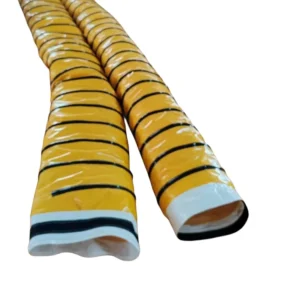
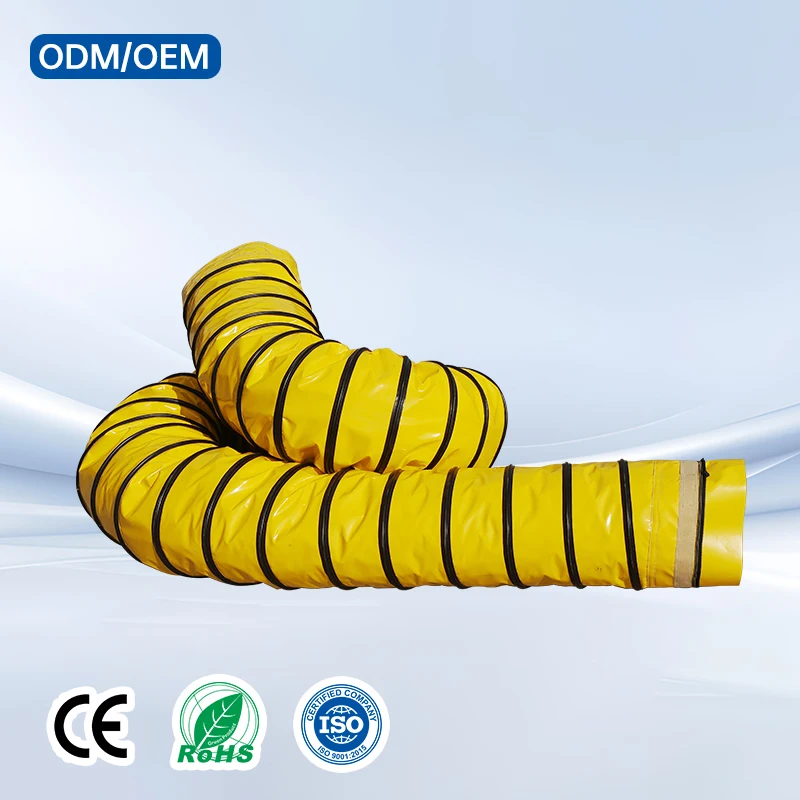
Coated Fabric Engineering Expertise — deep process control over PVC coating weight and insulation layer adhesion ensures every Aircraft PCA Air Duct meets airport ground support requirements from the coating line to the apron.
Technical Specifications
| Parameter | Value |
|---|---|
| Product Type | Aircraft PCA Air Duct |
| Coating Material | PVC coated fabric-reinforced layer |
| Insulation Layer | Built-in aluminum foil bubble film |
| Temperature Range | -30°C to 150°C |
| Connection Method | Zipper and Velcro link |
| Outer Layer Color | Yellow-black alternating (high visibility) |
| Characteristic | Mildew resistance, water resistance, high strength and strong tension |
| Logo Customization | Supported (MOQ 100) |
| Pattern Customization | Supported (MOQ 100) |
| Standards | ISO, CE |
Application Suitability
| Application | Exposure & Requirement |
|---|---|
| Airport apron PCA unit to aircraft cabin connection | Constant outdoor deployment, UV exposure, jet blast debris, extreme temperature transfer (-30°C to 150°C) |
| Narrow-body and wide-body aircraft ground air supply | Repeated flexing during hookup and teardown, abrasion against tarmac and equipment edges |
| Aviation GSE manufacturer integration | Dimensional consistency across production batches, interface compatibility with multiple PCA unit models |
| MRO replacement for degraded duct assemblies | Rapid swap-out capability, matching existing connection fittings and diameter specifications |
Why Insulation Integrity Matters More Than Fabric Weight Alone
When sourcing an Aircraft PCA Air Duct manufacturer, buyers often focus on the outer PVC layer’s durability while overlooking how the insulation layer performs under daily thermal cycling on the apron.
The insulation layer determines whether pre-conditioned air reaches the aircraft cabin at the target temperature, not the outer fabric’s weight or thickness.
Ground support crews deploy and retract these ducts multiple times per turnaround, subjecting the aluminum foil bubble film to repeated compression and flex. If the insulation delaminates or the bubble cells rupture, thermal transfer drops measurably before any visible damage appears on the PVC exterior. I have seen duct assemblies returned after a single season of apron service where the outer shell was intact but the insulation had separated from the fabric-reinforced layer at the connection points [NEED_CITE: thermal delamination failure modes in flexible insulated ducting]. Without a cross-section inspection protocol, this failure mode goes undetected until cabin cooling complaints trigger an equipment audit.
Aluminum Foil Bubble Film as the Thermal Barrier
The built-in aluminum foil bubble film insulation layer serves as the primary thermal barrier between the pre-conditioned air stream and the ambient apron environment. This Aircraft PCA Air Duct design places the insulation between the PVC-coated outer shell and the air path, shielding the foil layer from direct mechanical damage during deployment. The bubble cell structure traps air pockets that resist conductive heat transfer, while the aluminum foil surface reflects radiant heat from tarmac surfaces that can exceed 60°C in summer operations. When the insulation layer maintains integrity through thousands of flex cycles, the duct delivers consistent thermal performance across the full rated temperature range of -30°C to 150°C without requiring auxiliary heating or cooling compensation at the PCA unit.
PVC-Coated Fabric Shell for Apron Durability
The outer PVC-coated fabric-reinforced layer must withstand conditions that degrade standard industrial ducting within weeks. Jet fuel residue, de-icing fluid overspray, and hydraulic fluid leaks on the apron attack unprotected fabrics, while the yellow-black alternating color pattern serves a dual purpose: high-visibility safety marking for ground crews operating around moving aircraft and equipment, and UV-absorbing pigmentation that reduces solar heat gain on the duct surface [NEED_CITE: ground support equipment visibility standards for apron operations]. The mildew and water resistance characteristics of the PVC coating prevent moisture ingress during rain events or wash-down cycles, eliminating the biological growth that compromises insulation performance in humid airport environments. The zipper and Velcro connection system allows a single ground handler to deploy or retract the full duct length between aircraft turns without requiring tools or additional personnel.
Temperature Range and Material Behavior at the Extremes
The -30°C to 150°C rating spans the operational envelope that airport ground equipment encounters across seasonal and geographic variation. At the cold end, PVC compounds can stiffen and lose flexibility, making the duct difficult to unroll and position against the aircraft interface; the fabric-reinforced layer must retain enough pliability at sub-zero temperatures to allow full deployment without cracking the coating. At the high end, pre-conditioned air from PCA units can reach elevated temperatures during heating mode, and the aluminum foil bubble film must maintain its cell structure without collapsing or delaminating from the substrate. The connection between the PVC shell and insulation layer becomes the critical failure point when thermal expansion rates differ between materials, which is why coating adhesion during manufacturing determines field performance more than individual material specifications alone. This Aircraft PCA Air Duct aftermarket supplier specifies the temperature range based on the combined assembly behavior rather than individual component ratings.
What Happens When the Insulation Layer Fails First
The most costly duct failures are not the ones where the outer fabric tears or the zipper jams — they are the failures where the insulation degrades silently while the shell appears serviceable. Ground crews continue deploying the duct, the PCA unit runs at full capacity, yet cabin temperature complaints increase gradually until maintenance staff trace the issue to the air supply system. By that point, the insulation delamination has often progressed across multiple duct sections, requiring a complete fleet replacement rather than a single unit swap [NEED_CITE: progressive insulation failure in aviation ground air supply systems]. This is why pre-shipment inspection must include cross-section sampling of the insulation-to-fabric bond, not just visual examination of the outer surface and connection hardware.
Why Procurement Teams Choose This Source
Three full production lines and 36 sets of professional equipment support consistent output across batch volumes that airport GSE fleets demand, with coating weight and insulation adhesion controlled at each stage rather than sampled after completion. A dedicated 10-person R&D team handles diameter and length customization for specific PCA unit interfaces, developing samples within days rather than weeks when MRO facilities need replacement ducting for legacy equipment. QA/QC protocols include inspection of the insulation layer bond strength, zipper and Velcro function testing across the full connection length, and dimensional verification against the specified diameter before packing. The ISO and CE certified production system provides traceable documentation that aviation procurement departments require for compliance audits. Custom logo and pattern application is supported from an MOQ of 100 units, allowing airline or GSE fleet identification without excessive inventory commitment.
Documentation & Verification
- Material specification sheet stating base fabric composition, PVC coating weight, and aluminum foil bubble film insulation layer construction
- Temperature range test report covering performance at -30°C and 150°C extremes per aviation ground equipment protocols
- Pre-shipment inspection record verifying insulation-to-fabric bond integrity, zipper function, and dimensional accuracy
- Certificate of origin and customs documentation prepared for international airport procurement channels
- Flame retardant test report available upon confirmation of the specific grade required for your airport authority
Fabrication, Handling & Storage
- Zipper and Velcro connections require alignment before pressurization; inspect teeth and hook surfaces for apron debris before each hookup
- Store folded duct sections in dry, shaded areas to prevent UV degradation of the yellow-black PVC outer layer between operations
- Avoid dragging the insulated duct across tarmac surfaces to protect the aluminum foil bubble film layer from puncture
- Clean PVC exterior with mild detergent only; solvent-based cleaners can compromise the coating’s water and mildew resistance
- Inspect insulation bond at connection points quarterly; delamination at zipper zones is the first indicator of thermal cycling fatigue
Requesting a Specification Match
Provide the PCA unit model, aircraft types served, and typical deployment frequency so we can recommend the appropriate duct diameter, length, and connection configuration. Specify any fire-retardant or anti-static requirements dictated by your airport authority, as available grades must be confirmed against your local compliance standards before production.
Frequently Asked Questions
Q: What fire-retardant or anti-static certifications are available for aviation PCA ducts?
A: Fire-retardant and anti-static treatments are available in multiple grades. The specific certification required depends on your airport authority’s ground equipment standards and national fire codes. Confirm the exact grade needed for your operation before quoting, so we can match the appropriate treatment and provide the corresponding test report with your shipment.
Q: How is the duct diameter and length customized to match specific PCA unit and aircraft models?
A: Diameter and length are built to match your PCA unit output fitting and the distance to the aircraft air conditioning interface. Our R&D team develops samples within days based on your equipment dimensions, allowing fit verification before full production runs. Zipper and Velcro connection zones are positioned to align with your specific hookup hardware.
Q: How does the insulation perform in extreme ambient temperatures on the apron?
A: The aluminum foil bubble film insulation layer maintains thermal resistance across the -30°C to 150°C operating range. In high ambient heat, the reflective foil surface reduces radiant heat absorption from tarmac surfaces. In cold conditions, the bubble cell structure limits conductive heat loss from the pre-conditioned air stream to the surrounding environment.
Q: Can the outer color and branding be customized for airline or GSE fleet identification?
A: Logo and pattern customization is supported from a minimum order of 100 units. The standard yellow-black alternating color provides high-visibility safety compliance on the apron, and custom branding can be applied to the PVC outer surface for fleet identification without affecting the insulation layer performance beneath.
Q: How are the duct ends finished to ensure a secure seal at the PCA unit and aircraft interface?
A: Duct ends are finished with zipper and Velcro connection systems that wrap around the mating flange of your PCA unit and aircraft air conditioning port. The connection method allows rapid deployment during aircraft turnaround while maintaining a seal that prevents pre-conditioned air loss at the junction points.