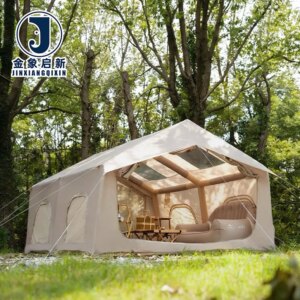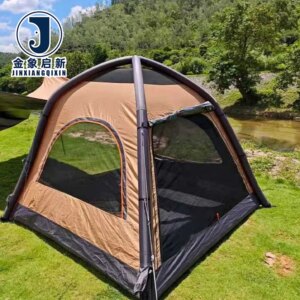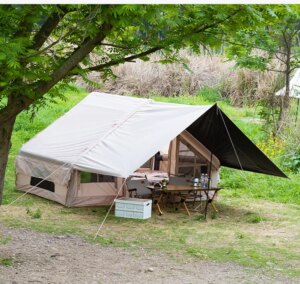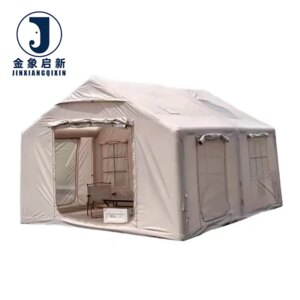
Coating Process Mastery — nearly three decades of PVC formulation and coating weight control underpin every roll of inflatable tent fabric we supply, ensuring batch-to-batch waterproofing consistency critical for commercial outdoor gear manufacturers.
Technical Specifications
| Parameter | Value |
|---|---|
| Product Type | Inflatable Tent Fabric |
| Core Material | PVC tarpaulin, single-layer construction |
| Waterproof Rating | ≥2000mm water column (source value — verify against manufacturer catalog) |
| Tear Resistance | ≥300N (standard not stated in source) |
| UV Treatment | 500 hours exposure basis (source value — verify against manufacturer catalog) |
| Key Features | Waterproof, UV-resistant, tear-resistant, fire-retardant available, anti-static available |
| Fire-Retardant Grade | Available in flame retardant grades — confirm the grade required for your market |
| Anti-Static Standard | Available with anti-static treatment — specify the standard required for your application |
| Customization Scope | OEM & ODM including sample customization, pattern printing, material selection, product design |
| Prototype Lead Time | 7–10 business days |
| Production Lead Time | 15–20 days for standard orders |
| Certifications | ISO9001, ISO14001, ISO45001, CE |
Application Suitability
| Application | Exposure & Requirement |
|---|---|
| Commercial inflatable camping tent production | Repeated inflation cycles, full weather exposure, abrasion at ground contact points, waterproofing integrity at welded seams |
| Family-sized 4-season inflatable shelters | Cold-temperature flexibility, UV degradation resistance during extended outdoor stays, tear resistance under wind load |
| Professional outdoor equipment lines | Batch consistency across large production runs, compliance documentation for regulated markets, weld strength matching fabric tensile capacity |
| Wholesale and distribution for commercial camping operators | Shipping durability of finished units, long-term storage without coating tack or delamination, colour uniformity across inventory batches |
Why "Waterproof" on the Label Is Not Enough Without Batch Test Data
A stated waterproof rating means little unless every roll in your order actually meets it — our inflatable tent fabric manufacturer process verifies water column performance per production batch before any roll ships.
Outdoor gear manufacturers scaling inflatable camping tent lines have faced the same problem: the first production run performs well, but subsequent batches allow moisture penetration after repeated inflation and deflation cycles. The coating weight varies, the adhesion between PVC layers drifts, and warranty claims spike. When a single inflatable camping tent material batch underperforms, the finished product fails in the hands of end users who expect four-season reliability. [NEED_CITE: hydrostatic pressure testing methods for coated technical textiles per ISO 811]
Consistent waterproofing in an inflatable tent fabric depends on controlled coating application, monitored curing temperatures, and verified film thickness across the entire roll width. Without these controls documented per batch, manufacturers are assembling products on faith rather than specification.
Coating Weight Control Across Every Roll
Maintaining uniform PVC coating weight across the full width of each roll is the foundation of reliable inflatable tent fabric performance. Our three full production lines operate with dedicated QA and QC staff monitoring coating application at every stage. When an inflatable tent fabric manufacturer allows coating weight to drift even slightly between the roll edges and the centre, the result is uneven waterproofing and inconsistent weld behaviour during fabrication. Ten-person R&D oversight means formulation adjustments are made based on measured data, not production floor assumptions.
Weld Integrity at Air Chamber Seams
Inflatable camping tents place extraordinary demand on welded seams because the air chambers expand and contract with every use cycle. The weld line must match or exceed the tear resistance of the base fabric itself. Our custom inflatable camping tent material is produced with coating adhesion engineered to support high-frequency welding without delamination at stress points. When the coating formulation and the base fabric denier are matched correctly during specification, the seam survives the repeated flexing that occurs as air pressure shifts with temperature changes throughout the day. [NEED_CITE: hot air welding parameters for PVC coated polyester fabrics]
Decoding the Specification Sheet for Inflatable Tent Materials
The ≥2000mm water column rating indicates the hydrostatic pressure the fabric can resist before moisture penetrates, but this number only holds value when tested under controlled conditions on the actual roll being supplied. Tear resistance of ≥300N reflects the force required to propagate a tear through the coated fabric, a critical value for inflatable tent panels that experience wind loading and mechanical stress at valve and anchor points. The single-layer PVC tarpaulin construction balances durability with packing weight — manufacturers shipping finished inflatable tents globally benefit from lower dimensional weight in freight calculations. UV treatment based on 500 hours exposure provides a reference point for colour stability and tensile retention, though the actual outdoor service duration depends on geographic UV index, seasonal exposure patterns, and whether the finished tent is stored or left pitched between uses. Fire-retardant and anti-static treatments are available in grades suited to different regulatory frameworks, and the specific grade must be confirmed against the safety requirements of each target market before production begins.
The Cost of Ignoring Batch Consistency in Tent Fabric Sourcing
When inflatable tent fabric arrives with colour variation between rolls, the manufacturer faces a choice: mix rolls on the production floor and ship tents with visible panel mismatches, or sort and waste material to maintain visual uniformity. Either path drives up unit cost and delays shipment schedules. Coating weight inconsistency between batches causes unpredictable behaviour during high-frequency welding — some seams bond correctly at standard parameters while others delaminate under air pressure, creating field failures that surface only after the product reaches the end user. Anti-static treatment claimed without a test report means the finished tent may not pass safety inspections at commercial campsites or event venues where static discharge near electrical equipment is a documented risk. [NEED_CITE: electrostatic discharge testing requirements for temporary structures]
What Our Production Process Delivers for Tent Manufacturers
Our 9,180 square metre facility dedicates three full production lines to coated fabric, providing the capacity needed when commercial tent manufacturers place bulk orders with tight delivery schedules. The 36 sets of professional processing equipment handle everything from base fabric preparation through coating application, curing, and finishing — keeping the entire production sequence under one roof reduces handoff errors. Ten R&D technicians work directly on material selection, sample development, and pattern printing specifications so that custom inflatable camping tent material requirements move from inquiry to approved sample within days rather than weeks. Dedicated QA and QC staff inspect every roll at each production stage, with 100% pre-shipment inspection covering coating weight, colour consistency, and waterproof performance before dispatch. The ISO9001, ISO14001, ISO45001, and CE framework provides the documentation trail that regulated markets require for market access.
Documentation & Verification
- Batch-specific inspection report confirming waterproof performance and coating weight per roll before dispatch
- Material safety data sheets provided with full PVC formulation transparency on request
- UV stability and tear resistance test results documented per production batch
- ISO9001, ISO14001, ISO45001, and CE certificate copies included with every shipment
- Fire-retardant and anti-static grade test reports supplied matching the specification confirmed at order placement
- Pre-shipment inspection record with dimensional tolerance verification per roll
Fabrication, Handling & Storage
- High-frequency welding parameters must be matched to the single-layer PVC tarpaulin coating weight to prevent delamination at air chamber seams
- Store rolls upright in a climate-controlled environment to prevent compression marks that transfer to finished inflatable tent panels
- Avoid dragging PVC tarpaulin rolls across unprotected surfaces during warehouse handling to prevent coating surface scoring
- Confirm cleaning agent compatibility with the specific surface finish before specifying maintenance instructions for end users
- Allow material to acclimatise to ambient workshop temperature before welding to ensure consistent seam strength across the roll
- Plan cutting patterns to maximise material utilisation from standard roll widths and minimise offcuts at curved panel intersections
Requesting a Specification That Matches Your Production Line
Tell us your target market’s fire safety classification, the expected inflation cycle frequency of the finished tent, and your annual roll volume. We will recommend a coating formulation and treatment package aligned with your compliance requirements and production throughput. If pattern printing or custom colour is part of your product range, share the artwork and Pantone references early so that sample rolls can be developed alongside your prototype schedule. Specify whether you need rolls at standard widths or custom dimensions, and whether pre-cut panels are required for your assembly line.
Frequently Asked Questions
Q: How do we verify the waterproof rating when rolls arrive at our factory?
A: Each shipment includes a batch-specific inspection report documenting the water column test result for every roll produced. You can run independent hydrostatic testing on arrival to confirm performance matches the documented value. If any roll tests below the agreed threshold, our quality team investigates the production batch and arranges replacement material to keep your production schedule on track.
Q: What is the UV treatment basis and how does it translate to real-world tent performance?
A: The UV treatment reference is based on 500 hours of controlled exposure testing, which provides a comparative benchmark for colour stability and tensile retention. Actual outdoor service duration depends on geographic location, seasonal UV index, pitch duration, and storage conditions between uses. We recommend confirming the specific UV additive package against your target market’s expected exposure patterns during the sampling phase.
Q: Which fire-retardant grades are available for inflatable camping tent fabric?
A: Flame retardant treatment is available in multiple grades aligned with different regional safety frameworks. The specific grade required depends on the country or venue where the finished tent will be deployed. Confirm your target market’s fire classification requirement at the inquiry stage so that test reports and certification documentation can be prepared alongside production.
Q: What is the timeline from inquiry to approved sample for custom specifications?
A: Sample development for custom inflatable camping tent material typically takes 7–10 business days after specification confirmation. This covers material selection, coating formulation adjustment, pattern printing proofs where applicable, and shipping the sample roll to your facility. Once approved, standard production orders move to completion within 15–20 days depending on order volume and customisation scope.
Q: How do you ensure colour and coating consistency across multiple rolls in a single order?
A: Every roll undergoes in-process quality checks during coating application and a full 100% pre-shipment inspection covering coating weight, colour measurement, and surface finish. Batch-specific documentation accompanies each shipment so your receiving team can verify consistency against the order specification. Any variation detected during inspection triggers corrective action before the roll leaves the facility.