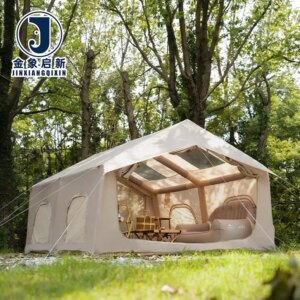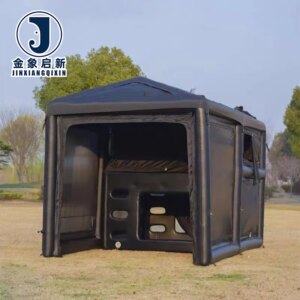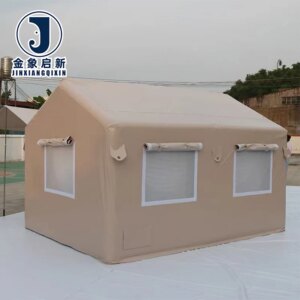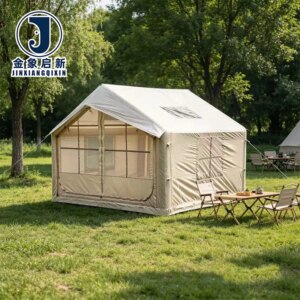
Coating Adhesion Control — Nearly 30 years focused on coated fabric, with dedicated QA/QC ensuring that heat-welded seams on inflatable structures hold as long as the PVC tarpaulin membrane itself.
Technical Specifications
| Parameter | Value |
|---|---|
| Product Type | Inflatable Tent Fabric |
| Core Material | PVC Tarpaulin |
| Product Forms | Extended Type, Single Layer Construction |
| Waterproof Performance | Fully waterproof coated construction |
| UV Resistance | Available in UV-resistant grades — confirm the grade required for your market (test basis not stated) |
| Tear Resistance | Tear-resistant construction |
| Customization Service | OEM & ODM (sample customization, pattern printing) |
| Quality Control System | Full-process quality inspection with dedicated QA & QC staff |
| Certifications | ISO 9001, ISO 14001, ISO 45001, CE |
Application Suitability
| Application | Exposure & Requirement |
|---|---|
| Emergency response centers | Rapid inflation cycles, repeated deployment and packing, all-weather waterproofing |
| Disaster recovery temporary storage | Prolonged UV exposure, wind loading on inflated tube frames, abrasion from ground contact |
| Mobile command posts for engineering projects | Frequent transport and redeployment, seam integrity under internal air pressure |
| Construction site auxiliary workspaces | Dust, moisture, mechanical contact with tools and materials, temperature fluctuation |
| Remote industrial installations | Extended outdoor deployment in varied climates, structural stability under wind load |
| Logistics hub temporary shelters | High-traffic entry and exit points, forklift proximity, ground-level abrasion |
Why Coating Adhesion Matters More Than Fabric Weight in Inflatable Structures
Seam failure on inflatable tube structures almost always traces back to coating delamination, not base fabric rupture.
When an inflatable shelter is pressurised, the highest stress concentrates at the heat-welded joints where tube sections meet. If the PVC coating does not bond firmly to the base fabric, the weld line peels apart under cyclic loading — long before the membrane itself reaches its tensile limit. [NEED_CITE: coating adhesion test methods for PVC tarpaulin per ISO 2411] Buyers who specify PVC Inflatable Tent Fabric based on GSM alone often discover that a heavier roll with poor adhesion produces weaker seams than a lighter roll with controlled coating weight. This is why every production run requires verified adhesion values, not just a weight stamp on the label.
Coating Weight and Adhesion for Reliable Heat-Welded Joints
The performance of Inflatable Shelter PVC Tarpaulin depends on how evenly the PVC compound is distributed across the base fabric and how deeply it penetrates the weave. Uneven coating creates thin spots where heat welding produces incomplete fusion, leaving channels for air leakage under pressure. Our production lines maintain controlled coating application so that the material delivers consistent weld behaviour across the entire roll width, reducing the trial-and-error that fabricators face when dialling in weld temperature and dwell time.
Single-Layer Construction for Rapid-Deployment Frames
A single-layer extended-type construction keeps the overall weight manageable for transport while providing the tear resistance needed for inflatable tube frames that flex during inflation and deflation. The PVC tarpaulin membrane must absorb the stress of repeated pressurisation cycles without micro-cracking at fold lines or creases. This balance between portability and structural integrity is critical for emergency shelter deployments where the tent may be packed, shipped, inflated, deflated and redeployed multiple times within a single operational period. [NEED_CITE: cyclic inflation fatigue testing for inflatable structural membranes]
How Base Fabric Density and Coating Method Shape Real-World Performance
GSM tells you how much material is present, but the base fabric denier and weave density determine how that material resists tearing once a puncture initiates. A high-denier yarn in a tight weave slows tear propagation, giving the inflated structure time to maintain shape even if the membrane sustains local damage. The coating method — whether knife-over-roll, dip, or calender — controls how much PVC sits on the surface versus penetrating the weave. Knife-coated fabrics typically deliver higher surface coating weight, which improves waterproofing and weld integrity but can reduce flexibility if the coating is too thick. For Inflatable Tent Fabric applications, the coating must remain pliable enough to fold without cracking yet thick enough to form a reliable heat-welded bond. Surface finish also plays a role: a glossy top coat sheds dirt and water more readily, while a matte finish can improve grip during handling and reduce glare in bright conditions. Available in glossy or matte finish depending on project specification.
The Hidden Cost of Specifying on Weight Without Verifying Adhesion
Fabricators who source PVC tarpaulin for inflatable shelters sometimes receive rolls that meet the quoted GSM but fail at the weld line during prototype testing. The root cause is often insufficient coating adhesion — the PVC layer separates from the base fabric when the weld is stressed, leaving the joint unable to hold air pressure. [NEED_CITE: relationship between coating adhesion and weld strength in PVC coated fabrics] This failure mode is especially costly in disaster-relief procurement, where a batch of shelters may be deployed in the field before the seam weakness is discovered. Batch-to-batch consistency in coating weight and adhesion is therefore not a luxury but a baseline requirement for any supplier providing material for pressurised inflatable structures. Colour variation between rolls in the same order creates visible mismatches once shelters are installed side by side at a relief site, forcing sorting and reallocation that delays deployment.
Why Procurement Teams Source Inflatable Tent Fabric Here
Deep process control over coating weight and adhesion has been refined across nearly 30 years of focused coated fabric production, directly addressing the weld-line failures that plague inflatable shelter manufacturers. Three full production lines and 36 sets of professional equipment support the volume requirements of large disaster-relief tenders while maintaining roll-to-roll consistency. A 10-technician R&D team handles material selection, pattern printing and custom sizing, developing samples within days for project-specific inflatable shelter designs. Dedicated QA and QC staff inspect every production stage, with 100% pre-shipment inspection confirming that coating adhesion, colour and weight match the specification before rolls leave the facility. ISO 9001, ISO 14001, ISO 45001 and CE certifications are maintained on file for compliance documentation in tender submissions.
Documentation & Verification
- Material specification sheet stating GSM, base fabric denier, coating method and weight for each roll
- Test report for UV resistance grade supplied when UV-treated material is specified
- Pre-shipment inspection record with 100% QA/QC coverage confirming coating adhesion and colour consistency
- ISO and CE certificates available for inclusion in project tender compliance packages
- Roll packing list with individual roll identification for traceability through fabrication
Fabrication, Handling & Storage
- Heat-weld parameters should be tested on sample pieces before full production to match the specific coating weight and adhesion profile of this PVC tarpaulin
- Store rolls upright on pallets in a covered area to prevent flat-spot deformation that affects weld alignment on inflatable tube seams
- Allow material to acclimatise to workshop temperature before unrolling to avoid condensation between coating layers
- Use compatible PVC-based repair patches and solvent cement for field repairs on single-layer inflatable shelter membranes
- Plan cutting layouts to minimise cross-grain welds on tube sections where internal air pressure creates the highest circumferential stress
Request a Material Specification for Your Inflatable Shelter Project
Provide the intended deployment environment, expected inflation cycle frequency, and any fire-safety or UV-resistance grade required by your target market. Specify the roll width and colour reference needed, along with estimated annual volume, so we can confirm availability and lead time. If pattern printing or OEM branding is required, share artwork files for sample development before committing to a production run.
Frequently Asked Questions
Q: How is GSM verified on arrival to ensure the Inflatable Tent Fabric matches the quoted specification?
A: Every roll undergoes weight verification during our 100% pre-shipment inspection, and the results are recorded on the packing list. Buyers can cross-check incoming rolls against the material specification sheet supplied with the shipment. Any discrepancy is flagged before dispatch so that the fabric reaching your facility matches the agreed coating weight and base fabric construction.
Q: What UV test basis supports the anti-UV claim, and how does it relate to outdoor deployment duration?
A: UV-resistant treatment is available in different grades depending on the intended exposure period. The specific test basis and grade should be confirmed against your project’s deployment duration and geographic location. Request the applicable test report when specifying UV-treated Inflatable Shelter PVC Tarpaulin to ensure the grade aligns with your expected service conditions.
Q: What coating adhesion and heat-weld parameters should fabricators use on this PVC tarpaulin for inflatable tube seams?
A: Optimal weld temperature, pressure and dwell time depend on the specific coating weight and surface finish of the material batch. We recommend running weld tests on sample pieces from the actual production roll before full fabrication. Our technical team can provide baseline parameter guidance based on the coating construction supplied for your project.
Q: How is batch-to-batch colour consistency controlled across rolls for large inflatable shelter projects?
A: Colour consistency is monitored through our full-process quality inspection system with dedicated QA and QC staff at every production stage. Rolls within a single order are matched against the approved colour reference before dispatch. For multi-order projects, we retain colour standards on file to maintain continuity across separate production runs.
Q: What custom width, printing and sizing options are available, and what are the lead times and minimums?
A: OEM and ODM customisation includes custom roll widths, pattern printing and sample development for specific inflatable shelter designs. Our 10-technician R&D team can produce samples within days for approval before mass production. Lead times and order minimums vary by specification complexity and volume — submit your requirements for a detailed quotation.