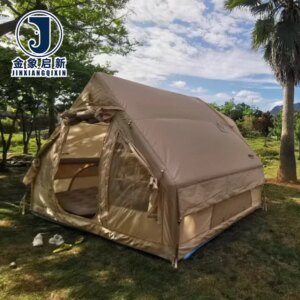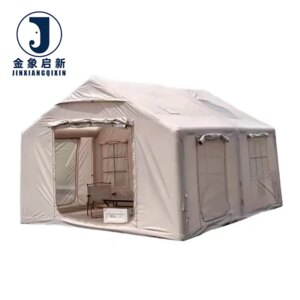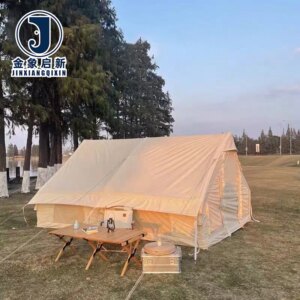
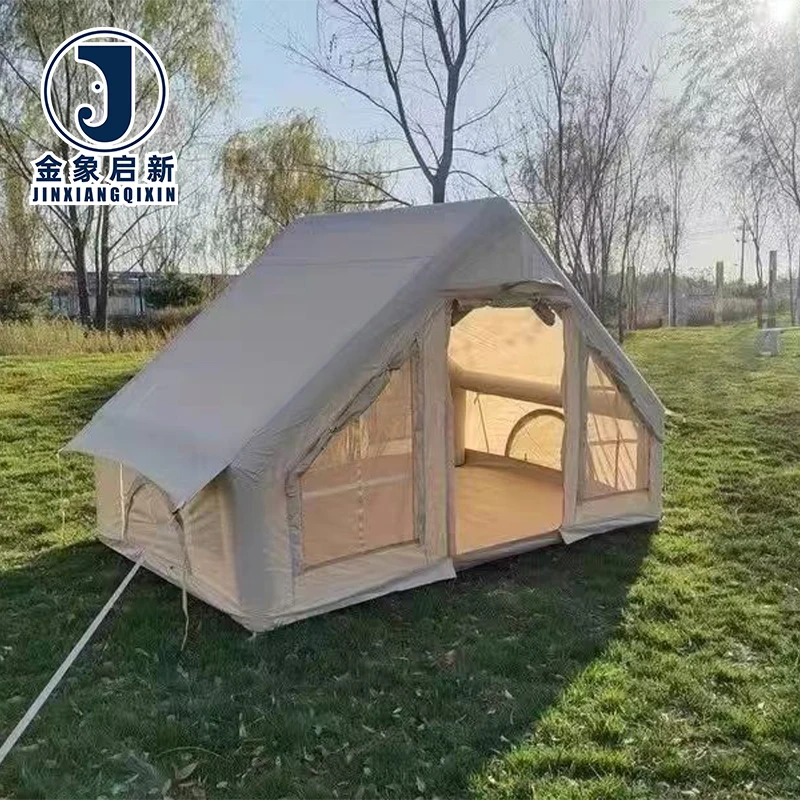
Coated Fabric Process Control — Three full production lines and a 10-person R&D team deliver complete PVC inflatable tent fabric customization from material selection to finished structure, with dedicated QA/QC at every production stage.
Technical Specifications
| Parameter | Value |
|---|---|
| Product Type | PVC Inflatable Tent |
| Core Material | PVC Tarpaulin |
| Waterproof | Yes, fully coated construction |
| UV-resistant | Available (test basis to be confirmed per project requirement) |
| Tear-resistant | Yes (grade to be specified per deployment scenario) |
| Fire-retardant | Available in flame retardant grades — confirm the grade required for your market |
| Anti-static | Available (standard / surface resistance to be specified for sensitive environments) |
| Product Form | Inflatable structure with quick automatic opening mechanism |
| Customization | OEM & ODM — sample customization, pattern printing, material selection, product design |
| Certifications | ISO 9001, ISO 14001, ISO 45001, CE |
Application Suitability
| Application | Exposure & Requirement |
|---|---|
| Temporary site command centers | Continuous outdoor UV exposure, frequent setup and teardown cycles, wind loading on inflatable frame |
| Equipment storage shelters in remote zones | Moisture ingress risk, ground contact abrasion, temperature fluctuation across seasons |
| Mobile workshop enclosures | Welding spark proximity, chemical vapour exposure, high foot traffic at entry points |
| Emergency disaster relief stations | Rapid deployment requirement, all-weather integrity, high-visibility colour consistency across batches |
| Membrane and inflatable structure fabrication | Roll-to-roll colour matching, weld seam strength matching fabric tensile, custom pattern printing adhesion |
What "Fire-Retardant" Means Without a Verifiable Grade Behind It
Specify the exact fire classification your destination market requires before requesting a quotation.
Many industrial buyers receive inflatable tent fabric labelled "fire-retardant" with no supporting test report, only to discover at site inspection that the material does not meet local building or worksite safety codes. An inflatable tent used as a temporary command center or disaster relief shelter operates under the same fire classification scrutiny as semi-permanent structures. Without a documented grade, the entire deployment can be shut down before operations begin. As a PVC Inflatable Tent aftermarket supplier, we provide material only with confirmed test documentation aligned to your compliance framework [NEED_CITE: fire classification standards for temporary inflatable structures in industrial zones].
Coating Adhesion and Structural Integrity Under Inflation Pressure
The performance of any inflatable tent fabric depends on how firmly the PVC coating bonds to the base fabric. When inflation pressure cycles repeatedly during setup and teardown, weak adhesion causes delamination at stress concentration points — particularly around valve openings and structural seams. Our PVC Inflatable Tent aftermarket supplier capability includes coating weight and adhesion process control refined across three full production lines. The 10-person R&D team reviews base fabric denier and weave compatibility before confirming any material recommendation for inflatable applications.
Seam and Weld Behaviour in Rapid-Deployment Structures
Inflatable tents rely on welded seams that must match or exceed the tensile strength of the parent fabric. If weld parameters are set without accounting for the specific coating formulation and GSM, seams fail before the fabric itself does — typically at the point where the inflatable tube flexes most during inflation. We develop weld parameter recommendations alongside fabric supply, ensuring the heat-seal window matches the coating chemistry [NEED_CITE: weld strength testing methods for PVC coated fabrics per ISO 1421]. Batch consistency across rolls is verified so that multi-unit tent orders seal identically from first roll to last.
Reading the Specification Sheet Beyond the GSM Number
GSM alone tells you the areal weight but nothing about how that weight is distributed between base fabric and coating. A PVC tarpaulin with high coating weight but low base fabric denier will feel heavy yet tear easily along the warp or weft. Conversely, a tighter weave with balanced coating delivers superior tear propagation resistance — critical when an inflatable tube is punctured on a construction site and the tear must not spread. Surface finish also plays a role: glossy coatings shed dirt and allow easier field cleaning, while matte finishes reduce glare for command tent interiors and accept printed markings more reliably. Anti-static treatment, when specified for sensitive deployment environments, requires confirmation of the applicable surface resistance standard before production begins.
The Hidden Cost of Colour Drift Across a Multi-Tent Order
When a disaster relief agency orders fifty identical inflatable shelters and the rolls arrive with visible shade variation, the entire batch looks mismatched once deployed side by side. This is not a cosmetic complaint — it signals inconsistent coating formulation that may extend to UV stabilizer distribution and fire-retardant loading. Colour variation between rolls in the same production run indicates insufficient in-process QA. We address this through dedicated QA/QC checkpoints at every production stage, with 100% inspection before shipment and roll packing lists that trace each unit to its production batch [NEED_CITE: batch colour consistency standards for coated technical textiles].
Why Industrial Buyers Source Inflatable Tent Fabric Through This Facility
Our 9,180 m² facility operates three full production lines and 36 sets of professional processing equipment, supporting bulk capacity for large-scale inflatable tent projects without compromising on-time delivery. The 10-person R&D team handles material selection, structural pattern design, and sample development — samples for custom inflatable configurations are typically produced within days. Dedicated QA/QC at every stage means coating weight, colour reference, and seam integrity are verified before any roll ships. OEM and ODM capability covers pattern printing, custom sizing, and full product design, allowing inflatable and membrane structure manufacturers to consolidate fabric sourcing and finished product development in one workflow.
Documentation & Verification
- Material specification sheet stating GSM, base fabric denier, coating type, and colour reference for every roll
- Fire-retardant test report matching the grade specified for your destination market
- UV resistance test documentation confirming performance basis for outdoor deployment
- ISO 9001, ISO 14001, ISO 45001, and CE certificates included with shipment
- Pre-shipment inspection record covering coating adhesion, colour consistency, and dimensional accuracy
- Roll packing list with batch traceability for multi-unit inflatable tent orders
Fabrication, Handling & Storage
- Heat-seal temperature and dwell time must match the specific PVC coating formulation supplied
- Weld seam width should be proportionate to inflatable tube diameter for uniform load distribution
- Store rolls upright on pallets to prevent permanent creasing across the coating surface
- Avoid unrolling PVC tarpaulin below recommended minimum temperature to prevent coating crack
- Field repairs require compatible PVC adhesive matched to the coating chemistry on the supplied fabric
Requesting a Specification Recommendation
To receive a precise material recommendation, share your target deployment climate, the fire classification required by your local authority, and the expected setup-teardown frequency. Confirm whether you need rolls for your own fabrication line or finished inflatable structures with custom sizing and pattern printing. Specify colour requirements with a reference standard if batch consistency across multiple units is critical to your project.
Frequently Asked Questions
Q: What fire-retardant grades can be supplied for inflatable tent fabric?
A: We supply PVC inflatable tent fabric in fire-retardant grades aligned to major international classification systems. The specific grade must be confirmed against your destination market’s safety regulations before production. A test report documenting the achieved classification is included with shipment documentation for every order.
Q: How is roll-to-roll colour consistency controlled for large inflatable tent orders?
A: Every production run passes through dedicated QA/QC checkpoints where colour is verified against the approved reference standard. Rolls showing deviation are flagged before shipment. A 100% pre-shipment inspection ensures that all units in a multi-tent order match visually when deployed side by side.
Q: What is the sample development process for custom inflatable tent configurations?
A: Submit your structural design, sizing, and material performance requirements. Our 10-person R&D team develops a sample covering fabric selection, weld parameters, and pattern printing if applicable. Samples are typically ready within days, allowing pre-production approval before bulk manufacturing begins.
Q: Can anti-static treatment be specified for sensitive deployment environments?
A: Anti-static treatment is available for PVC inflatable tent fabric intended for environments where static discharge poses a risk. The applicable surface resistance standard must be specified during the inquiry stage so the correct formulation is applied and documented in the shipment test report.
Q: What customization options exist beyond standard inflatable tent sizing?
A: OEM and ODM services cover custom sizing, structural pattern modifications, colour matching, and pattern printing. Material selection is adjusted based on deployment conditions including UV exposure, fire-retardant requirements, and inflation pressure cycles. Minimum order quantities vary by customization scope and are confirmed at the quotation stage.