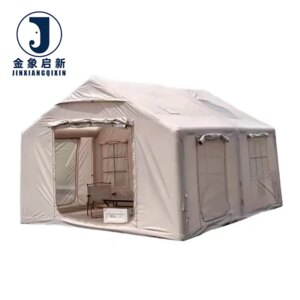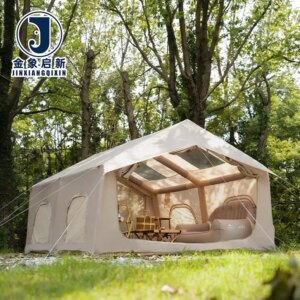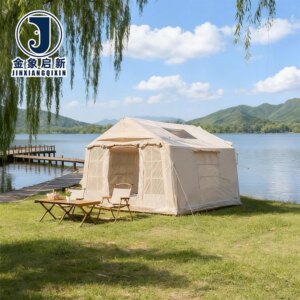
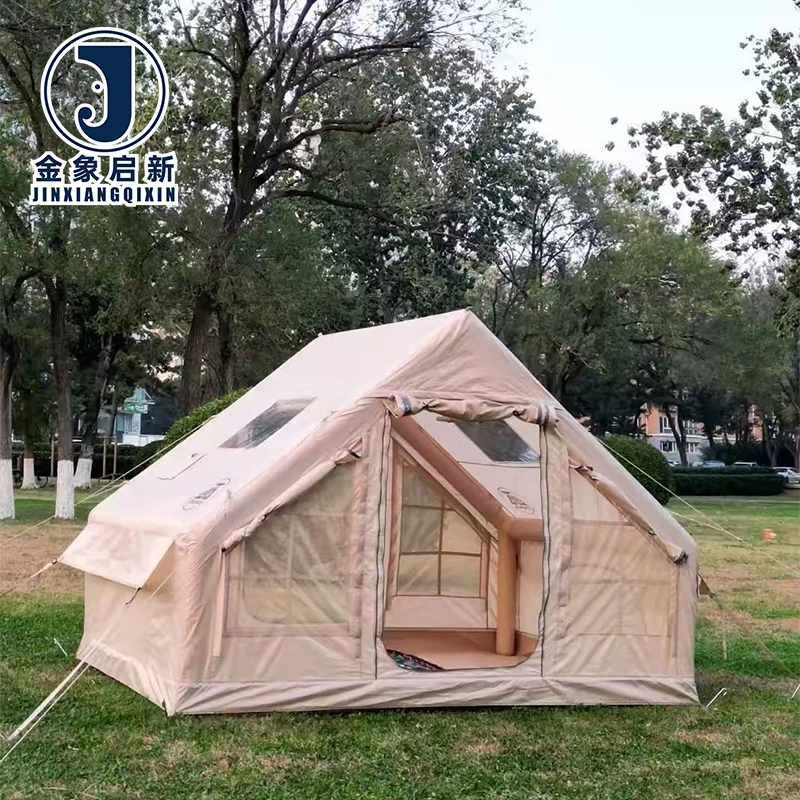
Proven coating expertise — nearly three decades of PVC fabric development applied to inflatable tent membrane and bladder construction, where air retention and repeated inflation cycles demand consistent coating adhesion.
Technical Specifications
| Parameter | Value |
|---|---|
| Product Type | PVC Inflatable Tent |
| Core Material | PVC waterproof coated fabric |
| Product Forms | Automatic opening, four-season design, single layer, extended type |
| UV Resistance | Available with treatment — test basis to be confirmed per order |
| Tear Resistance | Engineered for inflatable stress points (tear-resistant claimed, test standard not stated) |
| Waterproof Rating | Fully coated PVC construction |
| Customization | OEM & ODM, sample customization, pattern printing |
| Production Facility | 9,180 m² with 3 full production lines |
| Processing Equipment | 36 sets of professional equipment |
| R&D Team | 10 technicians |
| Certification | ISO 9001, ISO 14001, ISO 45001, CE |
Application Suitability
| Application | Exposure & Requirement |
|---|---|
| Disaster relief operations | Rapid deployment, prolonged outdoor weathering, structural integrity under wind load |
| Emergency response centers | Immediate shelter requirement, repeated inflation and deflation cycles |
| Construction site shelters | Dust and debris exposure, UV and rain, heavy daily use |
| Temporary storage facilities | Extended outdoor standing, moisture ingress prevention, wind stability |
| Industrial emergency preparedness | Stockpiled for extended periods, reliable inflation on demand |
Why "Tear-Resistant" Means Nothing Without a Test Standard Behind It
Tear resistance on a data sheet only matters when the test method is named and the result is documented.
Inflatable tents place unusual stress on fabric — every inflation cycle loads the material biaxially, and the seams where panels meet experience concentrated peel forces. When a PVC inflatable tent fabric supplier claims tear resistance without referencing ISO 1421, DIN 53354, or an equivalent standard, there is no way to compare that claim against what the structure will actually endure in field conditions. [NEED_CITE: tensile and tear test methods for coated fabrics per ISO 1421]. Procurement teams that accept unstated test bases often discover the gap between quotation and reality only after the first deployment fails.
How PVC Coating Weight and Base Fabric Interact in Inflatable Structures
Selecting the correct PVC inflatable tent fabric requires understanding that coating weight alone does not determine air-holding capability or structural stiffness. A heavier PVC coating on a loosely woven base fabric may seal well but tear easily along the weave, while a tightly woven base with insufficient coating thickness allows air permeability that defeats the purpose of an inflatable bladder. Our material development process evaluates base fabric denier, weave density, and coating method together — not as isolated specifications — so the final fabric performs as a composite system under inflation pressure.
What Four-Season Inflatable Tent Fabric Must Survive
A four-season PVC inflatable tent faces temperature extremes that push coated fabric to its physical boundaries. At low temperatures, PVC becomes progressively stiffer and can crack if folded or handled while cold; at elevated temperatures, the same coating softens and may allow slow air migration through the membrane. [NEED_CITE: PVC glass transition temperature and low-temperature flexibility of plasticised PVC]. The plasticiser formulation and coating adhesion method directly determine whether the fabric maintains a reliable seal across the operating temperature range your deployment environment requires.
Coating Method and Its Effect on Weld Integrity
The way PVC is applied to the base fabric — whether by knife coating, lamination, or calendering — changes how the material behaves when panels are heat-welded together during tent fabrication. Knife-coated PVC typically penetrates the base weave more deeply, creating stronger mechanical anchoring that resists delamination at weld lines. Laminated coatings may offer smoother surfaces but can separate under the repeated flex loading that inflatable tent joints experience. [NEED_CITE: coating adhesion and peel strength testing for welded PVC joints]. When sourcing PVC inflatable tent fabric, requesting the coating method specification alongside GSM allows fabricators to set weld parameters correctly from the first production run.
The Cost of Ignoring Batch Consistency in Inflatable Tent Production
When PVC inflatable tent fabric arrives with visible colour variation between rolls or measurable differences in coating weight, the consequences extend well beyond aesthetics. Panels cut from inconsistent rolls weld at different rates, producing seams that may pass initial pressure testing but fail after weeks of inflation cycles. In emergency deployment scenarios where tents are stockpiled and deployed months after manufacture, batch inconsistency in coating thickness can mean some units inflate reliably while others leak at the seams. [NEED_CITE: batch variation in coating weight affecting weld consistency in PVC fabrication]. Pre-shipment inspection with roll-by-roll weight verification prevents this category of failure from reaching the field.
Why Material Documentation Determines Inflatable Tent Procurement Success
Our R&D team of 10 technicians develops custom inflatable tent PVC inflatable tent fabric specifications with full traceability from base fabric selection through coating application. Each production run on our 36 sets of processing equipment is accompanied by documentation that matches the quoted specification — not a generic product family range. We supply material specification sheets that state the exact coating method and base fabric denier for your batch, so there is no ambiguity between what was approved at sample stage and what arrives on the production floor. Our 10-person R&D team handles pattern printing, size adjustment, and material modification requests with sample turnaround measured in days, not weeks.
Documentation & Verification
- Material specification sheet stating coating method, base fabric denier, and PVC formulation per batch
- Test reports for UV resistance and waterproof performance with stated test basis
- ISO 9001, ISO 14001, ISO 45001, and CE documentation available per order
- Pre-shipment inspection record with batch-specific coating weight verification
- Roll packing list with lot traceability back to coating production date
Fabrication, Handling & Storage
- Heat weld parameters must be adjusted per PVC coating method — confirm knife-coated or laminated before setting temperature
- Store PVC inflatable tent rolls upright to prevent permanent creasing through the coated surface
- Avoid folding four-season PVC fabric at low temperatures where plasticiser stiffness increases crack risk
- Pattern printing adhesion should be validated on sample before full-roll production runs
- Clean PVC-coated surfaces with pH-neutral agents only to preserve waterproof coating integrity
- Extended type tent panels require reinforced weld zones at inflation valve attachment points
What We Need to Quote Your Inflatable Tent Fabric Accurately
Provide the inflation pressure your tent design operates at, the deployment temperature range, and whether the fabric must meet specific fire classification standards in your target market. Specify whether you require rolls for your own fabrication or finished panels, along with colour references and any pattern printing requirements. Annual volume and required roll width allow us to confirm production line allocation and lead time.
Frequently Asked Questions
Q: What base fabric denier and weave options are available for inflatable tent PVC fabric?
A: Our PVC inflatable tent fabric is produced on base fabrics selected to match the inflation pressure and flex requirements of your tent design. Denier and weave density are specified per project based on the tensile and tear loads your structure imposes. Request a material specification sheet that documents the exact base fabric parameters for your batch, rather than selecting from a generic range.
Q: How is UV resistance tested and what test duration or standard is applied?
A: UV resistance is available as a treatment option for our PVC inflatable tent fabric, with the specific test standard and exposure duration confirmed at the inquiry stage. We provide test documentation that states the method applied, so you can verify the claimed performance against the UV exposure conditions your tent will face in its target deployment environment.
Q: What coating method is used and how does it relate to weld strength?
A: Our PVC inflatable tent fabric is produced using coating methods selected for the end-use requirements — the coating penetration depth and surface finish directly influence heat weld parameters and seam peel strength. We document the coating method on the material specification sheet so your fabrication team can set weld temperature and dwell time correctly from the first production run.
Q: Can you provide flame-retardant grades for inflatable tent fabric?
A: Flame-retardant PVC inflatable tent fabric is available — confirm the grade required for your market and application at the inquiry stage. We supply test reports that reference the specific standard applied, so your procurement and compliance teams can verify the fire classification against local building or event safety regulations before production begins.
Q: How do you ensure batch-to-batch consistency in coating weight and colour?
A: Every roll of PVC inflatable tent fabric undergoes coating weight verification and visual colour inspection before dispatch, documented in the pre-shipment inspection record. Our 3 full production lines and dedicated QA process ensure that replacement orders match the original approved sample, so fabrication parameters established during initial production remain valid across subsequent batches.