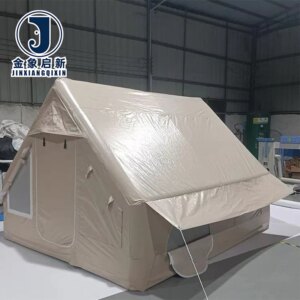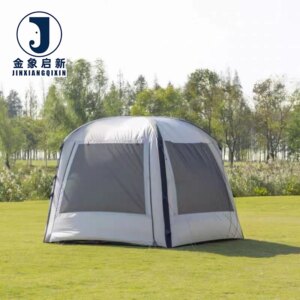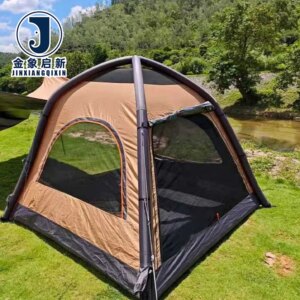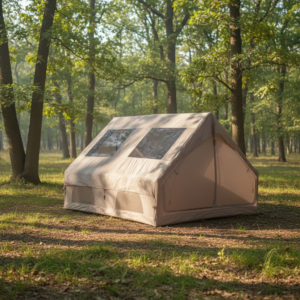
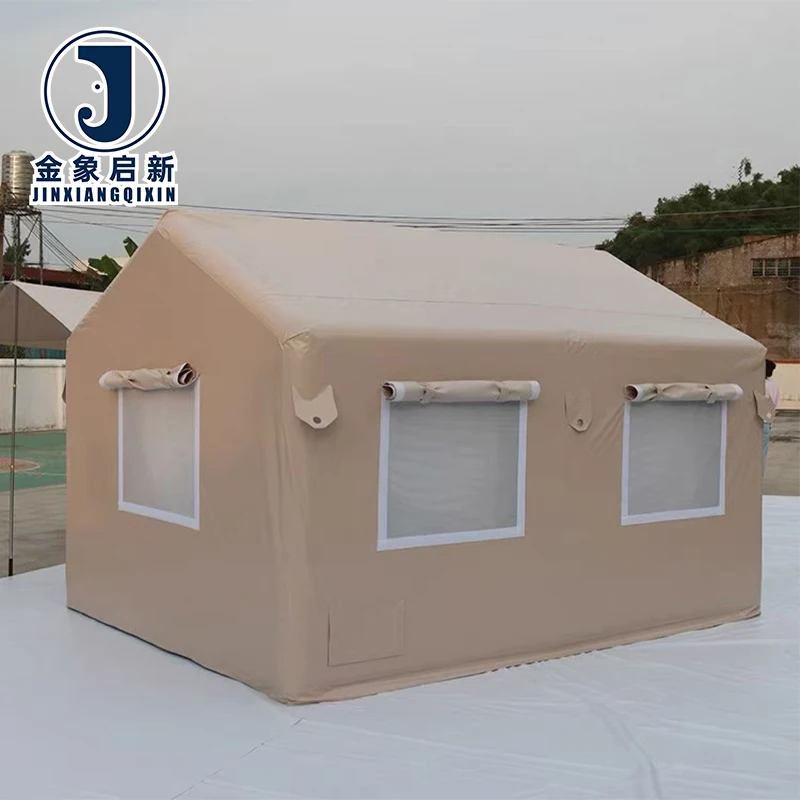
Precision coating control on inflatable shelter fabric — Our 10-person R&D team manages material selection, coating weight, and pattern printing for inflatable tent membranes, backed by full-process QA from base fabric to dispatch.
Technical Specifications
| Parameter | Value |
|---|---|
| Product Type | Inflatable Tent |
| Core Material | PVC Tarpaulin |
| Capacity | 6-8 persons |
| Deployment Feature | Quick Automatic Opening |
| Design | Four-Season, Single Layer Construction, Extended Type |
| Waterproof | Coated waterproof construction |
| UV Treatment | UV-resistant (test basis not stated in source) |
| Flame Retardant Grade | Grade not stated in source |
| Anti-Static | Not stated in source |
| Tear Resistance | Tear-resistant (test standard not stated in source) |
| Customization Service | OEM & ODM (material selection, design, pattern printing) |
| Production Facility Area | 9,180 square meters |
| Production Lines | 3 full production lines |
| Processing Equipment | 36 sets of professional equipment |
| R&D Team Scale | 10 technicians |
| Quality Control System | Full-process inspection with dedicated QA & QC staff |
| Standards | ISO 9001, ISO 14001, ISO 45001, CE |
Application Suitability
| Application | Exposure & Requirement |
|---|---|
| Emergency response command centers | Rapid inflation cycles, high wind loading, continuous UV and rain exposure |
| Remote construction site offices | Abrasive dust, equipment contact, temperature extremes across four seasons |
| Equipment storage in remote areas | Prolonged sun exposure, puncture risk from stored machinery, moisture ingress |
| Temporary warehousing at logistics hubs | Forklift proximity abrasion, repeated inflation and deflation, wind uplift forces |
| Disaster recovery shelters | Immediate deployment pressure, ground moisture, multi-day continuous occupation |
Why "Waterproof" and "UV-Resistant" Mean Nothing Without a Test Report
When procurement teams source PVC inflatable tent material for emergency shelters, supplier claims about waterproofing and UV resistance frequently arrive without any test documentation to verify them. This gap between marketing language and measurable performance is where field failures originate.
The only reliable way to confirm performance is to require the test report before production begins, not after delivery.
Inflatable shelter membranes operate under constant internal pressure, meaning any coating inconsistency or base fabric weakness becomes a failure point within days, not months. A fabric that passes a hydrostatic head test at the coating stage but fails at the welded seams will still leak in the field. Similarly, UV resistance claimed without a test basis leaves buyers exposed when the membrane surface chalks or embrittles after a single season of deployment [NEED_CITE: UV degradation test methods for PVC coated fabrics]. Our approach is to state what we can document and ask buyers to confirm the specific grades their market requires — rather than imply performance we have not measured.
How Base Fabric and Coating Weight Determine Membrane Integrity
The performance of any PVC inflatable tent material starts with the relationship between base fabric denier and coating weight. A high-denier yarn woven at tight density provides the tensile backbone, while the PVC coating fills the weave and creates the airtight barrier. When coating weight is too light relative to the base fabric, the membrane flexes but the coating micro-cracks under inflation pressure. When coating weight is excessive, the fabric becomes stiff and resists the rapid unfolding required during automatic opening.
Our production process controls coating application across all three lines, ensuring the PVC inflatable tent material maintains consistent weight from the first roll to the last. This consistency matters most when multiple panels are welded together to form a single inflatable chamber — thickness variation between panels causes uneven inflation and stress concentration at the seams.
Seam Welding Integrity Under Inflation Pressure
Every inflatable shelter depends on welded seams holding under continuous internal pressure. The weld must bond coating to coating without degrading the base fabric underneath. On our 36 sets of professional processing equipment, heat and pressure parameters are set specifically for the PVC formulation used in inflatable membranes, ensuring the weld zone achieves peel strength that matches or exceeds the parent material [NEED_CITE: weld peel strength testing per ISO 1421].
A seam that fails before the fabric does is almost always traceable to incorrect welding temperature or speed. For inflatable structures, this failure mode is critical because the entire shelter deflates when a single chamber seam ruptures. Our QA protocol includes pressure testing and dimensional verification on each unit before dispatch, catching weld weaknesses that visual inspection alone cannot detect.
Understanding the Specification Variables That Matter
GSM (grams per square metre) is the most quoted specification in coated fabric procurement, but it is incomplete without understanding what contributes to that weight. A PVC inflatable tent material can reach a given GSM through heavy base fabric, thick coating, or a combination of both — and each approach produces different performance characteristics. Heavy base fabric delivers higher tensile and tear strength but reduces flexibility, which affects how quickly the shelter inflates and how compactly it folds for transport.
The coating method — whether knife-over-roll, dip, or calender — determines how deeply the PVC penetrates the weave. Deeper penetration improves adhesion and airtightness but can stiffen the hand feel. For inflatable shelters requiring rapid automatic opening, flexibility and coating adhesion must be balanced precisely, which is where our R&D team’s material selection capability becomes relevant to buyers specifying custom inflatable membranes.
Surface finish also plays a functional role. A glossy finish sheds dirt and water more effectively, while a matte finish reduces glare and improves print adhesion for branding or identification markings applied to the shelter exterior.
What Happens When Material Specifications Are Wrong
Selecting PVC inflatable tent material based on price-per-roll without verifying coating weight or base fabric denier leads to predictable field outcomes. Under-coated membranes develop pinhole leaks within the first inflation cycle. Base fabric with insufficient denier tears at the eyelet or anchor points when wind loads transfer through the shelter structure. Welded seams on fabric with inconsistent coating thickness peel apart because the heat-seal parameters cannot accommodate the variation.
Batch colour inconsistency across rolls used in the same shelter creates visible panel differences once the structure is inflated and viewed in daylight [NEED_CITE: colour consistency standards in coated fabric production]. For emergency shelters deployed in high-visibility disaster response scenarios, this is not merely cosmetic — it signals inconsistent material sourcing to the end user. The hidden cost is never the fabric itself; it is the replacement, re-deployment, and reputational damage that follows.
Why Industrial Buyers Source Inflatable Shelter Fabric Here
Our 9,180 square metre facility runs three dedicated production lines, giving us the capacity to fulfil bulk inflatable membrane orders without compressing lead times or sacrificing process control. Each line is equipped with coating and welding machinery specifically maintained for PVC tarpaulin production, ensuring consistent output quality across large-volume runs.
The 10-technician R&D team handles material selection, custom sizing, and pattern printing development directly — buyers communicate with the people who set the coating parameters, not a sales intermediary. Sample development for custom inflatable shelter requirements is completed within days, allowing buyers to evaluate material hand, weld behaviour, and inflation response before committing to production volumes.
Full-process inspection runs from incoming base fabric verification through coating weight checks to final pressure testing of inflatable units. Every PVC inflatable tent material roll and finished shelter is inspected by dedicated QA and QC staff before dispatch, with pre-shipment inspection records provided as part of the documentation package.
Documentation & Verification
- Material specification sheet stating base fabric denier, coating weight, and GSM for each inflatable membrane roll
- Test reports for UV resistance and flame retardant grade where applicable to the destination market
- Pre-shipment pressure test and dimensional verification records for each inflatable unit
- ISO 9001, ISO 14001, ISO 45001, and CE certificates included with shipment documentation
- Certificate of origin and customs support documentation for international dispatch
- Roll packing list with batch traceability from production to delivery
Fabrication, Handling & Storage
- Welding temperature and speed must match the specific PVC formulation — request our recommended parameters for inflatable membrane seams
- Store PVC tarpaulin rolls upright on pallets to prevent flat-spot deformation that affects inflation uniformity
- Avoid folding inflatable shelter panels at sharp creases; roll loosely for transport to preserve coating integrity
- Clean membrane surfaces with mild detergent only — solvents degrade the PVC coating and compromise airtightness
- Repair minor punctures with compatible PVC patch material heat-welded at manufacturer-specified temperature
- Allow fabric to reach ambient temperature before unrolling in cold conditions to prevent coating crack damage
What We Need to Prepare Your Quotation
To provide an accurate specification and sample for your inflatable shelter project, please share the intended deployment environment and expected inflation frequency. If your market requires specific flame retardant grades or anti-static certification, confirm the standard that applies at the destination. Let us know whether you need finished inflatable units or PVC tarpaulin rolls for your own fabrication, along with any colour or pattern printing requirements.
Frequently Asked Questions
Q: How do I verify PVC coating weight and base fabric denier on arrival for inflatable structures?
A: We provide a material specification sheet with every shipment stating base fabric denier, coating weight, and GSM. On receipt, you can cross-check by cutting a measured sample and weighing it against the stated GSM. For coating weight separation, a lab peel test distinguishes coating from base fabric mass, confirming the coating was applied to the agreed specification.
Q: What test basis supports the UV-resistant claim on inflatable shelter fabric?
A: UV resistance is available as a treatment option on our PVC inflatable tent material, but the specific test standard applicable depends on your market requirements. We recommend confirming the UV test method your region accepts — such as ISO 4892 or ASTM G154 — so we can supply the matching test report. Without this alignment, the claim remains unverified for your compliance documentation.
Q: What flame retardant grades are available for inflatable tents in different regional markets?
A: Flame retardant treatment is available in multiple grades, and the required classification varies by market — European buyers typically need EN 13501-1 or DIN 4102 B1, while other regions may specify NFPA 701 or local equivalents. Confirm the grade required for your destination before ordering so we can supply the PVC inflatable tent material with the correct formulation and matching test documentation.
Q: How is airtight seam welding quality verified during inflatable shelter production?
A: Each welded seam on our inflatable shelters undergoes visual inspection and pressure testing before the unit is cleared for dispatch. Our QA team checks weld peel strength against the parent material specification, and dimensional verification confirms the inflated chamber holds its designed shape. Pre-shipment inspection records documenting these checks are included with every order.
Q: What customisation options exist for inflatable shelter fabric regarding sizing, colour, and printing?
A: Our OEM and ODM service covers custom dimensions, colour specifications, and pattern printing for inflatable shelter fabric. The 10-technician R&D team develops samples within days, allowing you to approve material hand, colour accuracy, and print registration before mass production begins. Custom width and length are produced on our three full production lines with batch consistency maintained across the entire order.