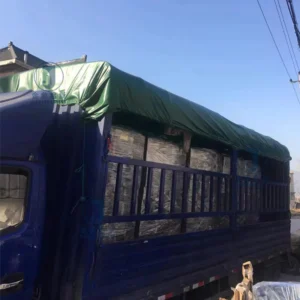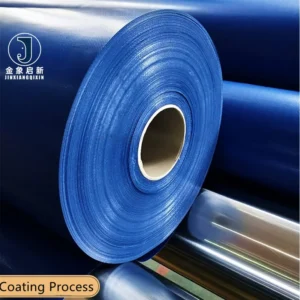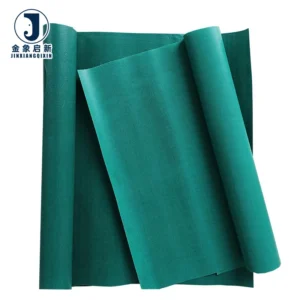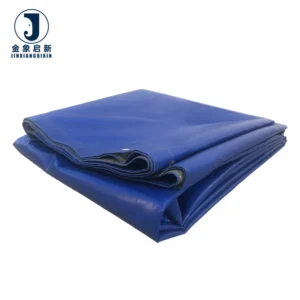
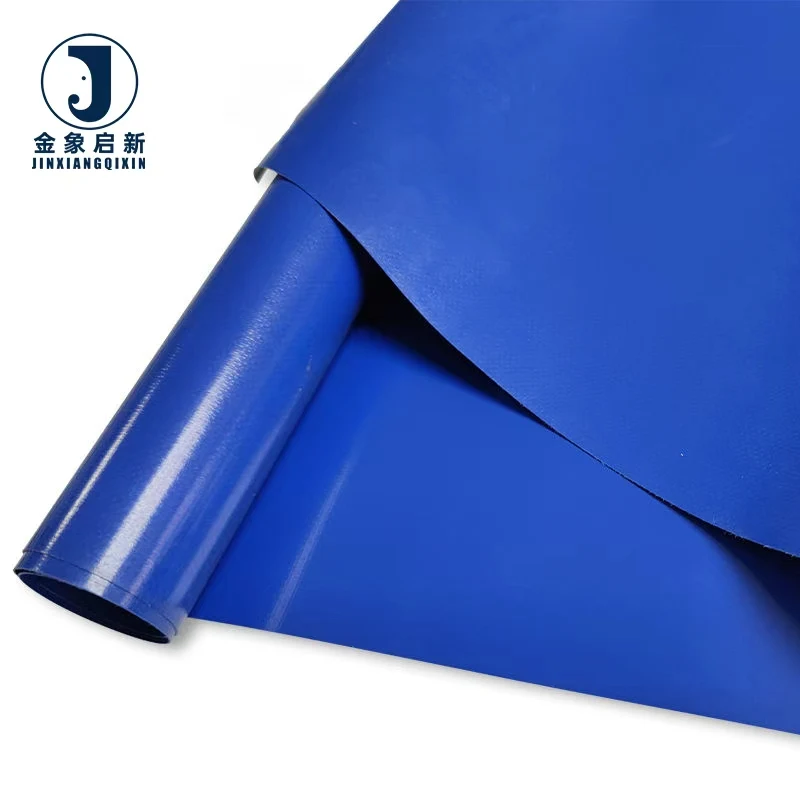
Coating weight precision — Three full production lines and 36 sets of professional equipment deliver repeatable PVC adhesion and consistent GSM across every roll of PVC coated tarpaulin fabric.
Technical Specifications
| Parameter | Value |
|---|---|
| Product Type | PVC Coated Tarpaulin Fabric Roll |
| Base Fabric Denier | 500D, 1000D, or 500D–2000D |
| Weight (GSM) | 400–500 g/m², 700–1000 g/m², or 1100–1500 g/m² |
| Total Thickness | 0.35–0.45 mm, 0.70–1.0 mm, or 1.2–1.5 mm |
| Tensile Strength (N/5cm) | Warp 1500–2000 / Weft 1200–1800 (medium); Warp 2000–2500 / Weft 1800–2200 (heavy-duty); Warp 2500–3000 / Weft 2200–2800 (super heavy) |
| Roll Width | 6 ft, 8 ft, 10 ft, 12 ft, 2 m, 4 m, or 6 m |
| Roll Length | 100 yards, 100 meters, or custom |
| Coating Material | PVC |
| Color | Blue, Blue/Orange, Green, Grey, Black, Clear, Grey/Green, Orange, or custom |
| UV Treatment | Available — confirm the test basis required for your market |
| Flame Retardant Grade | Available — confirm the grade required for your market |
| Waterproof | Yes |
| Anti-Mildew | Yes |
| Coating Process | 100% PES dipping coating available for vinyl-coated polyester mesh |
| Key Features | Tear resistant, washable, mildew proof, anti-aging |
| Certification | ISO, CE |
Application Suitability
| Application | Exposure & Requirement |
|---|---|
| Truck side curtain | Constant flexing, road abrasion, UV exposure, weld seam integrity at load points |
| Tensioned structural fabric | Sustained wind load, UV degradation, tensile stress across wide spans |
| Industrial pipe canopy | Water ingress, chemical contact, puncture from equipment handling |
| Engineering protective cloth | Abrasion from aggregate and machinery, weather exposure during construction |
| Tent and awning fabric | Repeated fold/unfold cycles, UV exposure, colour retention over seasons |
| Lumber and steel tarps | Heavy load abrasion, tie-down tension, puncture from sharp edges |
Why Tensile Data Matters More Than GSM Alone for PVC Coated Tarpaulin Fabric
A roll that weighs the right number of grams can still fail at the weld line if the base fabric denier and weave density are not engineered to carry the load.
Technical buyers often receive a quotation stating a target GSM, only to find that the delivered material shows lower tensile values at the seam or weld point where the load flexes most. The weight of the PVC coating accounts for a significant portion of total GSM, but the coating does not carry tensile load — the base fabric does. When base fabric denier is underspecified relative to the coating weight, the result is a material that passes incoming weight inspection yet tears prematurely under working tension [NEED_CITE: tensile and tear test methods for coated fabrics per ISO 1421].
How Base Fabric Denier Drives Load Performance
The PVC coated tarpaulin fabric roll range is structured so that each GSM band is paired with a corresponding denier grade. The 400–500 g/m² grades use 500D base fabric, the 700–1000 g/m² grades move to 1000D, and the 1100–1500 g/m² grades reach 2000D. This pairing ensures that as total weight increases, the underlying yarn structure scales proportionally rather than relying on thicker PVC coating to hit the target GSM.
For fabricators welding panels into truck side curtains or tensioned structures, the denier grade determines how much load the base fabric carries before the PVC layer begins to stretch and crack. A 1000D base at 700 g/m² will hold a welded seam longer than a 500D base at the same GSM because the yarn structure absorbs the flex energy rather than transferring it entirely to the coating.
Coating Process and Adhesion Consistency
The PVC dipping and coating process bonds the coating layer to the base fabric through full penetration, producing consistent adhesion between the PVC and the polyester yarn. For vinyl-coated polyester mesh variants, the 100% PES dipping coating is applied over knitting or plain weave construction, which creates a fully encapsulated yarn that resists delamination under repeated flexing [NEED_CITE: coating adhesion test methods for PVC coated fabrics].
This matters most at welded seams. When a heat weld melts through the PVC layer to fuse two panels, the seam strength depends on how tightly the coating is bonded to the base fabric. Poor adhesion means the coating peels away from the yarn at the weld edge, creating a failure point that propagates under load. The dipping process produces higher adhesion values compared to surface-only coating methods, making it the preferred choice for applications where welded seams must carry structural load.
Reading the Tensile Data Across Weight Grades
The tensile strength figures are provided in both warp and weft directions for every grade, measured per 5 cm strip width. Across the range, warp strength scales from 1500 N/5cm at the 500D medium grade up to 3000 N/5cm at the 2000D super heavy grade. Weft values follow a similar progression from 1200 N/5cm to 2800 N/5cm.
For a fabricator calculating panel dimensions and weld spacing on a tensioned membrane structure, these directional values determine the maximum span between support points. Warp and weft are rarely equal because the weaving process produces higher density in the warp direction. When panels are cut on the bias or installed with the weft direction carrying the primary load, the lower weft tensile value governs the design — and specifying on warp strength alone would overestimate the working capacity of the material.
The Hidden Cost of Specifying on Thickness Instead of Denier
A common specification error is selecting PVC coated tarpaulin fabric based on total thickness in millimetres without verifying the underlying denier and GSM. Two rolls can measure the same thickness yet have very different base fabric constructions — one with high denier and thin coating, another with low denier and thick coating. The thicker-coated, lower-denier option will show equivalent GSM on a weight check but will fail earlier at flex points because the PVC layer absorbs more deformation energy than the base yarn can recover [NEED_CITE: relationship between denier count and tear propagation in coated fabrics].
Colour inconsistency across rolls in a single order is another specification failure that becomes visible only after installation. When one roll was produced in a different coating batch, the colour shift between adjacent panels is immediately apparent on a truck trailer or building facade. Batch-to-batch colour verification during production and before shipment prevents this visible defect from reaching the job site.
Why Source PVC Coated Tarpaulin Fabric from This Production Line
Deep process control over PVC coating weight and adhesion is maintained across three full production lines, with dedicated QA/QC at every stage from base fabric inspection through coating, winding and packing.
The 10-person R&D team handles material selection, custom GSM and denier matching, pattern printing and sample development — with samples produced within days for custom requirements. This allows fabricators to validate weld parameters and seam strength before committing to a full production run.
Roll-to-roll colour consistency is verified before shipment, with 100% pre-shipment inspection including GSM spot-checks to confirm that the delivered weight matches the quoted specification. Every roll is checked, not just sampled.
ISO and CE certified production supports export documentation across North American, European and Asian markets, with customs documentation and certificates of origin prepared as part of the standard dispatch process.
Documentation & Verification
- Material specification sheet stating GSM, base fabric denier and coating weight for every roll shipped
- Test report for UV resistance and flame retardant grades supplied where applicable — not just a data sheet claim
- Pre-shipment inspection record with GSM spot-check results confirming quoted weight
- Roll packing list with colour reference, roll dimensions and batch identification for traceability
- Certificate of origin and ISO/CE documentation supporting customs clearance in destination market
Fabrication, Handling & Storage
- Heat weld parameters should be adjusted for coating thickness — 0.35–0.45 mm and 1.2–1.5 mm grades require different temperature and dwell settings
- Galvanised eyelets must be set through reinforced hem areas where the PVC coating is backed by folded base fabric, not through single-layer material
- Store rolls upright on cores to prevent flat-spotting and creasing that can damage the PVC coating layer permanently
- Allow rolls to acclimatise to workshop temperature before unrolling — cold PVC coating is brittle and cracks when flexed
- Clean with mild detergent only; solvent-based cleaners degrade the PVC coating surface and reduce weld adhesion
- Cut panels with the warp direction aligned to the primary load path to use the higher tensile strength axis
What to Include in Your Next Enquiry
To receive an accurate specification recommendation, provide the application type, expected load direction and working tension, and the environmental exposure conditions including UV and flame retardant requirements for your market. Confirm whether you need roll stock in specific widths and lengths or finished tarpaulin panels with eyelets and reinforced hems. If colour matching across multiple rolls is critical for your installation, state the Pantone or RAL reference and the total roll quantity in the order.
Frequently Asked Questions
Q: How does base fabric denier relate to GSM and tensile strength?
A: Denier determines the yarn thickness in the base fabric. Higher denier yarns produce higher tensile and tear values. In this range, 500D pairs with 400–500 g/m², 1000D with 700–1000 g/m², and up to 2000D with 1100–1500 g/m². GSM alone does not guarantee strength — the base fabric construction must be verified alongside the total weight.
Q: What coating process is used, and how does it affect weld performance?
A: The standard PVC coating process penetrates the base fabric for strong adhesion. For vinyl-coated polyester mesh, a 100% PES dipping coating is applied over knitting or plain weave construction. Both methods produce bonded coating layers that resist delamination at heat-welded seams, which is critical for structural and truck curtain applications.
Q: Can I get test reports for UV and flame retardant performance?
A: Test reports for UV resistance and flame retardant grades are supplied where applicable with each shipment. Confirm the specific grade or test standard required for your market and application before production, so the correct treatment is applied and documented.
Q: How is colour consistency maintained across multiple rolls?
A: Colour matching is verified between rolls during production and again at pre-shipment inspection. If your installation places panels side by side — on a truck trailer or building facade — state the colour reference and roll quantity so batch consistency is prioritised throughout the production run.
Q: Which denier grade suits truck side curtains versus static covers?
A: Truck side curtains experience constant flexing and road abrasion, typically requiring 1000D or higher at 700+ g/m² for weld seam durability. Static engineering covers with lower flex demand can use 500D at 400–500 g/m². The tensile data for each grade is available to help match your specific load and span requirements.