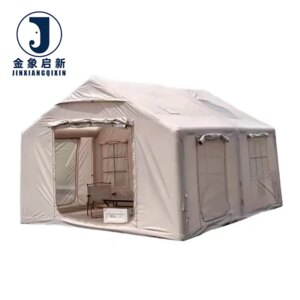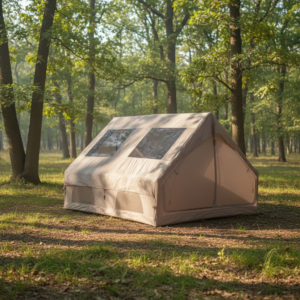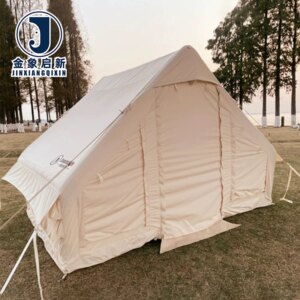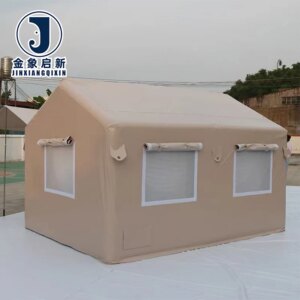
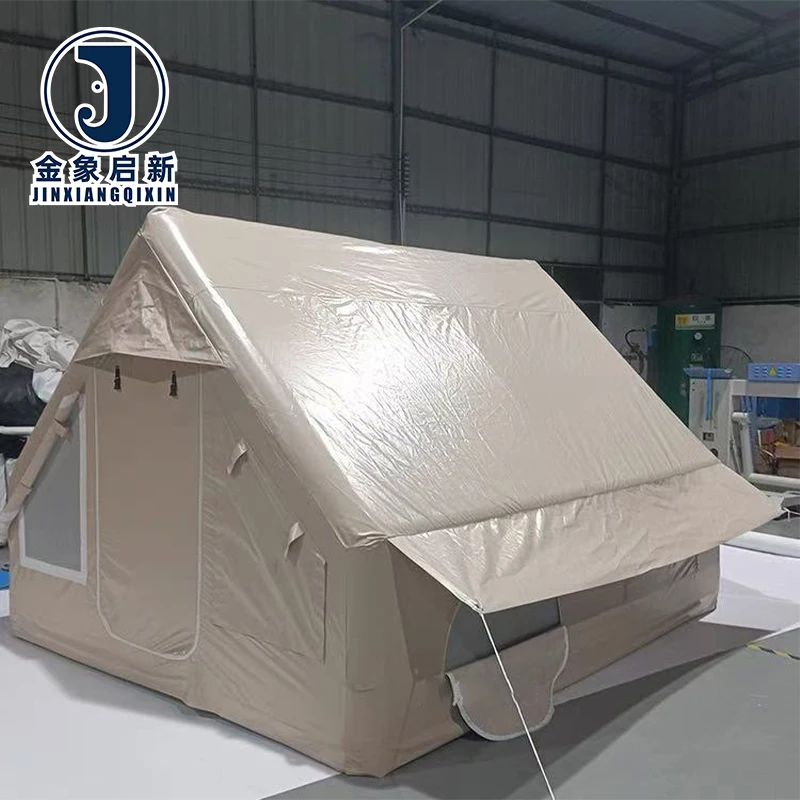
Coating Adhesion Control — Three full production lines maintain consistent coating weight and bond strength across every roll of PVC inflatable tent fabric we produce.
Technical Specifications
| Parameter | Value |
|---|---|
| Product Type | Inflatable Tent |
| Core Material | PVC tarpaulin |
| Key Performance | Waterproof, UV-resistant (test basis not stated in source), tear-resistant, fire-retardant (grade not stated in source), anti-static (standard not stated in source) |
| Capacity | 5-8 Person |
| Feature | Quick automatic opening, all-season outdoor use |
| Customization Service | OEM & ODM, sample customization, pattern printing |
| Production Lines | 3 full production lines |
| Processing Equipment | 36 sets of professional processing equipment |
| R&D Team | 10 technicians |
| Certifications | ISO9001, ISO14001, ISO45001, CE |
Application Suitability
| Application | Exposure & Requirement |
|---|---|
| Temporary site accommodation for construction crews | Continuous weather exposure, wind loading on inflatable beams, ground moisture contact, repeated inflation cycles |
| Mobile field operations bases for engineering teams | Remote deployment, rapid setup and teardown, UV exposure during extended occupancy, transport abrasion |
| Emergency response shelters for industrial disaster management | Immediate deployment under pressure, variable weather, visibility and branding requirements, regulatory compliance |
| Resource exploration base camps | Prolonged outdoor exposure in harsh climates, thermal fluctuation, high wind resistance on air-beam frames |
| Large-scale event management structures | High foot traffic, repeated assembly cycles, aesthetic finish requirements, fire safety compliance for public occupancy |
Why Coated Fabric Consistency Matters More Than Stated Weight for Inflatable Tents
GSM alone does not determine whether an inflatable tent air-beam will hold pressure through its service life — coating adhesion and base fabric construction are equally critical.
When sourcing PVC inflatable tent material, buyers often focus on grams per square metre as the single measure of quality. In practice, a fabric with the correct stated weight but poor coating-to-yarn bond will delaminate at the heat-welded seams where air-beam flex concentrates. The inflatable structure loses pressure, the tent sags, and the field crew faces an unplanned teardown [NEED_CITE: tensile and tear test methods for coated fabrics per ISO 1421]. We have seen coated rolls pass incoming weight inspection yet fail at the weld interface because the coating formulation was not matched to the thermal profile of the fabrication process.
Coating Formulation and Air-Beam Structural Integrity
The PVC coating applied to inflatable tent fabric must achieve a specific balance between flexibility and rigidity. Too soft a formulation and the air-beam walls deform under internal pressure; too rigid and the fabric cracks at fold lines during packing and transport. Our process controls coating weight and adhesion strength at each production stage, ensuring the PVC Inflatable Tent fabric you receive performs consistently when fabricated into pressurised beam structures. This control extends across the full roll length, so the first metre and the last metre behave identically under heat welding.
Fire-Retardant and Anti-Static Treatment for Industrial Compliance
Inflatable tents used on construction sites, mining operations, and public event venues face fire safety scrutiny that generic camping tents never encounter. We offer PVC inflatable tent fabric in fire-retardant grades — confirm the grade required for your market and application before ordering. Anti-static treatment is also available where electrostatic discharge poses a risk to sensitive equipment housed inside the structure. Each treatment option is documented with the applicable test report so your compliance submission is supported by evidence, not a claim on a data sheet [NEED_CITE: DIN 4102 fire classification for building materials].
Reading Beyond the GSM Number on Your Quotation
GSM tells you how much material is present per square metre, but it does not tell you how that material is distributed between base fabric and coating. A PVC-coated fabric can reach the same GSM through a heavier coating on a lighter base yarn, or through a denser weave with a thinner coating layer. For inflatable tent air-beams, the base fabric denier and weave density govern tear propagation resistance — the force required to stop a small puncture from splitting the beam open. The coating weight governs abrasion resistance and waterproofing. Understanding this split lets you specify intelligently rather than relying on a single headline number. The surface finish — whether glossy or matte — also affects how the fabric handles dirt accumulation and how well printed branding adheres during the tent’s working life.
The Hidden Cost of Specifying on Price Alone
When an inflatable tent manufacturer selects coated fabric based purely on the lowest per-kilogram cost, the consequences surface in the field. Rolls that arrive lighter than the quoted GSM force the fabricator to use more material per tent, eroding the margin the cheap price promised. Colour variation between rolls in the same shipment becomes visible once panels are joined side by side on the finished tent, triggering rejection from brand-conscious event clients. Heat-welded seams that fail before the fabric body does leave the inflatable structure deflated at the worst possible moment [NEED_CITE: common failure modes in heat-welded PVC tarpaulin seams]. These are not rare occurrences — they are predictable outcomes of specifying without verification.
Why Technical Buyers Source PVC Inflatable Tent Fabric Here
Our 10-person R&D team works directly with inflatable tent manufacturers to match coating formulation to the specific thermal and mechanical demands of air-beam fabrication. Three full production lines and 36 sets of professional equipment give us the capacity to fulfil roll-stock orders at volume while maintaining batch-to-batch consistency. Dedicated QA/QC inspection at every production stage means coating weight, adhesion strength, and colour are verified before any roll leaves the facility. Samples for custom width, colour, or pattern printing are developed within days, letting you validate material behaviour on your own welding equipment before committing to a production run. Full documentation — from material specification sheets to pre-shipment inspection records — accompanies every dispatch.
Documentation & Verification
- Material specification sheet stating GSM, base fabric denier, and coating type for each roll
- UV and fire-retardant test reports provided for grades where applicable to your market
- Pre-shipment inspection record confirming coating weight and colour against your approved sample
- ISO9001, ISO14001, ISO45001, and CE certificates included for compliance verification
- Batch quality inspection report linking every roll to its production run data
Fabrication, Handling & Storage
- Heat-weld temperature and dwell time must match the PVC coating formulation — request our welding parameter guide
- Store rolls horizontally on pallets to prevent permanent creasing of the coated surface
- Allow cold-stored rolls to reach ambient temperature before unrolling to avoid coating micro-cracking
- Use compatible PVC adhesive for field repair patches on punctured air-beam sections
- Pattern printing should be tested on a sample swatch to confirm ink adhesion to the specific surface finish
Before You Request a Quote
To give you an accurate material recommendation, we need to understand your inflatable tent design and end-use environment. Share the air-beam diameter and operating pressure so we can advise on base fabric denier and coating weight. Tell us the fire safety classification your target market requires, and whether anti-static treatment is needed for the intended application. If you need custom roll width or pattern printing, provide your cutting layout so we can optimise the specification for minimum waste.
Frequently Asked Questions
Q: How can I verify the GSM of inflatable tent fabric when the rolls arrive?
A: We include a pre-shipment inspection record with every order showing measured coating weight per roll. On receipt, cut a measured sample from the roll end, weigh it on a calibrated scale, and compare against the stated value. Any discrepancy beyond normal tolerance should be flagged before fabrication begins so we can resolve it immediately.
Q: What fire-retardant grades are available for inflatable tent material?
A: We supply PVC inflatable tent fabric in fire-retardant grades suited to industrial and public occupancy applications. The specific grade must align with the fire safety code in your target market. Share your regulatory requirement with us during the inquiry stage, and we will provide the matching test report with your sample and documentation package.
Q: How is UV resistance tested and what outdoor exposure can I expect?
A: UV-resistant formulation is available for PVC inflatable tent fabric intended for prolonged outdoor deployment. The test basis and exposure classification depend on the specific additive package selected. Request the UV test report for your chosen grade to review the exposure data and confirm suitability for your climate and expected service duration.
Q: Can I order custom roll widths and printed branding for tent production?
A: Yes. We offer custom roll width, colour matching, and pattern printing for inflatable tent manufacturers. Provide your cutting layout and artwork files during the sampling phase so we can develop a roll specification that minimises off-cut waste and ensures print registration accuracy across the full production run.
Q: What is the recommended heat-welding approach for inflatable air-beam seams?
A: Heat-welding parameters — temperature, pressure, and dwell time — must match the specific PVC coating formulation on your fabric. We provide a welding parameter guide with every material order. Run test welds on sample pieces before production to confirm seam peel strength meets your air-beam pressure requirement.