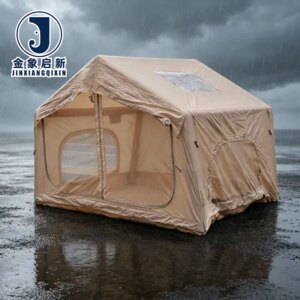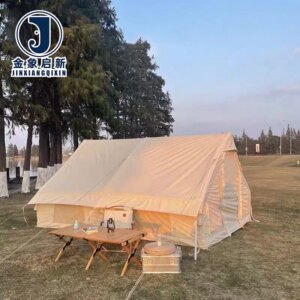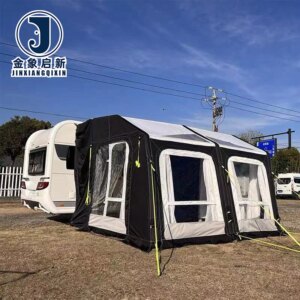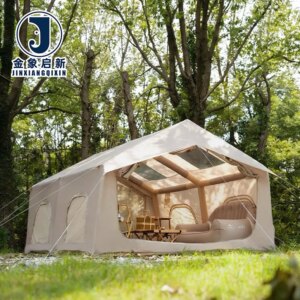
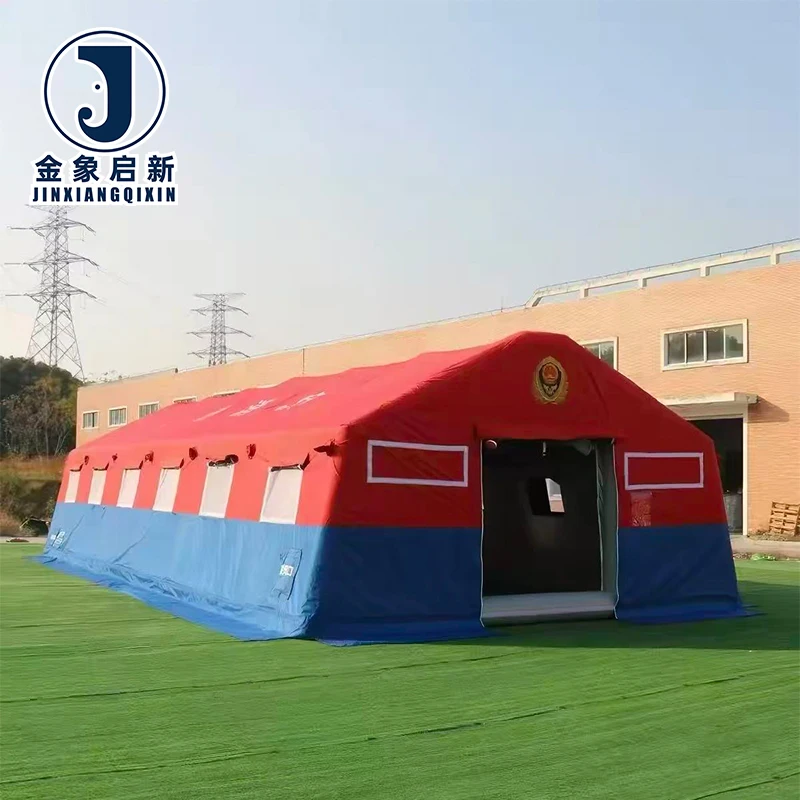
Deep Process Control — coating weight and adhesion consistency are verified at every production stage, ensuring the PVC tarpaulin used in inflatable tent structures meets structural integrity requirements from roll to finished deployment.
Technical Specifications
| Parameter | Value |
|---|---|
| Product Type | Inflatable Tent Fabric |
| Core Material | PVC Tarpaulin |
| Construction | Single Layer |
| Waterproof Rating | 3000mm |
| Design Classification | Four-Season, Extended Type |
| Opening Mechanism | Quick Automatic Opening |
| Customization Service | OEM & ODM |
| Quality Control | Full-Process Inspection with Dedicated QA&QC Staff |
| Standards | CE, ISO9001, ISO14001, ISO45001 |
Application Suitability
| Application | Exposure & Requirement |
|---|---|
| Disaster relief shelters | Rapid deployment, continuous weather exposure, waterproof integrity under wind-driven rain |
| Temporary storage facilities at construction sites | UV exposure, dust ingress prevention, puncture resistance from site debris |
| Mobile command centers for infrastructure projects | Frequent inflation and deflation cycles, material fatigue at fold and weld lines |
| Emergency response units for utility maintenance | Short-notice setup, variable terrain contact, temperature fluctuations |
| Industrial and commercial outdoor deployments | Prolonged solar exposure, structural load from inflation pressure, abrasion at ground contact points |
Why Inflatable Tent Fabric Demands More Than a Quoted GSM
Coating adhesion and heat-weld compatibility matter as much as base fabric weight when the structure holds air pressure.
Inflatable tents place unique stress on coated fabric. The material must maintain airtight seals along welded seams while resisting the outward force of continuous inflation. When coating adhesion is inconsistent, seams separate under pressure long before the base fabric reaches its tensile limit. [NEED_CITE: peel strength and weld compatibility testing for inflatable membrane structures per ISO 2411] Technical buyers specifying Inflatable Tent Fabric material PVC coated often discover that a heavier GSM does not compensate for poor coating-to-yarn bonding — the failure mode shifts from fabric tear to delamination at the heat-weld line.
Coating Formulation and Structural Air Retention
The PVC tarpaulin used for inflatable tent manufacturing requires a coating formulation that supports high-frequency heat welding without burning through or leaving brittle edges. Single-layer construction demands that the coating carries both the waterproof barrier and the structural welding surface. Inflatable Tent Fabric material PVC coated for this application must balance plasticiser content so the material remains flexible during cold-weather deployment while holding seam integrity under sustained inflation pressure across temperature variations.
Four-Season Material Stability Under Field Conditions
A four-season classification means the PVC formulation resists softening at elevated temperatures and avoids embrittlement in cold environments — both critical for inflatable structures that rely on consistent material stiffness to hold shape. UV-resistant additives are incorporated into the PVC compound to address prolonged solar exposure on disaster relief and construction site deployments. [NEED_CITE: accelerated weathering test methods for PVC coated fabrics] The single-layer design reduces overall weight, improving transport efficiency and inflation speed while still meeting the 3000mm waterproof rating required for emergency and industrial shelter use.
Reading the Specification Sheet Beyond Weight
Three parameters interact to define real-world performance of Inflatable Tent Fabric material PVC coated for inflatable structures. First, the base fabric denier and weave density determine how tears propagate — a tighter weave arrests tear spread before it reaches a structural seam. Second, the coating method — whether knife-over-roll, lamination, or calendering — governs peel strength, which directly predicts whether heat-welded seams survive repeated inflation cycles. Third, the waterproof rating of 3000mm reflects hydrostatic pressure resistance, but field performance also depends on seam construction and surface treatment. A glossy finish sheds water faster and resists dirt adhesion, which matters for shelters deployed across multiple emergency rotations.
The Hidden Cost of Specifying on Price Per Square Metre Alone
When procurement teams select inflatable tent fabric based on the lowest quoted rate per square metre, the first failure point is almost always the heat-welded seam. Under-coated material lacks sufficient PVC thickness to form a proper fusion weld, so seams leak air within days of inflation. [NEED_CITE: coating weight verification methods and field failure correlation for welded PVC structures] Batch-to-batch colour variation becomes visible when multiple tent units are deployed side by side on a disaster relief site — forcing replacement of entire panels rather than isolated sections. These are not manufacturing defects but specification errors: the quoted material lacked the coating depth and colour consistency controls needed for inflatable structure fabrication.
What This Supply Chain Delivers for Inflatable Fabric Buyers
Three full production lines and 36 sets of professional equipment support the volume consistency required when fabricators order PVC tarpaulin by the roll for inflatable tent manufacturing. A 10-person R&D team handles material formulation adjustments, custom width and colour development, and sample runs so buyers can verify heat-weld parameters before committing to bulk orders. [NEED_CITE: in-process QA inspection points for coated fabric production] Dedicated QA and QC staff perform 24-hour pressure retention tests and waterproof integrity checks on finished material — not just random sampling — before any roll ships. Full OEM and ODM capability means engineering drawings and material specifications are provided alongside each order, reducing integration friction for fabricators building custom inflatable shelter designs.
Documentation & Verification
- Material specification sheet stating GSM, base fabric denier, weave pattern, and coating method for each roll
- Waterproof test report with 3000mm rating traced to specific production batch reference
- CE and ISO certificates (ISO9001, ISO14001, ISO45001) supplied as certified copies per shipment
- Pre-shipment inspection record covering coating adhesion, weld compatibility, and visual consistency checks
- Roll packing list with net weight, gross weight, and dimensional data for container loading planning
Fabrication, Handling & Storage
- Heat-weld temperature and dwell time must be calibrated to the single-layer PVC coating thickness — request recommended parameters before first production run
- Store rolls upright on end-caps to prevent flat-spot deformation that affects inflation uniformity across tent panels
- Cold-weather transport requires acclimatisation before unrolling — PVC tarpaulin stiffness increases below recommended deployment temperatures
- Cut panels with sealed edges to prevent moisture ingress into the base fabric weave at exposed cross-cuts
- Surface cleaning with mild detergent only — solvent-based cleaners degrade the PVC plasticiser balance and compromise weld-line integrity
- Allow for thermal expansion and contraction in panel sizing, as single-layer PVC dimensional shift varies with ambient temperature swings
Before You Request a Quote
Provide your target inflation pressure range and typical deployment temperature window so the PVC formulation can be matched to your structural requirements. Specify whether you need rolls at standard width or custom slit widths to reduce waste in your panel cutting layout. If your end-use market mandates fire-retardant certification, confirm the grade required — flame-retardant grades are available, and the appropriate test standard must be identified before production begins. Share your annual volume estimate and colour or print requirements to determine the most efficient production run structure.
Frequently Asked Questions
Q: How is the waterproof rating verified on each production batch?
A: Every batch of Inflatable Tent Fabric material PVC coated undergoes hydrostatic pressure testing to confirm the 3000mm waterproof rating before release. Test records are traced to specific roll numbers and included in the pre-shipment documentation package. Buyers receive batch-level inspection data rather than generic certificate claims.
Q: Can the material be supplied in custom widths for inflatable panel layouts?
A: Custom slit widths are available to match your panel cutting patterns and reduce material waste during fabrication. The R&D team reviews your engineering drawings and provides a slitting recommendation. Minimum order quantities apply for non-standard widths, and sample rolls can be produced for weld parameter validation before full production.
Q: What is the heat-weld compatibility of this PVC tarpaulin for inflatable seams?
A: The single-layer PVC coating formulation is engineered for high-frequency and hot-air welding used in inflatable tent construction. Recommended weld temperature and dwell time parameters are supplied with each order. Buyers are encouraged to run sample welds on received material to confirm settings against their specific welding equipment before cutting full panels.
Q: Are flame-retardant grades available with supporting test documentation?
A: Flame-retardant grades are available — confirm the grade required for your market and application. When specified, the appropriate test report is generated for the production batch and included with shipment documentation. Different regional markets reference different fire classification standards, so identifying the required standard early avoids specification mismatches.
Q: How does batch-to-batch colour consistency work across multiple roll orders?
A: Colour matching is controlled at the compounding stage using reference standards, and each production run is checked against the approved sample before release. For large multi-roll orders deployed as a single inflatable structure, colour consistency verification is performed across all rolls in that batch. Repeat orders reference the original colour formulation record to maintain continuity.