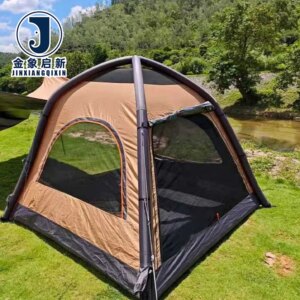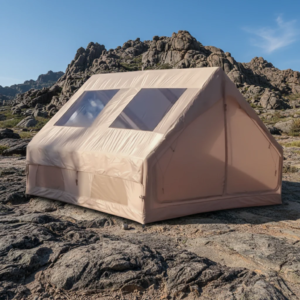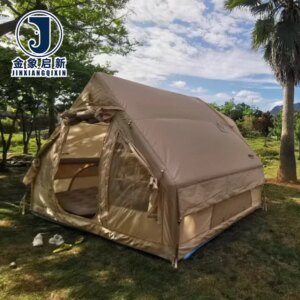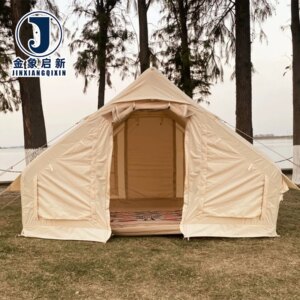
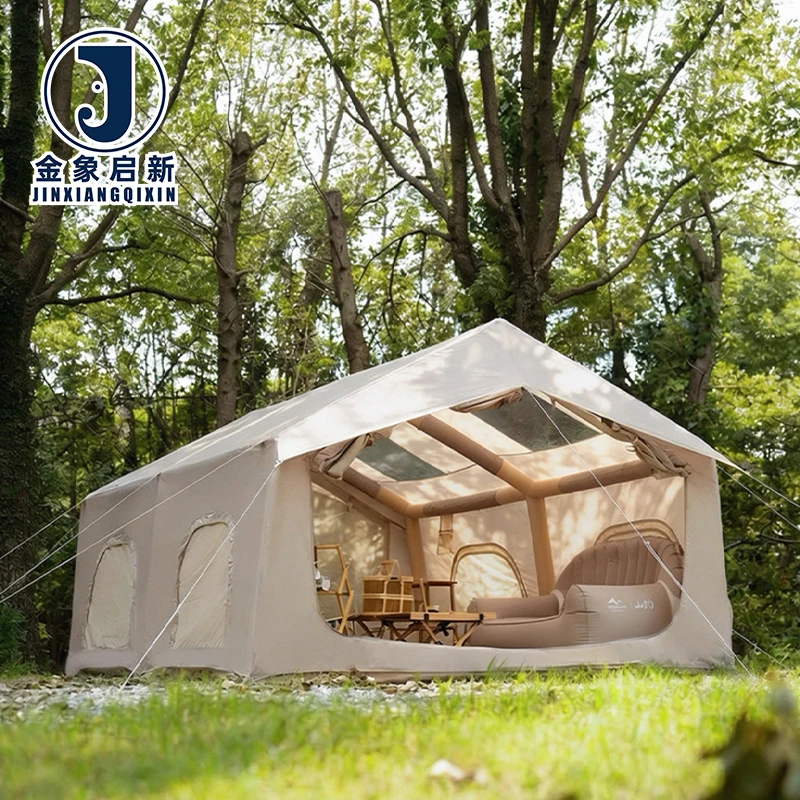
Coating Formulation Control — Every roll of PVC inflatable tent fabric is produced under a strict in-process QA regime that tracks coating weight, adhesion strength, and surface finish against the material specification sheet before it leaves the line.
Technical Specifications
| Parameter | Value |
|---|---|
| Product Type | Inflatable Tent Fabric |
| Core Material | PVC tarpaulin |
| Key Performance | Waterproof, UV-resistant (test basis not stated), tear-resistant |
| Construction | Single layer |
| Configuration | Extended Type |
| Capacity | 2-8 Person |
| Season Rating | 4-Season |
| Opening Mechanism | Quick Automatic Opening (inflatable) |
| Customization | OEM & ODM, sample customization, pattern printing |
| Production Facility | 9,180 m² with 3 full production lines, 36 sets of professional equipment |
| R&D Team | 10 technicians |
| Quality Control | Full-process QA/QC with 100% pre-shipment inspection |
| Standards | ISO 9001, ISO 14001, ISO 45001, CE |
Application Suitability
| Application | Exposure & Requirement |
|---|---|
| Disaster relief shelter deployment | Rapid inflation cycles, constant UV exposure, variable precipitation, rough ground contact |
| Temporary site command centers | Extended outdoor standing, wind loading on membrane surfaces, frequent relocation |
| Emergency equipment storage | Waterproof barrier against sustained rain, abrasion from loading and unloading |
| Infrastructure recovery logistics | 4-season temperature swings, repeated pack-and-deploy handling, chemical exposure from site environments |
Why Coating Weight Claims Fail in the Field
A stated GSM without a verified test method is a number on paper, not a performance guarantee on the ground.
When procurement teams receive inflatable tent fabric rolls that measure lighter than the quotation specified, the entire structure’s pressure retention and weather resistance are compromised from day one. The PVC inflatable tent aftermarket supplier landscape is full of material that passes initial visual checks but reveals its true coating weight only when a section is weighed in the warehouse. Technical buyers need more than a quoted number — they need a documented test method and a pre-shipment verification record that traces each roll back to the production batch. [NEED_CITE: ISO test methods for coated fabric weight verification]
How Coating Weight Interacts with Base Fabric in Inflatable Structures
The relationship between PVC coating mass and the underlying woven substrate determines how well the membrane holds internal pressure during inflation and how it responds to repeated flexing at stress points. In inflatable tent applications, the fabric must distribute air pressure evenly across large unsupported spans, which means both the tensile strength of the base weave and the coating adhesion to that weave must work in concert. A heavier coating does not automatically deliver better performance if the base fabric denier and weave density are insufficient to anchor it, which is why material selection always starts with the complete construction specification rather than a single GSM figure.
The PVC Inflatable Tent Aftermarket Supplier Gap Most Buyers Encounter
Technical buyers sourcing fabric for disaster relief structures frequently discover that batch-to-batch consistency is where supply chains break down. A roll produced in January may have a slightly different coating viscosity profile than one produced in June, leading to variations in surface finish, weld behaviour, and ultimately colour appearance when panels from different batches are joined on site. Our production process controls coating application across all three full production lines with dedicated QA checkpoints, ensuring that the PVC inflatable tent aftermarket supplier delivers material with documented batch traceability from order number to individual roll. [NEED_CITE: quality control standards for coated fabric batch consistency]
Reading the Specification Sheet Beyond the Headline Numbers
When evaluating PVC tarpaulin for inflatable tent fabrication, four parameters interact to define real-world behaviour. Base fabric denier dictates the thread thickness in the woven substrate — higher denier yarns resist tear propagation but add weight, making the balance critical for rapid-deployment shelters. The PVC coating method determines how the polymer bonds to the substrate; knife-coated layers achieve strong adhesion for heat welding, while laminated constructions may separate at seams under inflation pressure. Surface finish — glossy or matte — affects both UV reflection characteristics and the adhesion of printed branding or pattern customisation. Waterproof performance in a single-layer construction depends entirely on the integrity of the coating across the full width, with pinholes or thin spots becoming failure points under sustained rain exposure. The tear resistance of the finished fabric reflects both the base weave density and the flexibility of the cured coating, as a brittle surface layer can crack and initiate tears during handling.
What Happens When Material Specifications Are Taken at Face Value
Buyers who accept a PVC coating specification without requesting the underlying test data often face problems during fabrication. Heat-welding settings calibrated for one coating formulation may produce weak seams on a different formulation, and the failure appears only after the inflatable structure is pressurised and loaded. UV-resistant treatment claimed without a documented test basis leaves procurement teams unable to demonstrate compliance when disaster relief contracts require verified material certifications. [NEED_CITE: coating formulation impact on thermal welding parameters for PVC fabrics] Colour variation between rolls in the same order becomes visible only when large tent panels are installed side by side, forcing either acceptance of an inconsistent appearance or costly panel replacement. These are not manufacturing defects — they are specification gaps that could have been resolved with proper documentation at the inquiry stage.
Why Technical Buyers Source This Fabric Through Our Process
Our 10-person R&D team handles material selection and sample development specifically for inflatable membrane structures, meaning customisation requests are evaluated against the mechanical demands of pressurised deployment rather than treated as standard tarpaulin orders. Three full production lines equipped with 36 sets of professional processing equipment provide the capacity to deliver consistent roll stock across large orders while maintaining the coating control that inflatable applications require. Every roll undergoes 100% pre-shipment inspection against the material specification sheet, with dedicated QA and QC staff verifying coating weight, surface finish, and dimensional accuracy before dispatch. Samples are developed within days for custom requirements, allowing fabrication teams to validate weld settings and handling characteristics before committing to full production volumes.
Documentation & Verification
- Material specification sheet stating GSM, base fabric denier, coating method, and colour reference per roll
- Test report for UV-resistant grades where applicable with documented test basis included
- ISO 9001, ISO 14001, ISO 45001, and CE certificates for cross-border procurement compliance
- Pre-shipment inspection record with 100% roll-by-roll verification before dispatch
- Certificate of origin and customs documentation supporting international relief shipments
Fabrication, Handling & Storage
- Heat-welding parameters should be validated on sample pieces before joining large inflatable tent panels
- Single-layer PVC tarpaulin requires careful roller pressure adjustment to avoid coating compression marks
- Store rolls upright on pallets to prevent flat-spot deformation of the PVC coating surface
- Low-temperature transport may stiffen the coating — allow material to acclimatise before unrolling on site
- Use only PVC-compatible cleaners to avoid dissolving the waterproof coating layer during field maintenance
What We Need to Prepare Your Quotation
Provide the intended deployment environment including expected temperature range, UV exposure duration, and whether flame-retardant certification is required for your market. Specify the roll width, colour, and any pattern printing requirements along with the estimated annual volume so we can align production scheduling. Let us know if you need sample rolls for fabrication testing before confirming the full order.
Frequently Asked Questions
Q: How is the PVC coating weight verified and what test method is used?
A: Coating weight is measured using standardised cut-and-weigh procedures on samples taken during production. The material specification sheet documents the stated GSM alongside the test method applied. Pre-shipment inspection verifies each roll against the quoted specification, and the inspection record accompanies the shipment for buyer review.
Q: What is the relationship between base fabric denier and tear strength?
A: Base fabric denier determines individual yarn thickness in the woven substrate. Higher denier yarns resist tear propagation more effectively, which is critical for inflatable tent panels that bear internal air pressure across unsupported spans. The PVC coating must bond firmly to this substrate to prevent delamination under stress.
Q: UV-resistant treatment — what test basis supports the claimed performance?
A: UV-resistant treatment is available for this PVC inflatable tent fabric, though the specific test basis is not stated in the current specification. Buyers requiring documented UV performance data should request the applicable test report during the inquiry stage to confirm suitability for their deployment environment.
Q: How does the PVC coating respond to high-frequency and hot-air welding?
A: PVC tarpaulin is well suited to both high-frequency and hot-air welding methods commonly used in inflatable tent fabrication. Welding parameters including temperature, pressure, and dwell time should be established on sample material first, as coating formulation directly influences the thermal behaviour at the seam interface.
Q: How are batch-to-batch colour and coating consistency controlled?
A: Coating formulation, application weight, and curing conditions are controlled across production runs through dedicated QA checkpoints. Batch traceability is maintained by order number, and the pre-shipment inspection record documents verification results for each roll, allowing buyers to confirm consistency before fabrication begins.