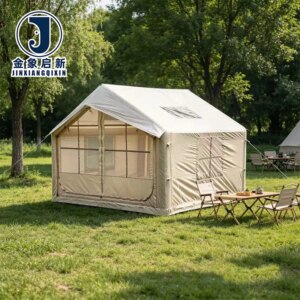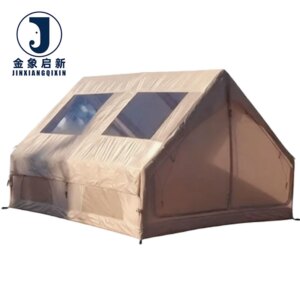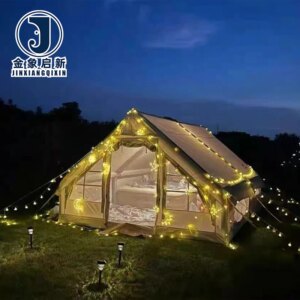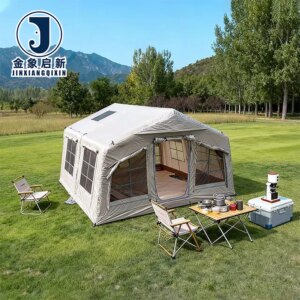
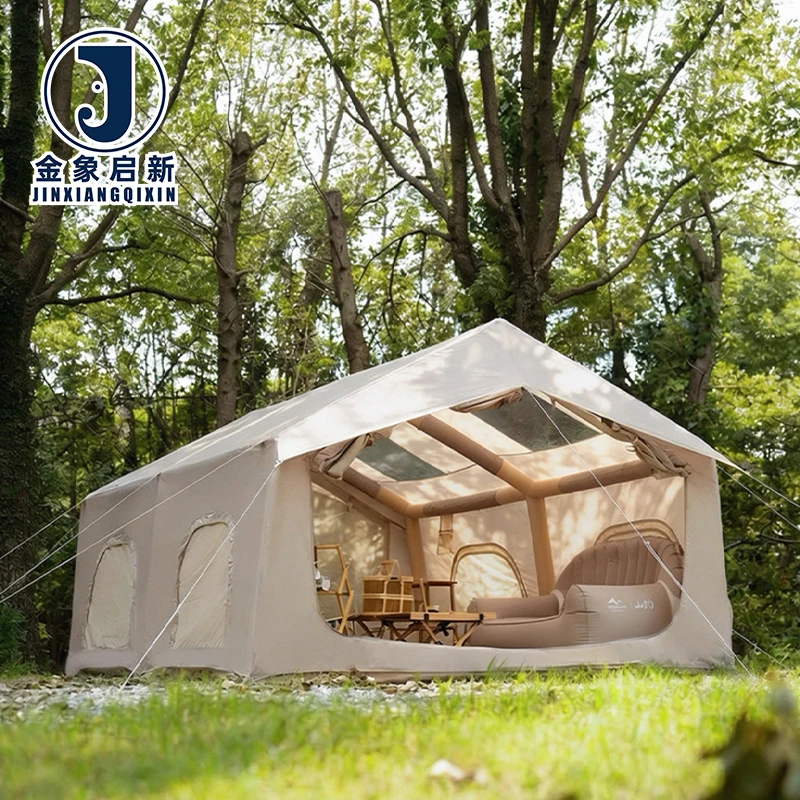
Coating formulation control — every roll of PVC tarpaulin leaving this facility carries batch-level traceability on base fabric denier, coating weight, and UV treatment status, ensuring the inflatable tube structure you fabricate meets the deployment spec you committed to.
Technical Specifications
| Parameter | Value |
|---|---|
| Product Type | Inflatable Tent Fabric |
| Core Material | PVC tarpaulin |
| Construction | Single layer |
| Key Performance | Waterproof, tear-resistant |
| UV Resistance | Available with anti-UV treatment (test basis not stated in source — confirm grade required for your market) |
| Flame Retardant | Available in flame retardant grades (grade not stated — confirm the standard required for your market) |
| Capacity Range | 2–8 Person inflatable shelters |
| Season Rating | 4-Season |
| Deployment Method | Quick Automatic Opening |
| Configuration | Extended Type |
| Customization | OEM & ODM, sample customization, pattern printing |
| Certifications | ISO 9001, ISO 14001, ISO 45001, CE |
Application Suitability
| Application | Exposure & Requirement |
|---|---|
| Disaster relief inflatable shelters | Rapid deployment under rain, wind load, and temperature swings; fabric must hold air pressure in inflatable beams without delamination |
| Temporary site command centers | Continuous UV exposure, foot traffic abrasion at entry points, thermal welding integrity at tube seams |
| Emergency equipment storage | Waterproof barrier against precipitation and ground moisture, puncture resistance from shifting cargo |
| Infrastructure recovery logistics | Year-round outdoor siting, repeated inflation/deflation cycles, transport packing stress on folded fabric |
Why "Waterproof PVC" Still Fails at the Inflatable Tube Seam
The coating adhesion to the base fabric — not the coating thickness alone — determines whether your inflatable beam holds pressure or splits at the weld.
When an inflatable tent is pressurised, the tube seams carry concentrated stress at every flex point. If the PVC coating was applied without sufficient bond strength to the polyester base, the weld line becomes the weakest link. The fabric itself may never fail, but the seam opens under cyclic loading. Inflatable Tent Fabric PVC coating technology must be evaluated on peel strength and weld compatibility, not just surface waterproof claims. Buyers who specify only by GSM often discover this failure mode after the first deployment cycle [NEED_CITE: tensile and peel test methods for coated fabrics per ISO 1421].
Base Fabric Denier and Weave Density in Inflatable Structures
The load path in an inflatable tent tube runs circumferentially around the beam. A higher denier base yarn with a tight weave provides the dimensional stability needed to maintain tube shape under internal pressure. Inflatable Tent Fabric PVC coating technology applied over a loosely woven base will show surface wrinkling and uneven stress distribution once pressurised, leading to premature fatigue at repeated fold lines.
Coating Method and Its Effect on Weld Behaviour
The method used to apply the PVC layer — whether knife-over-roll, dip, or calender — directly influences how the fabric responds to thermal welding. Knife-coated fabrics typically deliver a more uniform coating thickness, which translates to consistent weld parameters across the production run. For inflatable structures where dozens of tube seams must hold identical pressure, this consistency reduces rework and field failures [NEED_CITE: welding behaviour of PVC coated polyester fabrics].
Reading the Specification Sheet Beyond GSM
GSM alone tells you the combined weight of base fabric and coating, but not how that weight is distributed. Two fabrics at identical GSM can perform very differently: one may use a heavier base yarn with a thinner coating, offering better tear resistance; the other may rely on a thick coating over a light base, giving stiffness but poor flex endurance. For inflatable tent applications where the fabric folds during transport and inflates under pressure, the base-to-coating ratio matters more than the total weight. Anti-UV treatment adds another variable — its effectiveness depends on the additive package in the coating formulation, not the GSM. Request the base fabric denier, weave density, and coating weight separately to compare options meaningfully.
What Happens When the Wrong Grade Ships
A tent fabric specified for 4-season deployment that arrives without verified UV treatment will show surface chalking and embrittlement within one season of continuous sun exposure. When inflatable beams lose flexibility, they crack at the fold points during packing. Colour variation between rolls in a single order becomes visible once multiple tent units are deployed side by side at a disaster relief site. These are not cosmetic issues — they trigger rejection at the receiving dock and delay the entire project timeline [NEED_CITE: colour consistency standards for batch-dyed coated fabrics].
Why Procurement Teams Consolidate Here
Three full production lines and 36 sets of processing equipment allow this facility to run dedicated batches for inflatable tent orders without mixing product families on the same line, which protects colour and coating consistency. The 10-person R&D team develops custom samples for inflatable structure fabricators, adjusting coating formulation and base fabric selection to match the inflation pressure and fold endurance your design requires. Every roll undergoes 100% inspection before dispatch, with pre-shipment records tied to the batch number. Nearly 30 years of coated fabric process control means the coating adhesion and weld compatibility parameters have been refined across thousands of production cycles, not guessed from a data sheet.
Documentation & Verification
- Material specification sheet listing base fabric denier, coating weight, and colour reference per roll
- UV test report supplied with batch traceability for anti-UV treated grades
- ISO 9001 / ISO 14001 / ISO 45001 / CE certificates included in shipment documentation
- Pre-shipment inspection record documenting GSM and visual quality per roll
- Certificate of origin and customs support documents for cross-border shipment
Fabrication, Handling & Storage
- Thermal weld temperature and dwell time must be matched to the specific PVC coating weight on your inflatable tube seams
- Store rolls upright on pallets to prevent flat-spot creasing that weakens the coating at fold lines
- Cut pattern layout should account for the fabric weave direction to maximise tube circumferential strength
- Use PVC-compatible cleaners only; solvent-based products can degrade the coating surface and reduce UV additive effectiveness
- Repair minor field punctures with matching PVC patch material heat-welded to the inflatable tube surface
What to Include in Your Enquiry
Provide the inflation pressure your tube design operates at, the deployment climate range, and whether your target market requires a specific flame retardant standard. Confirm the fabric width you need and whether you require rolls or finished panels. If colour matching or pattern printing is part of the specification, send your Pantone or RAL reference and indicate the annual volume so sample development can be scheduled accordingly.
Frequently Asked Questions
Q: How do I verify the PVC coating weight and base fabric denier on arrival?
A: Each shipment includes a pre-shipment inspection record with batch-specific GSM data. You can cross-check by cutting a measured sample and separating the coating from the base fabric using a controlled solvent dip, then weighing each component independently to confirm the stated specification matches the received material.
Q: What is the test basis for the UV-resistant treatment on this fabric?
A: UV-resistant treatment is available as an option with the additive package specified during order confirmation. The test basis and expected outdoor performance data are provided in the batch test report upon request. Confirm the UV standard required by your end-use market before placing the order.
Q: How does PVC tarpaulin behave during thermal welding for inflatable tube seams?
A: The PVC coating fuses at the weld interface when heated to the correct temperature for the specific coating weight. Consistent coating thickness across the roll ensures uniform weld strength. Request a sample roll to validate your welding equipment parameters before committing to full production.
Q: Can colour vary between rolls in the same inflatable tent order?
A: Batch-to-batch colour consistency is controlled through dedicated production runs on the same line with identical dye formulations. The pre-shipment inspection includes visual colour comparison across all rolls in the order. Specify your tolerance level during enquiry if your deployment places multiple units side by side.
Q: Are custom pattern printing and branding available for inflatable structures?
A: Pattern printing and branding can be applied to the PVC surface during production. Provide artwork files and colour references during the sample development stage. The R&D team will confirm print durability against flex and weather exposure specific to your inflatable structure design.