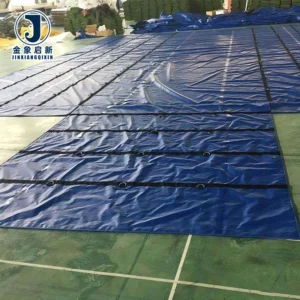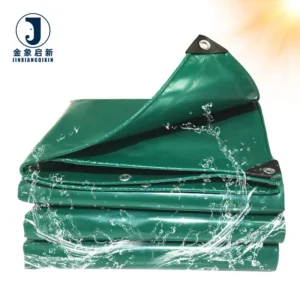
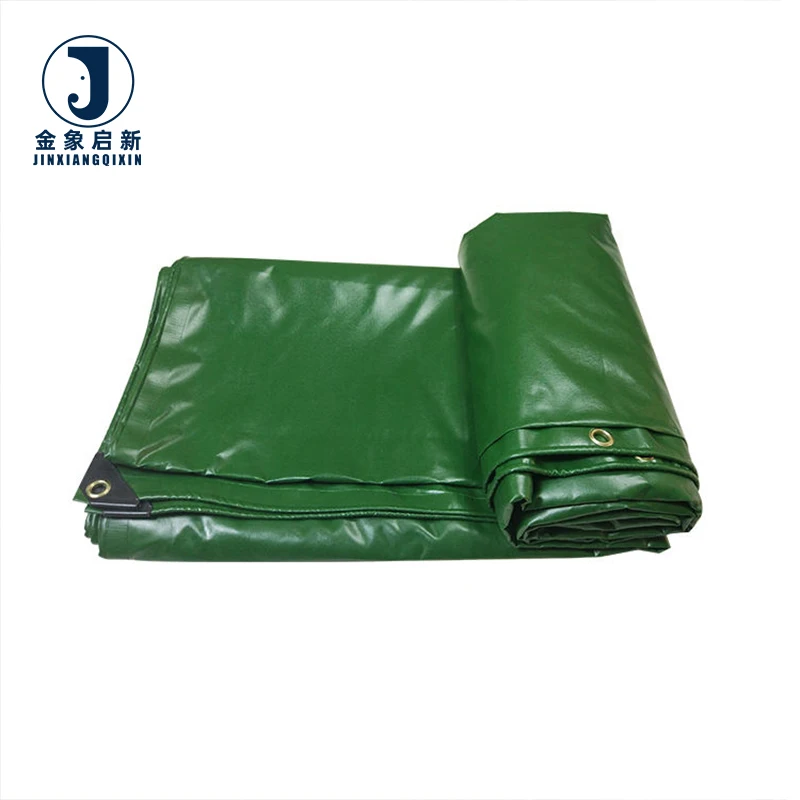
Verified GSM on Every Roll — every roll of 500gsm PVC Coated Tarpaulin is backed by a material specification sheet stating base fabric denier and exact coating weight before it leaves the factory.
Technical Specifications
| Parameter | Value |
|---|---|
| Product Type | PVC Coated Tarpaulin |
| Specification | 500gsm |
| Base Fabric | High-strength polyester mesh fabric |
| Coating | PVC |
| Coating Method | Laminated technology & Hot-melt Coating technology |
| Weight | 500gsm |
| Thickness | 0.45mm |
| Roll Size Options | 2m × 75m or 2.1m × 50m |
| Finish Product Size | Custom cut to buyer dimensions or sold by inventory roll |
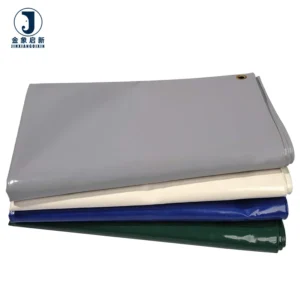
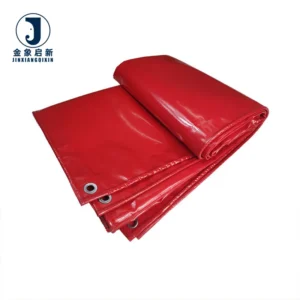
| Colour Options | Blue / Red / Yellow / Light blue / Grey (custom colours available) |
| Key Features | Waterproof, Cold Crack Resistance, Anti-Mildew, Best color fastness |
| Flame Retardant | Available upon request — confirm the grade required for your market |
| Anti-Static Treatment | Available upon request — confirm the grade required for your market |
| UV Stabilisation | Sunproof formulation — test basis available upon request |
| Service Life | 3–7 years under normal circumstances |
| Standards | ISO 14001, ISO 45001, CE, RoHS |
Application Suitability
| Application | Exposure & Requirement |
|---|---|
| Truck awning and side curtain | Constant flexing at hinge points, road abrasion, tie-down tension, UV exposure |
| Dump truck cover | Load shifting, hydraulic arm clearance, weather and debris impact |
| Cargo ship cover | Salt spray, heavy wind load, prolonged water contact, UV saturation |
| Tent and temporary shelter | Repeated assembly and disassembly, weld seam stress, seasonal temperature swings |
| Fish tank and pool liner | Permanent water immersion, chemical exposure from treatment agents, puncture risk |
Why the GSM Number Alone Will Not Tell You If the Fabric Holds Up at the Weld Line
Tensile and tear performance depend on the interplay between base fabric denier, weave density, and coating adhesion — not on weight alone.
A 500gsm PVC coated tarpaulin can behave very differently from another 500gsm roll depending on whether the polyester yarns are high-tenacity grade and how well the PVC bonds to the mesh. When a truck side curtain flexes thousands of times on the highway, the failure point is almost always the weld seam, not the body of the fabric. Coating adhesion and the tearing strength of the base mesh determine whether that seam survives. [NEED_CITE: tensile and tear test methods for coated fabrics per ISO 1421]
Coating Method and What It Means for Seam Integrity
This PVC Coated Tarpaulin is produced using both laminated technology and hot-melt coating technology. Laminated construction bonds pre-formed PVC films to the polyester mesh under heat and pressure, producing a smooth surface suited to printing and high-visibility applications. Hot-melt coating drives the PVC compound directly into the mesh structure, creating a mechanical lock between the coating and the yarn. For fabricators welding seams on truck awnings and side curtains, the hot-melt variant generally delivers stronger peel resistance at the joint.
Colour Consistency Across Multi-Roll Orders
When a tent manufacturer orders twenty rolls for a single event structure, visible colour variation between adjacent panels is a rejection-level defect. Colour fastness on this material is controlled through pigment formulation and coating temperature management during production. Each batch is checked under controlled lighting before dispatch. For orders spanning multiple production runs, providing a Pantone or RAL reference at the inquiry stage ensures the colour match is formulated from the first roll to the last. [NEED_CITE: colour fastness testing standards for coated textiles]
How GSM, Base Fabric, and Coating Weight Work Together
The 500gsm weight is the combined mass of the polyester base fabric and the PVC coating applied to both sides. A heavier coating does not automatically mean a stronger fabric — it may simply mean more PVC on a lighter mesh. True tensile strength comes from the denier of the polyester yarns and the density of the weave. Tear resistance is governed by how many yarns a propagating tear must cross before it extends. The 0.45mm thickness of this grade indicates a balanced ratio between base fabric and coating, providing adequate flexibility for folding and deployment while maintaining the structural body needed for welded fabrication. Coating method further influences behaviour: hot-melt coated rolls typically show better adhesion values than laminated ones, which affects how reliably a heat-welded seam performs under cyclic loading.
What Happens When Specification Verification Is Skipped
Fabricators who accept rolls without independent GSM verification sometimes discover that the material is lighter than quoted only after cutting and welding. A roll that is nominally 500gsm but actually weighs less will have thinner coating and reduced adhesion at the weld zone, leading to seam failure under load. Similarly, flame-retardant treatment claimed without a test report creates compliance risk when a building inspector or port authority requests documentation. Batch colour inconsistency discovered during installation forces the entire structure to be re-cut or accepted with visible panel differences. [NEED_CITE: weld seam failure modes in PVC coated fabric structures]
Why Fabricators Source This Material Here
Three full production lines and 36 sets of professional equipment support bulk roll output with on-time delivery schedules for container shipments. The 10-person R&D team handles custom colour matching, width adjustment, and sample development within days rather than weeks. Dedicated QA/QC operates at every production stage, with 100% inspection before shipment covering coating adhesion, dimensional tolerance, and visual consistency. Nearly 30 years of focused coated fabric production has built deep process control over coating weight accuracy and base fabric selection. ISO 14001 and ISO 45001 certification reflects established environmental and occupational safety management systems. Every order ships with a pre-shipment inspection record and material specification sheet.
Documentation & Verification
- Material specification sheet stating exact GSM, base fabric denier, and coating weight per roll
- Test report for UV stabilisation and flame-retardant grades supplied where treatment is specified
- Pre-shipment inspection record covering coating adhesion, weld test, and dimensional tolerance
- ISO 14001, ISO 45001, CE, and RoHS certificates included with documentation pack
- Roll packing list and certificate of origin provided for customs clearance
Fabrication, Handling & Storage
- Hot-melt coated rolls weld reliably at standard high-frequency or hot-air temperatures — run test pieces before full production
- Allow 2m × 75m rolls to acclimatise to workshop temperature before unrolling to prevent cold crack stress on the PVC surface
- Store rolls upright on end caps in a dry, shaded area to prevent flat-spot deformation of the 0.45mm material
- Cut patterns from 2.1m × 50m rolls should be nested to minimise off-cuts and maximise yield per roll
- Clean finished awning surfaces with mild detergent — avoid solvent-based cleaners that attack the PVC coating bond
- Reinforce eyelet zones with additional PVC patches to distribute tie-down load across the polyester mesh
What to Include in Your Inquiry
Specify the end-use application and the mechanical and environmental loads the fabric will face. If your market requires a particular flame-retardant or anti-static grade, state the standard so the correct formulation is quoted. Indicate whether you need full rolls or finished cut sizes, your target colour reference, and estimated annual volume. Samples are developed within days for approval before production begins.
Frequently Asked Questions
Q: How is the 500gsm weight verified on each roll before shipment?
A: Every roll undergoes a weight check against the material specification sheet during the pre-shipment inspection. The GSM value, base fabric denier, and coating weight are recorded and included in the documentation pack shipped with the order, so you receive written verification rather than relying on the quotation alone.
Q: What flame-retardant grades can be supplied and what test reports come with them?
A: Flame-retardant treatment is available upon request — confirm the grade required for your market, such as B1, M2, or NFPA 701. When a grade is specified, the corresponding test report is included in the shipment documentation so that compliance can be demonstrated to inspectors or end-users.
Q: How does hot-melt coating differ from laminated technology for weld seam performance?
A: Hot-melt coating penetrates the polyester mesh, creating a mechanical bond that generally delivers higher peel strength at heat-welded seams. Laminated technology bonds PVC films to the mesh surface, producing a smoother finish suited to printing. The choice depends on whether seam integrity or surface quality is the priority for your application.
Q: How is colour consistency maintained when ordering multiple rolls?
A: Pigment formulation is matched to your Pantone or RAL reference at the start of production. Rolls from the same batch are compared under controlled lighting before dispatch. For orders spanning multiple runs, the reference sample is retained and used to calibrate each subsequent production.
Q: What is the relationship between GSM, base fabric denier, and tensile strength?
A: GSM is the total weight of fabric and coating combined. Tensile and tear strength depend primarily on the denier of the polyester yarns and the weave density of the base fabric. A higher GSM with a lighter base mesh may have more coating but less structural strength, which is why the material specification sheet lists all three values independently.