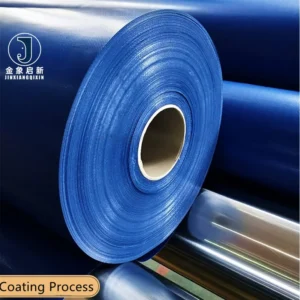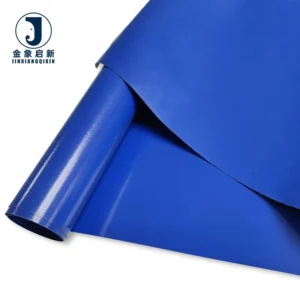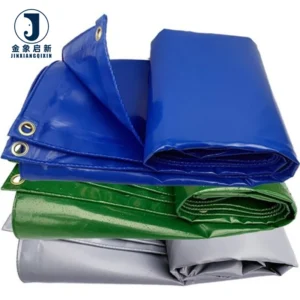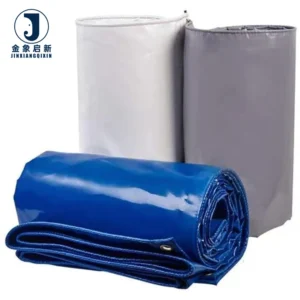
Consistent Coating Adhesion — Every roll is mapped to a published GSM and thickness value with coating method disclosed, eliminating the guesswork that plagues unverified tarpaulin supply.
Technical Specifications
| Parameter | Value |
|---|---|
| Product Type | PVC Coated Tarpaulin |
| Base Fabric | High-strength polyester mesh fabric |
| Coating Method | Laminated technology & Hot-melt Coating technology |
| Weight (GSM) | 350gsm / 420gsm / 500gsm / 550gsm / 600gsm / 750gsm (range covers product family — confirm the grade for this item) |
| Total Thickness | 0.32mm / 0.35mm / 0.4mm / 0.45mm / 0.5mm / 0.65mm (range covers product family — confirm the grade for this item) |
| Roll Size | 2m width × 75m length / 2.1m width × 50m length |
| Finish Product Size | Custom items as per customer’s needs or sold by inventory |
| Color | Blue / Red / Yellow / Light blue / Grey (Customized) |
| Key Features | High tenacity polyester yarns, good flexibility and adhesion strength, outstanding tearing strength for welding, cold crack resistance, waterproof, best color fastness |
| Special Treatments | Flame retardant (grade not stated in source), Anti-static (grade not stated in source), Anti-cold, Anti-mildew, 3P |
| Standards | ISO, CE |
Application Suitability
| Application | Exposure & Requirement |
|---|---|
| Truck awning | Constant flexing, road abrasion, UV exposure, welded seam integrity under dynamic load |
| Tent cover | Repeated assembly stress, weather exposure, color fastness under prolonged sunlight |
| Scaffolding or building enclosure | Wind load, rain ingress prevention, flame retardant compliance on active sites |
| Cargo ship cover | Salt spray, permanent moisture, tensile load from tie-down points |
| Fish tank / pool | Continuous water contact, anti-mildew treatment, puncture resistance from substrate |
| Construction covers | Debris impact, equipment abrasion, cold crack resistance during winter work |
Why GSM Alone Does Not Tell You How Strong the Fabric Is
A 650gsm roll with poor coating adhesion will delaminate at the weld long before the base fabric reaches its tensile limit.
Technical buyers often specify PVC coated tarpaulin roll by weight per square meter, assuming heavier automatically means stronger. But GSM combines base fabric density and coating weight into a single number, masking how the material actually performs under stress. A roll that measures correctly on the scale can still fail at the seam if the coating bond to the polyester mesh is weak. [NEED_CITE: tensile and tear test methods for coated fabrics per ISO 1421] Coating method, base yarn tenacity, and adhesion strength are the variables that determine whether a PVC coated tarpaulin roll survives fabrication and field use.
Base Fabric Denier and Weave Density Drive Tensile Performance
The polyester mesh at the core of this PVC coated tarpaulin roll determines how much force the fabric can absorb before tearing. High tenacity polyester yarns are selected for their resistance to elongation under sustained load, which matters when a truck awning or tent structure is tensioned during installation. Weave density controls how load distributes across the fabric — tighter weaves resist tear propagation better, while open weaves allow coating to penetrate deeper and improve adhesion. Selecting the right PVC coated tarpaulin roll means understanding which of these two properties your application prioritizes.
Coating Method Determines Weld Behaviour and Seam Life
Laminated and hot-melt coating technologies produce different adhesion profiles between the PVC layer and the base fabric. Laminated coating bonds pre-formed PVC film to the mesh under heat and pressure, creating a uniform surface that responds predictably to heat welding. Hot-melt coating applies molten PVC directly into the mesh, allowing deeper penetration and typically stronger peel resistance at the interface. [NEED_CITE: adhesion strength testing for coated textiles per ISO 2411] When fabricators weld seams on a PVC coated tarpaulin roll, the coating method determines the temperature window and dwell time needed to fuse joints without degrading the base yarn.
Reading the GSM-to-Thickness Map for Material Selection
Across the available range, GSM and total thickness increase together — but not in a fixed ratio. A heavier coating adds weight without proportionally increasing tensile strength, while a denser base fabric adds both weight and mechanical performance. The specification ladder from lighter to heavier grades lets technical buyers match material to application load: lighter grades suit temporary covers and low-stress enclosures, while heavier grades serve permanent structures and high-tension awnings. Specifying by both GSM and thickness, rather than either alone, gives a more reliable prediction of how the PVC coated tarpaulin roll will behave under your specific fabrication process.
What Happens When Coating Weight Is Underspecified
When a PVC coated tarpaulin roll arrives with less coating than the quotation promised, the consequences compound through the supply chain. Fabricators set welding parameters based on expected coating thickness; thinner coating burns through faster, producing weak seams that fail in the field. End users see delamination at stress points — the exact locations where the load flexes most — and blame the finished product rather than the raw material. [NEED_CITE: common failure modes in welded tarpaulin seams] Batch-to-batch consistency in coating weight is what separates a reliable roll supply from one that generates claims and rework.
Production Control and Verification Behind Each Roll
The facility operates three full production lines with 36 sets of professional equipment, supporting consistent coating application across the full GSM range. A dedicated QA/QC process runs at every production stage, with weight verification per roll before dispatch. The 10-person R&D team handles material selection and sample development, enabling custom width and treatment combinations without extended lead times. ISO and CE certified processes underpin the production system, and samples are developed within days when buyers need to validate a PVC coated tarpaulin roll grade before committing to volume.
Documentation & Verification
- Material specification sheet stating exact GSM, base fabric type, and coating method for each roll grade
- Test report for UV stability and flame retardant grades where applicable — request before confirming treatment
- Pre-shipment inspection record confirming roll-by-roll weight verification against quoted GSM
- ISO and CE certificates included as part of dispatch documentation package
- Roll packing list with batch reference for traceability across multi-roll orders
- Certificate of origin and customs support documentation for international shipment
Fabrication, Handling & Storage
- Set heat weld temperature and dwell time according to the coating method — laminated and hot-melt grades respond differently
- Allow heavier GSM rolls to acclimate before unrolling in cold conditions to prevent coating crack at the core
- Store rolls vertically on end caps to prevent flat spots that create permanent creases in the base fabric
- Cut patterns with the weave direction to maximize tensile alignment at high-stress tie-down points
- Clean surfaces with mild detergent only — solvents can degrade the PVC coating layer and reduce color fastness
- Reinforce eyelet positions with additional PVC patches matching the roll grade to distribute load through the mesh
Inquiry Preparation for Technical Buyers
Share the application environment and the specific stresses the fabric will face — static tension, dynamic flex, chemical exposure, or fire compliance requirements. Specify the GSM grade or thickness you need, along with roll width preference and whether you require custom colour or treatment options. Indicate whether you need full rolls or pre-cut sizes, and whether samples should be produced for weld testing before bulk dispatch.
Frequently Asked Questions
Q: How should I verify GSM when PVC coated tarpaulin rolls arrive at my facility?
A: Cut a measured sample from the outer layer of each roll, weigh it on a calibrated scale, and compare against the stated GSM. Expect minor tolerance variation within a batch. Request the pre-shipment inspection record from the supplier, which documents roll-by-roll weight checks conducted before dispatch. If values fall outside tolerance, notify the supplier before cutting or fabricating the material.
Q: What flame retardant grades are available and how do I get certification for my market?
A: Flame retardant treatment is available across the product range, but the specific grade must be confirmed for your market’s regulatory framework. Request the applicable test report before placing the order, as different regions require different classifications. Supply your compliance requirement at inquiry stage so the correct treatment can be applied during production and documented in the dispatch paperwork.
Q: How do laminated and hot-melt coating differ in weld performance?
A: Laminated coating produces a uniform PVC film surface that welds predictably within a specific temperature range. Hot-melt coating penetrates deeper into the polyester mesh, creating stronger peel resistance but requiring adjusted welding parameters. Fabricators should request samples of both types to establish optimal heat settings before committing to a full production run on PVC coated tarpaulin roll stock.
Q: Can flame retardant and anti-static treatments be applied to the same roll?
A: Both treatments are available and can be combined, but compatibility must be confirmed at the specification stage. Some chemical combinations affect coating flexibility or color stability. Provide your end-use requirement and the specific performance values you need so the R&D team can develop a sample for testing before bulk production begins.