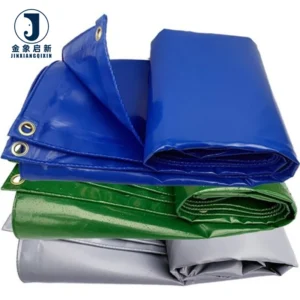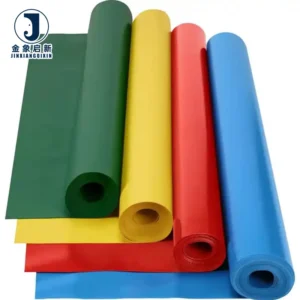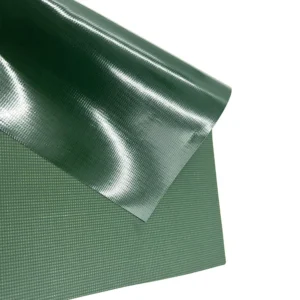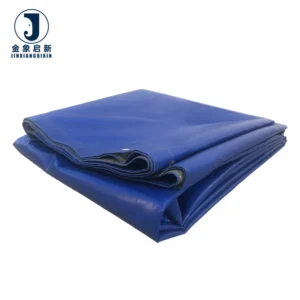
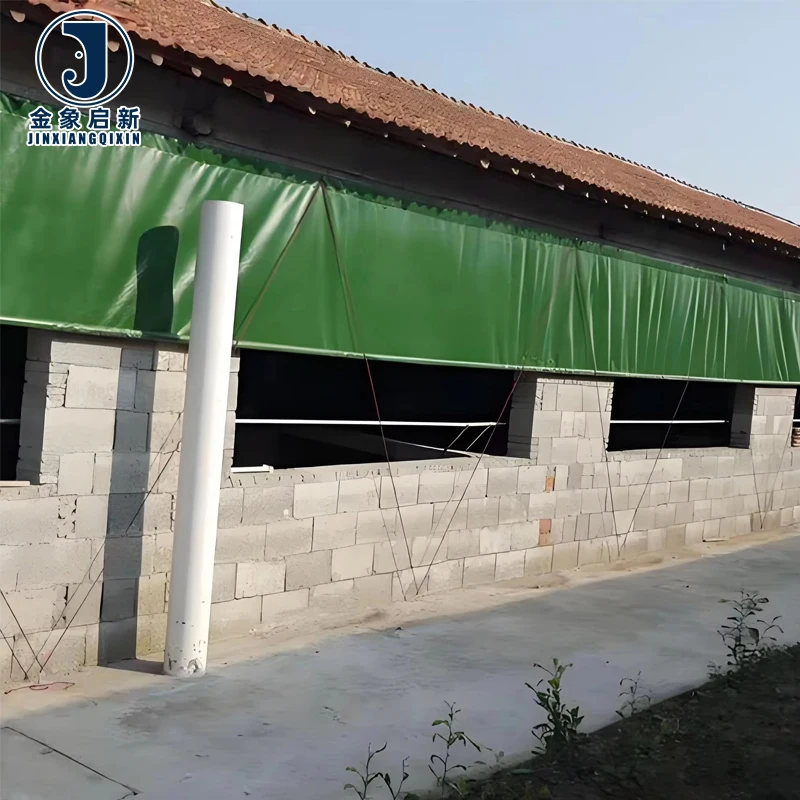
Process-controlled coating weight — every roll of PVC coated tarpaulin for farm covers is verified against the ordered GSM at the coating head, not just assumed from batch averages, giving agricultural specifiers confidence that the fabric on site matches the material specification sheet.
Technical Specifications
| Parameter | Value |
|---|---|
| Product Type | PVC Coated Tarpaulin Roll |
| Coating Material | PVC |
| Base Fabric | Warp knitted polyester |
| Coating Method | Knife coated |
| Waterproof | Yes — continuous coated barrier |
| Anti-Static | Stated (surface resistance value and test basis not stated in source — confirm requirement) |
| Tear Resistance | Stated (test basis not stated in source) |
| Finish | Plain style |
| Color | Customizable per order |
| Surface Treatment Options | Anti-UV, flame retardant — confirm the grade required for your market |
| Assembly State | Roll stock or cut-to-size sheets |
| Certification | ISO, CE |
Application Suitability
| Application | Exposure & Requirement |
|---|---|
| Poultry and broiler farm enclosures | Continuous moisture, ammonia vapour, wind-driven rain, daily temperature swings |
| Pig and sheep housing covers | Abrasion from structural frames, livestock contact, humidity, cleaning washdowns |
| Agricultural tent and temporary shelter | UV exposure, wind load, repeated erection and dismantling |
| Feed stockpile and equipment covers | Water ingress prevention, dust barrier, moderate UV exposure |
| Aquaculture pond liners (heavy-duty grades) | Permanent water contact, soil chemistry, puncture risk from substrate |
What "Waterproof" Actually Means When the Coating Weight Varies
A waterproof claim only holds if the PVC coating is applied at a consistent, verified weight across the entire roll.
On poultry and livestock farms, tarpaulin sheets are tensioned over frames and exposed to wind-driven rain for months at a time. When the coating weight dips below the threshold needed to seal the warp knitted base fabric, water finds the thinnest point and tracks through. This is not a seam or eyelet issue — it happens mid-panel, where the coating did not fully penetrate the knit structure during the knife coating pass. Buyers who have received rolls lighter than the GSM stated on the quotation often discover the leak only after the first heavy storm [NEED_CITE: relationship between coating weight consistency and waterproof integrity in PVC coated fabrics]. For farm covers, this means livestock exposure, feed spoilage, and emergency replacement orders mid-season.
Knife Coated Construction and What It Delivers for Farm Fabric
The knife coating process forces PVC paste directly into the warp knitted polyester base under controlled pressure, filling the interstices of the knit structure rather than sitting on top as a laminated film would. For PVC coated tarpaulin used in agricultural environments, this means the coating bonds mechanically with the yarn structure, resisting delamination when the fabric flexes under wind load or is folded during seasonal dismantling. The result is a single-layer composite where the waterproof barrier and the structural base act as one unit.
Warp Knitted Base Fabric: Dimensional Stability Under Farm Tension
Warp knitted polyester provides a stable grid that resists stretching in both machine and cross directions, which matters when farm covers are tensioned over curved or angled frame structures. Unlike woven fabrics that can bias-stretch at 45 degrees, the knit loops distribute load across multiple yarn paths. This dimensional stability keeps PVC coated tarpaulin gsm coating material performance predictable across the full panel, preventing the localized thinning that leads to premature coating failure at high-stress zones near ridges and corners [NEED_CITE: warp knitted versus woven base fabric behaviour under sustained tension in coated textiles].
Reading GSM Correctly for Agricultural Tarpaulin Specifications
GSM — grams per square metre — is the total weight of base fabric plus coating combined. A higher GSM does not automatically mean a stronger fabric; it could simply mean more coating on a lighter base, which adds weight without adding tear resistance. The warp knitted base fabric denier and stitch density determine how the material handles puncture and tear propagation, while the PVC coating weight governs waterproof integrity, UV shielding capacity and surface durability. When specifying PVC coated tarpaulin for farm enclosures, the material specification sheet should break down both base fabric weight and coating weight separately, so the buyer can verify the balance matches the application rather than relying on a single total GSM figure.
The Hidden Cost of Roll-to-Roll Colour Inconsistency on Farm Installations
When multiple rolls are installed side by side on a large poultry or pig housing enclosure, even a slight shade variation between rolls becomes immediately visible in daylight. This is not a cosmetic complaint — it signals that the coating batch was not controlled for pigment dispersion, which often correlates with inconsistent additive distribution for UV and flame retardant treatments. Buyers who have faced this issue report that the lighter-shaded rolls often weather faster, creating a patchwork appearance within months and forcing partial replacement [NEED_CITE: batch consistency control in pigmented PVC coating for multi-roll agricultural installations]. Re-ordering from a different production run rarely matches the original shade, leaving the structure visually uneven for its remaining service life.
Why Source Farm Cover Fabric Through This Production Line
Three full production lines with dedicated knife coating heads allow simultaneous coating of different GSM grades without cross-contamination between batches, keeping your poultry farm order isolated from unrelated industrial runs. The 10-person R&D team develops custom colour matches and confirms coating adhesion on the specific warp knitted base fabric before full production begins, reducing the risk of a batch that looks right but delaminates under farm conditions. Every roll undergoes inspection at each production stage, with a 100% pre-shipment check that verifies GSM, colour consistency and surface quality against the material specification sheet — not a sampling protocol. ISO and CE certification underpins the documentation package, giving importers the paperwork needed for customs clearance without delays at the port.
Documentation & Verification
- Material specification sheet stating total GSM, base fabric denier and coating weight per roll grade ordered
- Anti-UV and flame retardant test reports matched to the production batch — confirm the grade required
- Anti-static surface resistance value with applicable standard reference where claimed
- Pre-shipment inspection record confirming GSM and roll-to-roll colour consistency before dispatch
- Roll packing list with certificate of origin and customs support documentation
- ISO and CE certificates included with every shipment
Fabrication, Handling & Storage
- Hot-air welding parameters must match the knife coated PVC thickness — test a sample offcut before full seam production
- Store rolls upright on pallets to prevent flat-spotting the warp knitted base fabric, which shows as a visible crease line once tensioned
- Avoid dragging cut sheets across concrete floors during installation — the plain finish surface can scuff, exposing the base fabric to moisture
- In cold weather, allow rolls to acclimatise before unrolling; PVC becomes stiff and the knife coated layer may crack if force-flexed below its rated temperature
- Clean farm cover surfaces with mild detergent only — solvent-based cleaners can soften the PVC coating and reduce waterproof integrity
What We Need to Quote Your Farm Cover Project
Provide the livestock type and housing frame dimensions so we can recommend the appropriate GSM and width for minimal waste during cutting. Specify whether you need roll stock for your own fabrication or finished cut-to-size sheets with reinforced hems. Confirm the fire safety or anti-static requirements for your regional agricultural building codes, and whether UV treatment is needed for your climate zone.
Frequently Asked Questions
Q: How is GSM verified on arrival and what tolerance applies to coated farm tarpaulin?
A: Each roll is weighed and measured at dispatch, with the recorded GSM noted on the pre-shipment inspection record. Buyers can verify by cutting a known-area sample from the roll end and weighing it on a calibrated scale. The acceptable tolerance depends on the total GSM range — request the tolerance band specific to your ordered grade before production.
Q: What test basis supports the anti-static claim and which standard does it meet?
A: Anti-static properties are stated for this product, but the surface resistance value and applicable test standard must be confirmed at the inquiry stage. We provide a test report matched to your production batch showing the measured surface resistance. Specify the standard required by your regional agricultural building code so we can align the treatment accordingly.
Q: How do you control colour variation between rolls in a single farm cover order?
A: All rolls for one project are coated from the same pigment batch, and colour is checked against the approved reference at multiple points during the knife coating run. The pre-shipment inspection record includes a roll-to-roll colour comparison. If your project spans multiple production runs, we retain the colour formula to match subsequent orders as closely as the PVC coating process allows.
Q: What is the relationship between warp knitted base fabric and tear strength in PVC tarpaulin?
A: The warp knitted structure distributes tearing force across multiple yarn loops rather than along a single straight line, which slows tear propagation compared to a plain woven base. Combined with the knife coated PVC layer that bonds into the knit interstices, the composite resists both initiation and spread of tears at stress points typical in farm frame installations.
Q: What documentation ships with the rolls for import clearance?
A: Every shipment includes a roll packing list, certificate of origin, ISO and CE certificates, and the material specification sheet for each roll grade. For orders with UV or flame retardant treatment, the corresponding test reports are included. We also provide customs support documentation to assist with clearance at your destination port.