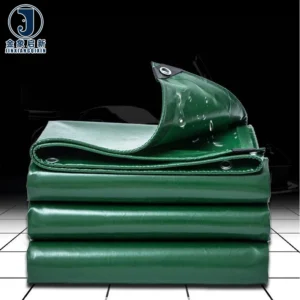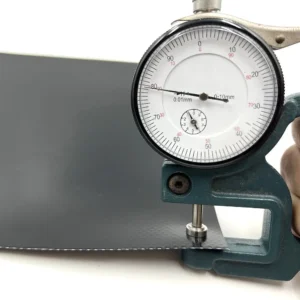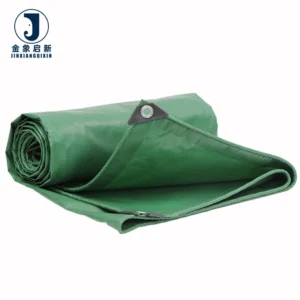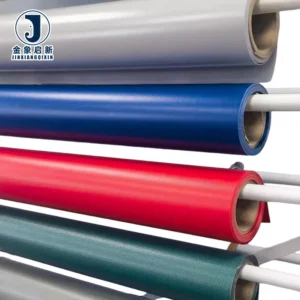
Process Control Over Coating Weight — nearly 30 years focused on coated fabric enables tight GSM verification and adhesion consistency across every roll of PVC coated tarpaulin shipped for agricultural enclosure use.
Technical Specifications
| Parameter | Value |
|---|---|
| Product Type | PVC Coated Tarpaulin Roll |
| Base Fabric | Warp knitted polyester |
| Coating Material | PVC |
| Finish | Plain style |
| Waterproof | Yes, fully coated construction |
| Anti-Static | Claimed (standard or surface resistance not stated in source) |
| Tear Resistance | Claimed (test standard not stated in source) |
| Colour | Customizable, confirm batch consistency for multi-roll orders |
| Certifications | ISO 9001, CE |
Application Suitability
| Application | Exposure & Requirement |
|---|---|
| Poultry and broiler house side curtains | Continuous moisture, ammonia exposure, dust accumulation, thermal cycling |
| Pig and sheep pen shelter covers | Animal contact and abrasion, wind load, rain and mud splash |
| Agricultural tent and temporary enclosures | Seasonal UV exposure, repeated erection and dismantling, field storage |
| Livestock waterproof barriers | Ground moisture, cleaning chemicals, mechanical stress from fixtures |
Why Coating Adhesion Matters More Than Stated GSM for Farm Covers
A PVC coated tarpaulin that delaminates at the weld line has failed at the coating interface, not the base fabric.
When fabricators specify PVC coated tarpaulin roll stock for livestock shelters, the focus often lands on GSM as the single proxy for durability. But coating weight alone does not predict how well the PVC bonds to the warp knitted substrate under heat welding or prolonged moisture exposure. I have reviewed field returns where the coating separated from the base fabric within months of installation on open-sided poultry houses, while the base fabric itself remained intact. The failure originates in the lamination process — insufficient coating penetration into the knit structure leaves a weak boundary layer that hot-air or wedge welding exposes immediately. Specifying by GSM without requesting adhesion data and weld-seam test results leaves fabricators guessing at the one property that determines whether seams outlast the fabric body. [NEED_CITE: peel adhesion test methods for coated fabrics per ISO 2411]
Warp Knitted Substrate and Dimensional Stability in Farm Structures
The warp knitted base fabric in this PVC coated tarpaulin provides a distinct structural advantage over plain woven alternatives when used for large-span poultry house curtains and livestock tent walls. Knitted construction distributes load across interlocking loop structures, which resists tear propagation when the fabric flexes under wind gusts or animal contact. For farm contractors cutting panels to non-standard shelter dimensions, this means fold lines and fixture points are less likely to initiate runaway tears that compromise the entire cover.
Coating Method and Waterproof Integrity Under Agricultural Conditions
The PVC coating applied to this roll stock determines how the fabric performs under continuous moisture, ammonia-rich atmospheres inside poultry houses, and repeated washdown cycles in pig and sheep pens. Fully coated construction ensures waterproof integrity across the entire panel surface, but the behaviour at cut edges and welded seams depends on coating thickness uniformity. When multiple rolls are joined to cover a single structure, inconsistent coating weight between rolls creates visible thickness variation at seam lines and potential weak points where water ingress begins. [NEED_CITE: waterproof performance testing for coated agricultural textiles]
Reading the Specification Sheet Beyond the GSM Number
GSM tells you the total mass per square metre but does not distinguish between base fabric contribution and coating contribution. A PVC coated tarpaulin can achieve the same GSM through a heavier base fabric with thinner coating, or a lighter base with thicker coating — and these two constructions behave very differently in the field. Heavier base fabric denier improves tensile strength and tear resistance at fixture points, while greater coating thickness enhances waterproof performance and chemical resistance against farm cleaning agents. The warp knitted construction used here prioritises dimensional stability and tear propagation resistance, which matters most when covers are tensioned across frame structures subject to wind loading. Specifiers should request the base fabric denier and coating weight breakdown alongside the total GSM to verify the balance matches their application demands. Surface finish — plain style in this product — affects how dust and organic matter adhere to the cover in enclosed livestock environments, influencing cleaning frequency and long-term light transmission where that is a factor.
The Hidden Cost of Specifying on Marketing Claims Alone
When anti-static treatment is stated on a quotation without a referenced test standard or measured surface resistance value, poultry farm specifiers have no basis to verify whether the fabric will actually reduce static accumulation in enclosed broiler houses where dust-borne pathogens are a concern. Similarly, tear resistance claimed without a test method provides no assurance that the fabric will survive the handling stresses of on-site installation across timber or steel frames. Batch-to-batch colour variation across rolls ordered for a single large farm installation forces contractors into costly panel reshuffling or outright rejection when colour mismatch becomes visible once panels are hung side by side. These are not edge cases — they represent recurring field complaints that trace back to procurement decisions made on incomplete specification data. [NEED_CITE: ISO 1421 tensile and tear test methods for coated fabrics]
Why Source This PVC Coated Tarpaulin from Jinxiang
Deep process control over coating weight and adhesion, built across nearly 30 years of focused coated fabric production, means every roll of this PVC coated tarpaulin leaves the line with verified GSM rather than a nominal target. Three full production lines and 36 sets of professional equipment support the volume consistency that agricultural contractors need when covering multiple farm structures in a single season. A 10-person R&D team handles custom colour matching and sample development within days, allowing specifiers to confirm shade and coating hand-feel before committing to full roll volume. Dedicated QA/QC inspection at every production stage, with 100% pre-shipment examination, catches coating adhesion variation and colour drift before rolls are packed for dispatch.
Documentation & Verification
- Material specification sheet stating exact GSM, base fabric denier and coating weight for every roll batch
- Test reports for anti-static and UV claims citing the specific standard and measured result value
- Pre-shipment inspection record covering coating adhesion, colour consistency and waterproof integrity
- ISO 9001 and CE certificates held on file with roll-level traceability from coating line to dispatch
- Certificate of origin and customs documentation prepared per destination country requirements
Fabrication, Handling & Storage
- Hot-air or wedge welding parameters must be matched to the PVC coating thickness for clean seam fusion
- Store rolls upright on pallets to prevent permanent creasing in the warp knitted base fabric
- Allow rolls to acclimatise before unrolling in cold conditions to avoid coating stiffness cracking
- Use mild detergent for cleaning — solvent-based agents may degrade the PVC coating surface
- Plan panel cutting layout to minimise weld seams across high-stress zones of the farm structure
- Field repairs require compatible PVC patch material and heat-activated adhesive matched to coating weight
What to Include in Your Enquiry
Provide the shelter type, frame dimensions and expected wind or animal-contact loading so we can recommend the appropriate coating weight and base fabric construction. Confirm whether your market requires documented anti-static or UV treatment performance, and specify the test standard your end customer expects. State your required roll width, colour reference and annual volume to receive accurate lead-time and batch-consistency commitments.
Frequently Asked Questions
Q: How is GSM verified on arrival and what tolerance is acceptable?
A: Every roll ships with a specification sheet stating the target GSM and base fabric denier. We recommend buyers weigh a measured sample from each roll against the stated value upon receipt. Acceptable tolerance depends on your application specification — confirm the tolerance band required by your project engineer or end customer before production begins, and request pre-shipment inspection records that document measured values across the batch.
Q: What test standard supports the anti-static claim for poultry farm use?
A: The anti-static property is claimed for this fabric, but the specific test standard and surface resistance value must be confirmed against your market requirements. Poultry house specifiers typically require measurement to a recognised standard such as EN 1149 or equivalent. Request a test report citing the standard and measured ohms-per-square value before specifying this PVC coated tarpaulin for enclosed environments where static and dust control are mandatory.
Q: How does warp knitted base fabric compare to woven for tear strength?
A: Warp knitted construction uses interlocking loop structures that resist tear propagation differently than plain woven fabrics. When a puncture or cut occurs, the knitted loops distribute stress across adjacent yarns rather than allowing the tear to run along a single warp or weft line. This makes warp knitted PVC coated tarpaulin particularly suited to farm covers where animal contact, fixture points and wind flex create localised stress concentrations.
Q: What UV treatment options are available for outdoor agricultural exposure?
A: UV stabiliser packages can be incorporated into the PVC coating formulation, but the specific treatment level and test duration must be confirmed for your climate zone and exposure conditions. Request a UV test report citing the accelerated weathering standard and measured retention values for tensile and colour properties. Agricultural covers in high-irradiance regions require higher stabiliser loading than seasonal-use enclosures.
Q: How is colour consistency controlled across multiple rolls for large installations?
A: When multiple rolls of custom-coloured PVC coated tarpaulin are installed side by side on a single farm structure, even slight shade variation becomes visible. We control this through matched coating batches and 100% pre-shipment colour inspection against the approved reference standard. For large multi-roll orders, specify that all rolls must come from a single coating run and request the inspection record before dispatch.