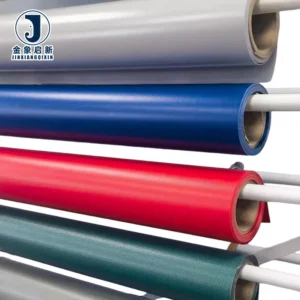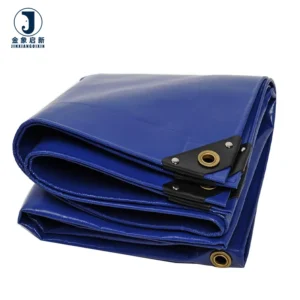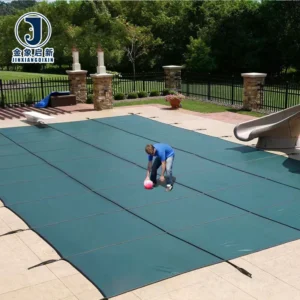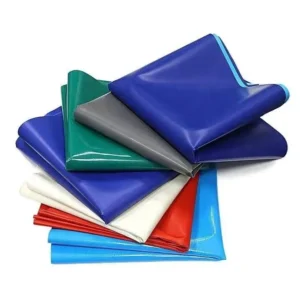
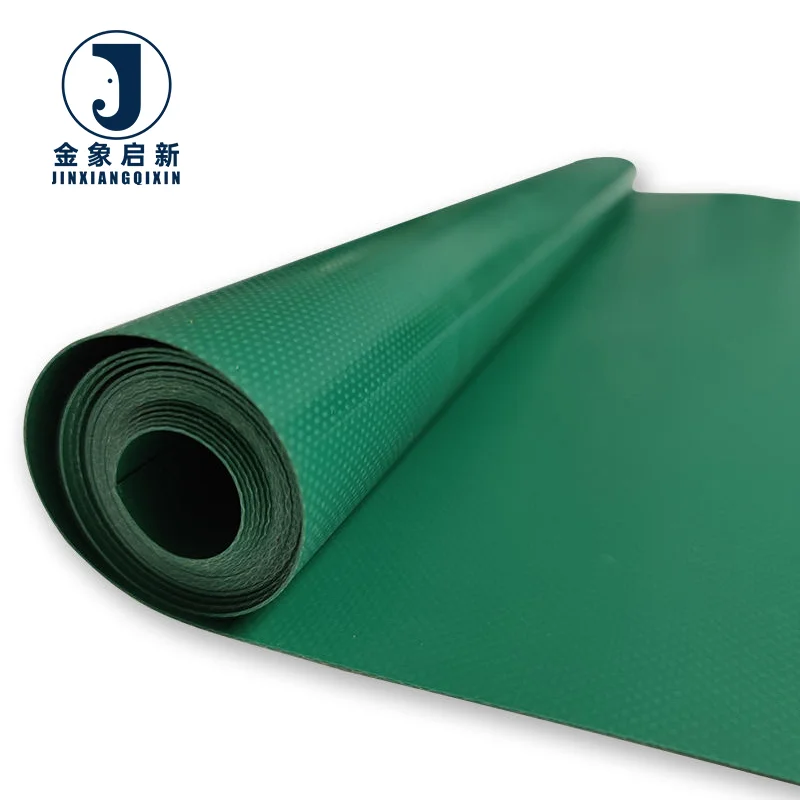
Coating Adhesion Control — verified through double-sided PVC coating on high-tenacity polyester, maintaining bond integrity at heat-welded seams under repeated load flexing.
Technical Specifications
| Parameter | Value |
|---|---|
| Product Type | PVC Coated Tarpaulin |
| Base Fabric Denier | 500D×840D / 500D×1000D / 1000D×1000D / 1000D×1300D / 1300D×1300D / 1000D×2000D |
| Mesh Count | 30×19 / 20×20 / 30×15 |
| Coating Material | PVC & Polyester |
| Total Thickness | 0.29mm / 0.32mm / 0.38mm / 0.44mm / 0.46mm / 0.55mm / 0.65mm |
| Warp Tensile Strength | 1650 N to 3900 N (test standard not stated) |
| Weft Tensile Strength | 1600 N to 3500 N (test standard not stated) |
| Density Parameter | 1.15–2.00 g/cm³ |
| Brittle Temperature | ≤ -50 to -60 °C |
| Softening Temperature | ≥ 80 °C |
| Melting Point | 212 °C |
| Key Features | Water resistant, waterproof, flame retardant (grade not stated — confirm grade required for your market), anti-UV (test basis not stated — confirm certification required) |
| Edge Finishing | 5mm rope without splicing, high-temperature heat-sealed seamless edge wrapping, 3cm enlarged aluminum alloy buttonhole, reinforced corners |
| Surface | Smooth, soft, leather-like texture |
| Repairability | Hot air welding |
| Customization | Size, hole spacing, color, printing |
| Standards | ISO certified, CE certified |
Application Suitability
| Application | Exposure & Requirement |
|---|---|
| Industrial shelter covers | Prolonged UV exposure, wind load, thermal cycling — requires stable base fabric and consistent coating adhesion |
| Truck and trailer covers | Constant road vibration, flex at tie-down points, abrasion from cargo movement |
| Awning and terrace pergola fabric | Permanent outdoor weathering, tension at frame mounting points, colour retention under sunlight |
| Tent and event structure fabric | Repeated assembly and teardown stress, waterproofing under wind-driven rain, flame retardant compliance depending on venue |
| Pond and reservoir liners | Continuous water contact, soil chemistry exposure, puncture risk during installation |
| Balcony and window rainproof covers | Residential proximity requiring clean appearance, moderate wind load, seasonal UV exposure |
Why Base Fabric Denier Defines the Real Grade of PVC Coated Tarpaulin
Two rolls can carry the same GSM label yet fail at completely different points in service.
When a PVC coated tarpaulin arrives lighter than the quotation stated, the problem often traces back to the base fabric rather than the coating layer alone. A roll built on 500D×840D yarn with a 20×20 mesh count will behave differently under tension than one woven from 1000D×1300D at 30×19 — even if both are coated to the same total thickness. Fabricators who specify only by GSM frequently discover that weld seams fail before the body fabric does, precisely because the underlying yarn structure lacked the denier to hold the weld under load flexing. [NEED_CITE: relationship between base fabric denier and heat-weld seam strength in PVC coated fabrics]
How Yarn Count and Mesh Density Shape Tensile Behaviour
The PVC coated tarpaulin range spans 500D×840D through 1000D×2000D base fabric, paired with mesh counts of 30×19, 20×20, and 30×15. Higher denier in the warp direction directly increases resistance to longitudinal tearing — critical when fabric is tensioned across a truck trailer side curtain or stretched over an industrial shelter frame. Mesh density governs how evenly coating paste penetrates the weave: a tighter 30×19 grid creates more coating anchor points per square inch, improving peel strength at the PVC-to-polyester interface. Specifying the correct combination prevents the coating from delaminating under sustained tension.
Thermal Envelope and Coating Integrity Across Seasons
With a brittle temperature of ≤ -50 to -60 °C and a softening threshold of ≥ 80 °C, this PVC coated tarpaulin maintains flexibility across most operating climates. [NEED_CITE: low-temperature flexibility testing methods for PVC coated polyester fabrics per ISO standards] Below the brittle point, the plasticiser in the PVC matrix stiffens, and impact from cargo shifting or wind-driven debris can initiate cracks that propagate along the warp yarns. Above the softening point, the coating becomes tacky and susceptible to marking from contact surfaces. Understanding these boundaries lets fabricators match the grade to the expected thermal range of the installation site, avoiding premature failure at seasonal extremes.
Reading the Specification Sheet Beyond GSM
Total thickness values from 0.29mm to 0.65mm correlate with the combined weight of base fabric and double-sided PVC coating, but thickness alone does not predict tensile performance. A 0.44mm fabric built on 1000D×1000D with a 20×20 mesh delivers different warp and weft strength figures than a 0.44mm fabric on 500D×1000D at 30×15 — the first relies on balanced yarn weight in both directions, while the second concentrates strength in the weft. For applications like side curtain fabric where flex cycles concentrate stress at the weld line, the base fabric denier determines how many thousands of flex cycles the seam survives before the polyester yarns begin to break through the coating. [NEED_CITE: DIN 53354 or ISO 1421 tensile test methods for coated fabrics]
The Cost of Overlooking Coating Adhesion at the Weld Line
Fabricators regularly report that heat-welded seams on PVC coated tarpaulin fail before the body fabric reaches its rated tensile limit. This happens when the coating formulation or base fabric surface texture does not allow sufficient molecular bonding during the hot-air welding cycle. A smooth, leather-like surface may look appealing on the roll but can indicate lower surface energy, reducing weld penetration. When a truck cover seam splits at the flex point under highway wind load, the repair cost and cargo exposure far exceed the price difference of selecting a grade engineered for reliable heat-sealed seams. [NEED_CITE: weld seam failure analysis in PVC coated technical textiles]
Why Technical Buyers Source PVC Coated Tarpaulin Here
Three full production lines and 36 sets of professional equipment support bulk roll output with consistent coating weight control, reducing the batch-to-batch variation that causes colour mismatch when two rolls are installed side by side. The 10-person R&D team handles material selection, pattern printing, and custom sizing — meaning a fabricator can request a specific denier and mesh count combination matched to their welding equipment parameters. Every roll passes dedicated QA/QC inspection at each production stage with 100% pre-shipment verification, so the GSM stated on the material specification sheet is the GSM that arrives at the loading dock. Samples are developed within days for custom requirements, allowing fabricators to test weld parameters before committing to a container order.
Documentation & Verification
- Material specification sheet confirming base fabric denier, mesh count, total thickness, and coating weight per grade
- Test reports for UV and flame-retardant grades where applicable, matched to the specific roll batch
- Pre-shipment inspection record with roll-by-roll GSM and colour verification before container loading
- Roll packing list with net weight and dimensions for accurate freight planning
- Certificate of origin and customs documentation for smooth import clearance
Fabrication, Handling & Storage
- Hot air welding parameters should be calibrated to the specific thickness (0.29mm–0.65mm) and coating formulation of each grade
- Edge wrapping uses high-temperature heat-sealed construction — avoid re-heating sealed edges during secondary fabrication to prevent delamination
- Store rolls horizontally on padded racks to prevent permanent creasing of the PVC surface, especially on grades above 0.44mm
- Allow cold-stored rolls to reach ambient temperature before unrolling to prevent micro-cracking of the PVC coating at ≤ -50 °C brittle threshold
- Clean surfaces with pH-neutral detergent only; solvent-based cleaners may degrade the plasticiser in the PVC matrix
Planning Your PVC Coated Tarpaulin Specification
Before requesting a quotation, prepare the base fabric denier and mesh count that match your fabrication method, along with the thickness range your welding equipment can handle. Confirm whether your end market requires a specific flame-retardant grade or UV test standard, as documentation is issued per applicable grade. Specify target roll width and annual volume so the production team can confirm batch consistency and lead time for your colour or print requirements.
Frequently Asked Questions
Q: How is base fabric denier related to GSM and overall tensile performance?
A: Base fabric denier defines the yarn thickness in warp and weft directions. Two PVC coated tarpaulin rolls with the same GSM can carry different denier constructions — a 1000D×1300D base will show higher warp tensile strength than a 500D×1000D base at equivalent coating weight. Request the material specification sheet to verify both denier and mesh count for your application.
Q: What test standards back the flame-retardant and anti-UV claims?
A: Flame-retardant and anti-UV treatments are available in specific grades, and test reports are issued for the applicable grade upon order confirmation. We recommend confirming the exact certification required by your local building code or transport regulation before specifying, so the correct grade and supporting documentation are matched to your shipment.
Q: How does PVC coating adhesion behave at heat-welded seams under load flexing?
A: Heat-welded seam integrity depends on coating formulation, base fabric surface texture, and correct welding temperature for the specific thickness. Our R&D team can supply sample rolls for fabricators to test weld parameters on their own equipment before bulk production, ensuring seam strength matches the body fabric tensile rating under expected flex cycles.
Q: What is the difference in service life and repairability between PVC coated and PE tarpaulin?
A: PVC coated tarpaulin is repairable by hot air welding, allowing damaged sections to be patched on site without replacing the entire cover. PE tarpaulin, typically heat-cut and stitched, cannot be welded and is generally replaced rather than repaired. PVC’s double-sided coating on polyester base fabric provides substantially higher tear resistance suited to extended outdoor exposure.
Q: How are roll-to-roll colour and coating weight consistency controlled during production?
A: Each production run passes through in-process QA checks at coating, curing, and winding stages. A 100% pre-shipment inspection verifies GSM and colour reference roll by roll. For large orders spanning multiple production batches, we confirm colour matching across all rolls before dispatch to prevent visible variation once installed side by side.