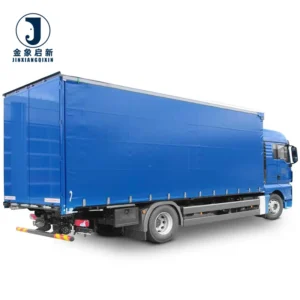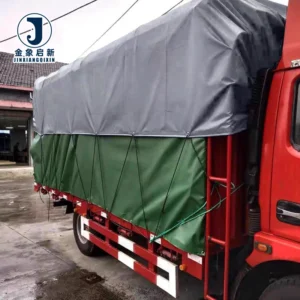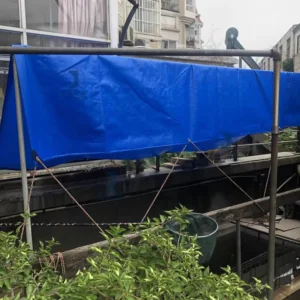
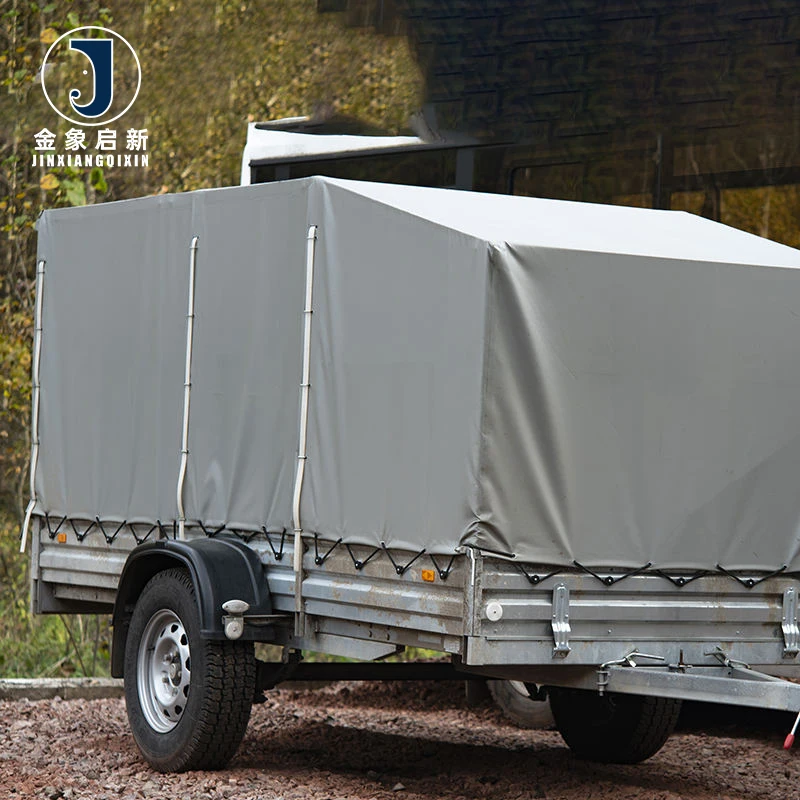
Process-Controlled Coating — every roll of this PVC Coated Tarpaulin Roll is produced on one of three dedicated coating lines with in-process weight checks, ensuring the hot-melt bonded PVC layer meets the stated GSM before it leaves the factory.
Technical Specifications
| Parameter | Value |
|---|---|
| Product Type | PVC Coated Tarpaulin Roll |
| Material | PVC coating on high-strength polyester mesh fabric |
| Coating Technology | Laminated technology & Hot-melt coating technology |
| Base Fabric | High tenacity polyester yarns |
| Weight Options | 350gsm / 420gsm / 500gsm / 550gsm / 600gsm / 750gsm |
| Thickness Range | 0.32mm / 0.35mm / 0.4mm / 0.45mm / 0.5mm / 0.65mm |
| Roll Size | 2m × 75m or 2.1m × 50m |
| Colour Options | Blue / Red / Yellow / Light blue / Grey (customised colours available) |
| Waterproof | Fully waterproof coated construction |
| Cold Crack Resistance | Stated cold-crack resistant formulation |
| Anti-Mildew | Anti-mildew treatment applied |
| UV Treatment | Sunproof treatment (test basis not stated — request report) |
| Flame Retardant | Available as special treatment (grade not stated — confirm the grade required for your market) |
| Anti-Static | Available as special treatment (standard not stated — confirm for site compliance) |
| Key Features | Outstanding tearing strength for welding, flexible in use, colour-fast formulation |
Application Suitability
| Application | Exposure & Requirement |
|---|---|
| Truck side curtain and awning fabric | Constant flexing at load points, road spray, UV exposure, wind flap fatigue |
| Tent and inflatable structure membrane | Tensioned spans, wind uplift, solar exposure, welded seam integrity |
| Marine and offshore maintenance enclosure | Salt-laden air, sustained moisture, cold-weather handling, chemical splash |
| Construction site and equipment cover | Abrasion from scaffolding contact, UV exposure, puncture from debris |
| Cargo ship deck cover | Saltwater immersion risk, heavy wind load, extended outdoor storage |
| Agricultural and aquaculture lining | Continuous water contact, biological growth pressure, soil chemistry |
What Coating Adhesion Means When the Weld Line Carries the Load
Hot-melt coating technology bonds the PVC layer into the polyester mesh rather than sitting on top of it, which is where weld seam failures typically originate.
When a truck side curtain flexes under highway wind load, the stress concentrates at every heat-welded seam. If the coating has poor adhesion to the base fabric, the PVC delaminates at the weld edge and the seam peels apart long before the fabric itself reaches its tensile limit. [NEED_CITE: tensile and tear test methods for coated fabrics per ISO 1421] Specifiers who select PVC Coated Tarpaulin gsm coating technology often focus on weight alone, but the coating method determines whether that weight actually transfers into usable seam strength. Laminated and hot-melt processes both force PVC into the mesh structure, creating a mechanical bond that survives repeated thermal cycling during fabrication and service.
How Laminated and Hot-Melt Coating Shape Fabrication Outcomes
The choice between laminated and hot-melt coating technology affects how the material behaves on the welding table. Hot-melt coating drives PVC into the open structure of the high tenacity polyester yarns under heat and pressure, producing a bond that resists peeling when the fabric is reheated during seam fabrication. Laminated technology applies the coating as a pre-formed film bonded to the mesh, offering a smoother surface finish that suits applications where visual appearance matters. Both methods are available across the full 350gsm to 750gsm range, so fabricators can match the coating process to their welding equipment and end-use requirements.
Selecting GSM Grade Against Tensile and Tear Demands
The six available weight grades correspond to a thickness progression from 0.32mm to 0.65mm, but the relationship between PVC Coated Tarpaulin gsm coating technology and actual field performance depends on the base fabric construction as much as the coating weight. A 500gsm fabric with a dense polyester mesh will resist tear propagation differently than a 500gsm fabric with an open weave and heavier coating. [NEED_CITE: relationship between base fabric denier and tear strength in coated polyester fabrics] Truck curtain fabricators working with side curtain tensioning systems typically specify from the middle to upper range of the GSM options, where the base fabric contributes more to tear resistance and the coating contributes more to weld integrity.
Coating Weight, Base Fabric, and the Physics of Tarpaulin Performance
The interplay between coating weight and base fabric density determines how this material handles real-world stress. Higher GSM grades add coating mass that increases puncture resistance and stiffness, but the polyester mesh denier and pick count govern how the fabric resists tearing once a cut or nick starts. Hot-melt coating fills the interstices of the mesh more completely than simple knife-coating, which means the coated fabric acts as a composite structure rather than two independent layers. This composite behaviour directly affects thermal welding: when heat is applied, the PVC within the mesh softens uniformly, allowing the two fabric faces to fuse through the full thickness of the coating rather than only at the surface. The available thickness range from 0.32mm to 0.65mm reflects different balances of flexibility and structural rigidity, and fabricators should match thickness to the bending radius their end product will experience in service.
The Hidden Cost of Specifying Weight Without Verifying Adhesion
A PVC Coated Tarpaulin gsm coating technology purchase that arrives at the correct weight but with poor coating adhesion will fail at the weld seams under load, while the unwelded fabric remains intact. [NEED_CITE: weld seam failure in coated fabric truck curtains under cyclic wind loading] Fleet operators replacing side curtains prematurely often discover that the coating was peeling at the hem and eyelet lines, where flexing is most severe. Batch-to-batch variation in coating adhesion can also produce inconsistent weld parameters, forcing fabricators to adjust heat settings from roll to roll. This is why pre-shipment inspection covers adhesion quality alongside weight verification, catching delamination risks before the material reaches the production floor.
Why Technical Buyers Source This Coated Fabric Here
Three full production lines with 36 sets of professional equipment give this facility the capacity to maintain consistent coating weight across large roll orders, which matters when a single truck curtain build may consume multiple rolls that must weld identically. The 10-person R&D team handles material selection and sample development for specific applications, allowing fabricators to test weld parameters on sample cuts before committing to bulk volumes. Dedicated QA/QC at every production stage means coating adhesion, colour consistency, and GSM weight are checked in-process, not only at final inspection. Rolls are developed as samples within days for custom width, colour, or treatment requirements, shortening the qualification cycle for new projects. ISO and CE certified production provides the documentation foundation that technical buyers and fabricators need for their own compliance records.
Documentation & Verification
- Material specification sheet stating exact GSM, base fabric construction, and coating method per roll
- Colour reference with batch traceability for multi-roll orders requiring visual consistency
- Test reports for flame retardant and UV grades where applicable — confirm standard before ordering
- Pre-shipment inspection record with 100% check of coating weight and adhesion quality
- Roll packing list with batch numbers enabling traceability from delivery back to production date
- Certificate of origin and customs documentation for international shipment
Fabrication, Handling & Storage
- Hot-weld temperature should be calibrated to the specific GSM grade and coating technology selected
- Store rolls horizontally on padded racking to prevent permanent creasing in the PVC coating layer
- Allow cold-stored rolls to reach workshop temperature before unrolling to avoid coating crack risk
- Weld seam width should exceed the minimum for the selected thickness to distribute flex load adequately
- Use compatible PVC-based repair patches matching the coating technology for field seam repair
- Plan cut patterns around the 2m or 2.1m roll width to minimise offcut waste on large panels
How to Specify Your Enquiry
Provide the target GSM grade and the coating technology preference for your welding setup, along with the roll width and colour requirements. If the end use demands flame retardant or anti-static compliance, state the specific standard your market requires so the correct treatment can be confirmed before sampling. For custom widths or finished panel dimensions, share the trailer model or structure drawings so sizing can be matched precisely.
Frequently Asked Questions
Q: How is the GSM weight of each roll verified before shipment?
A: Every roll undergoes 100% pre-shipment inspection where coating weight is measured and compared against the material specification sheet. The inspection record travels with the shipment documentation so you can cross-reference the stated GSM with the verified weight. This process catches any deviation before the material leaves the facility.
Q: What flame retardant grades can be supplied and how do I confirm the right one?
A: Flame retardant treatment is available as a special option, but the specific grade depends on your market’s regulatory framework. When you enquire, state the standard required for your application such as the classification applicable in your region. The team will confirm which grade is achievable and provide the supporting test report before you commit to the order.
Q: How does base fabric denier relate to tear strength at different GSM grades?
A: The high tenacity polyester yarns form the structural backbone of the fabric, and their denier and weave density determine how effectively a tear is arrested once initiated. Higher GSM grades add coating mass for puncture resistance, but tear propagation resistance depends primarily on the mesh construction underneath. Request the base fabric specification for the grade you are evaluating.
Q: What UV treatment is applied and is there a test report available?
A: The material carries a sunproof treatment for outdoor exposure, but the specific test basis for UV stability claims should be confirmed for your application. Request the UV test report during the enquiry stage so you can verify the treatment level matches your expected service environment and exposure duration before placing the order.
Q: How is colour consistency maintained when an order spans multiple rolls?
A: Batch-to-roll colour consistency is controlled through in-process QA checks at the coating stage and verified during 100% pre-shipment inspection. The packing list includes batch numbers so you can trace each roll back to its production run. For projects where adjacent panels must match visually, flag this requirement at enquiry so production can be planned from a single dye batch.