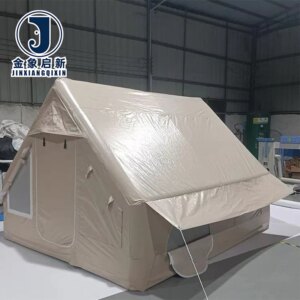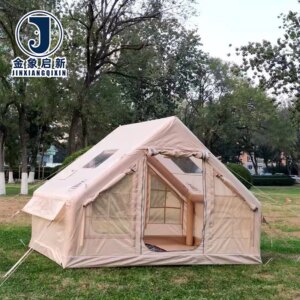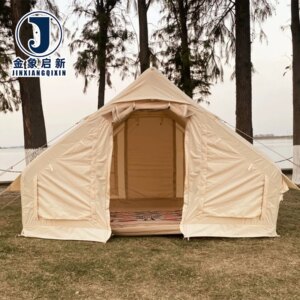
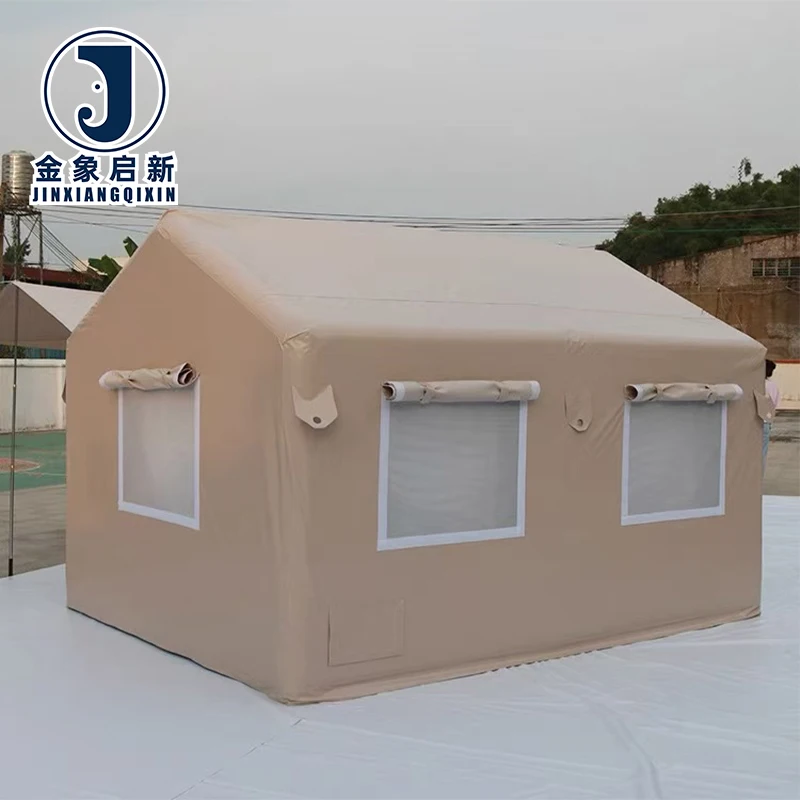
Coating Process Mastery — Three full production lines maintain precise PVC coating weight and adhesion control across 36 sets of processing equipment for inflatable tent fabric.
Technical Specifications
| Parameter | Value |
|---|---|
| Product Type | Inflatable Tent |
| Core Material | PVC tarpaulin |
| Material Thickness | 0.4mm–1.2mm |
| Waterproof | Stated (test basis to be confirmed per grade) |
| UV-Resistant | Stated (test basis to be confirmed per grade) |
| Tear-Resistant | Stated (test basis to be confirmed per grade) |
| Flame Retardant | Available in flame retardant grades — confirm the grade required for your market |
| Anti-Static | Available in anti-static grades — confirm the surface resistance standard for your application |
| Size Options | 2–8 persons |
| Key Features | Waterproof, UV-resistant, tear-resistant construction with OEM & ODM customization |
| Quality Control | Full-process inspection with dedicated QA&QC staff |
| Standards | ISO9001, ISO14001, ISO45001, CE |
Application Suitability
| Application | Exposure & Requirement |
|---|---|
| Disaster relief shelters | Rapid deployment in all-weather conditions, repeated inflation cycles, transport abrasion |
| Temporary site offices | Prolonged UV exposure, wind load on inflated structure, daily temperature swings |
| Emergency response operations | Contaminant exposure, high-frequency setup and teardown, field repair compatibility |
| Outdoor equipment storage | Moisture ingress prevention, UV degradation resistance, puncture from stored equipment edges |
| Agricultural field operations | Soil contact, chemical fertilizer exposure, seasonal storage and redeployment |
| Construction site enclosures | Dust and debris impact, welding spark proximity, crane and vehicle movement nearby |
Why "Flame Retardant" Means Nothing Without a Test Standard Behind It
The grade on the certificate determines whether your inflatable structure passes inspection — not the word on the data sheet.
When buyers specify PVC inflatable tent fabric for industrial or disaster relief use, fire safety compliance is non-negotiable. Yet quotations frequently carry a blanket "flame retardant" claim with no reference to the test method or classification level. A tent deployed as a temporary site office in a European construction project faces different fire classification requirements than one used in a Middle East relief camp [NEED_CITE: regional fire safety standards for temporary structures]. Without the specific grade documented, procurement teams either over-specify and pay for performance they do not need, or under-specify and face rejection at the site safety audit. The PVC inflatable tent fabric you order must carry a test report matched to the regulation enforced in your deployment region.
Base Fabric Construction and Coating Adhesion
The tensile and tear performance of PVC inflatable tent fabric depends on the interplay between the polyester base fabric denier, weave density, and the PVC coating weight applied to each face. A higher coating thickness in the 0.4mm to 1.2mm range adds abrasion protection and waterproof integrity, but the base fabric construction governs how the material resists the biaxial stress of inflation pressure. When evaluating PVC inflatable tent fabric, request the base fabric specification alongside the total material thickness to understand where the mechanical strength originates.
Coating Method and Seam Integrity
PVC tarpaulin produced through knife-over-roll or calender coating delivers different peel strength characteristics at the coating-to-yarn interface. For inflatable tent applications, the welded seams bear concentrated stress each time the structure inflates and deflects under wind load. The coating formulation and plasticizer system directly affect heat welding parameters — a PVC inflatable tent fabric that welds cleanly at one temperature setting may produce brittle seams if the fabricator uses incompatible equipment settings.
Thickness, Weight, and Structural Performance
Material thickness spanning 0.4mm to 1.2mm reflects the range available across the product family — confirm the specific grade suited to your inflatable tent design. Thicker coatings contribute to puncture resistance against ground debris and equipment contact, while the base fabric density governs how the material handles sustained inflation pressure without creep. The relationship between total weight and tensile strength is not linear [NEED_CITE: tensile and tear test methods for coated fabrics per ISO 1421]. A lighter fabric with a tightly woven high-denier base can outperform a heavier material built on a loosely constructed scrim, which is why reviewing the complete specification sheet matters more than comparing thickness figures alone.
The Hidden Cost of Specifying on Thickness Alone
Buyers who select PVC inflatable tent fabric based on a single thickness figure without verifying the coating adhesion, base fabric construction, and treatment certifications expose their projects to preventable failures. Fabric that arrives below the stated thickness tears at stress points during the first inflation cycle. Flame retardant grades claimed without a supporting test report cause site inspectors to reject the entire installation. Batch-to-batch thickness variation across a multi-unit order means some tents perform differently from others in the same deployment [NEED_CITE: batch consistency challenges in coated fabric production]. Each of these outcomes traces back to incomplete specification at the inquiry stage.
Why Procurement Teams Source This Material Here
Three full production lines running 36 sets of professional processing equipment give the factory capacity to hold coating weight consistency across multi-roll orders for inflatable tent projects. The 10-technician R&D team handles material grade selection, pattern printing development, and custom sizing from sample stage through production. Every production run passes through full-process quality inspection with dedicated QA and QC staff verifying coating adhesion, dimensional accuracy, and treatment compliance before dispatch. OEM and ODM capability covers material selection, structural design input, and branding requirements for fabricators building inflatable tents under their own specifications. ISO9001, ISO14001, ISO45001, and CE certification documentation ships with each order to support compliance audits in your target market.
Documentation & Verification
- Material specification sheet confirming PVC coating composition, base fabric denier, and total thickness for the selected grade
- Flame retardant test report matched to the classification standard enforced in your deployment region
- Anti-static surface resistance data where required for mining or industrial inflatable structures
- Pre-shipment inspection record with batch-specific dimensional and coating weight verification
- ISO9001, ISO14001, ISO45001, and CE certificates included with dispatch documentation
- Certificate of origin and customs support paperwork for cross-border shipment clearance
Fabrication, Handling & Storage
- Heat welding parameters must match the specific PVC coating formulation — request the recommended temperature and dwell time for the selected 0.4mm–1.2mm grade
- Reinforce stress concentration points at inflation valves and structural joints using compatible PVC patches bonded with the same coating chemistry
- Store rolls horizontally on padded racks to prevent creasing that creates permanent weak lines in the PVC tarpaulin coating
- Allow cold-stored fabric to reach ambient temperature before unrolling to avoid cracking the PVC coating at low flexibility thresholds
- Use only PVC-compatible cleaners on the coated surface — solvent-based products degrade plasticizers and compromise waterproof integrity
What to Include in Your Inquiry
Specify the deployment environment and the regulatory framework your inflatable tents must satisfy, including any fire classification or anti-static standard enforced at the site. Indicate the material thickness range, color requirements, and whether you need rolls for your own fabrication line or finished units with custom sizing. State your estimated annual volume and whether sample approval is required before production commitment.
Frequently Asked Questions
Q: Which flame retardant standard applies to inflatable tents in my market?
A: Fire classification requirements vary by region and application. European construction sites typically reference EN 13501 or DIN 4102 classifications, while other markets enforce NFPA 701 or local building codes. Provide your deployment region and application type so the correct flame retardant grade is selected and documented with a matching test report.
Q: How is UV resistance verified for the PVC inflatable tent fabric?
A: UV resistance claims require a test basis tied to the specific coating formulation and grade. Request the test method reference and exposure duration data for the material grade you are evaluating. The appropriate UV treatment level depends on your expected outdoor exposure duration and geographic solar intensity conditions.
Q: How can I verify material thickness and coating weight upon delivery?
A: Each shipment includes a pre-shipment inspection record with batch-specific thickness and coating weight data. Cross-check these figures against your purchase specification on receipt. Discrepancies should be flagged immediately with the inspection documentation as reference before any fabrication work begins on the delivered rolls.
Q: What are the heat welding considerations for this PVC tarpaulin fabric?
A: Welding temperature, pressure, and dwell time must match the PVC coating formulation of the specific grade selected. Incompatible settings produce brittle seams that fail before the fabric itself. Request the manufacturer’s recommended welding parameters for your material grade and run test welds on sample pieces before committing to production.
Q: Can I receive samples before placing a bulk order?
A: Samples are developed within days for custom requirements including material grade selection, color matching, and pattern printing. Evaluate the sample for coating adhesion, weldability, and treatment performance under your specific conditions before confirming the bulk production order.