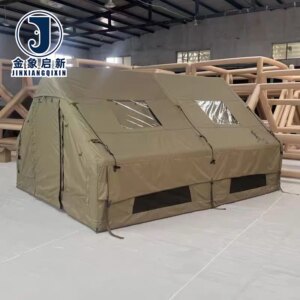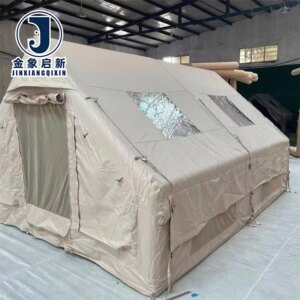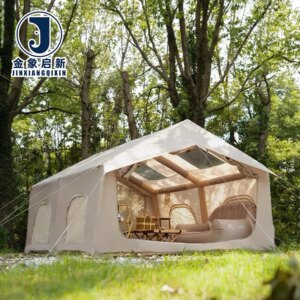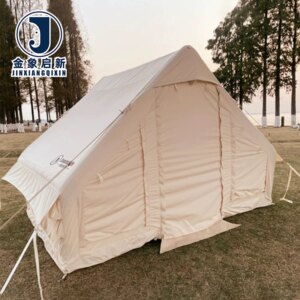
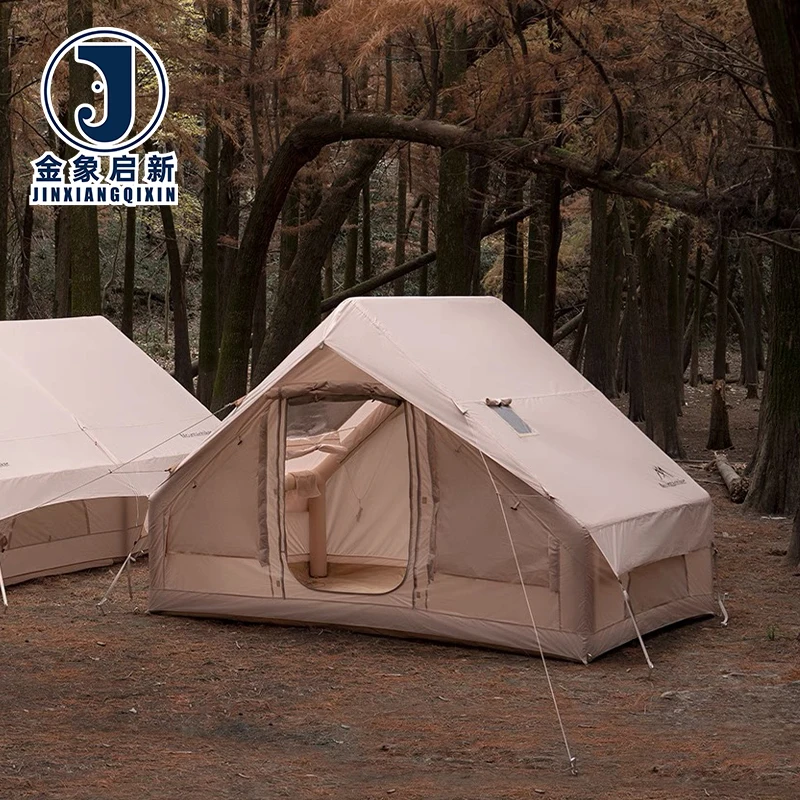
Deep Process Control — Nearly 30 years focused on coated fabric allows tight command over coating adhesion and GSM consistency across every roll of PVC inflatable tent fabric we produce.
Technical Specifications
| Parameter | Value |
|---|---|
| Product Type | Inflatable Tent Fabric |
| Core Material | PVC Tarpaulin (PVC knife-coated fabric / PVC coated fabric) |
| Coating Method | Knife coated |
| Waterproof | Yes |
| UV Treatment | UV-resistant (test basis not stated) |
| Flame Retardant | Fire-retardant (grade not stated) |
| Anti-Static | Anti-static (standard not stated) |
| Tear Resistance | Tear-resistant (test standard not stated) |
| Customization | OEM & ODM (sample customization, pattern printing, custom dimensions, material thickness adjustment) |
| Certifications | ISO9001, ISO14001, ISO45001, CE |
Application Suitability
| Application | Exposure & Requirement |
|---|---|
| 4–6 person inflatable camping tent manufacturing | Repeated inflation cycles, UV exposure, ground moisture, seam welding integrity |
| Commercial adventure tourism equipment | High-frequency deployment, abrasion from transport and site setup, colour consistency across batches |
| Industrial camping operations | Continuous weather exposure, fire safety compliance at managed campsites, tear resistance during assembly |
| Outdoor gear OEM factories | Roll-to-roll batch consistency, weldable seam compatibility, custom dimensions for pattern nesting |
Why Flame Retardant Claims Fail at Customs Without a Documented Grade
Fire-retardant without a grade on paper is just a marketing word — your tent fabric needs a test report tied to a recognised standard before it clears any regulated market.
Outdoor gear manufacturers regularly ship inflatable tents into markets with strict fire safety legislation, only to discover at the border that the fabric supplier claimed fire retardancy without providing a grade or test certificate. The shipment stalls, the buyer absorbs demurrage costs, and the production schedule unravels. This is not a rare edge case — it is one of the most common compliance failures in technical textile sourcing. [NEED_CITE: fire classification standards for temporary structures and camping equipment by market region]
When you specify an Inflatable Tent Fabric manufacturer custom grade, the conversation must start with which fire safety standard your destination market enforces, then work backwards to the coating formulation and test documentation required to prove it.
Coating Adhesion and the Weld Line Problem
The knife-coated PVC structure on this inflatable tent fabric is engineered so the coating penetrates and locks into the base fabric weave. This matters most at the weld line, where two panels are joined by heat and pressure to form the inflatable chamber. If coating adhesion is weak, the heat-activated bond separates the coating from the yarn rather than fusing the two PVC layers together. A well-controlled knife-coating process produces a uniform coating weight that melts consistently under the welding electrode, giving the seam strength to match the body fabric. This is where production line discipline directly translates to field performance.
Multi-Layer Moisture Barrier Construction
PVC inflatable tent fabric faces a demanding moisture environment — ground contact, condensation inside the inflated chamber, and rain exposure on the outer surface. The knife-coated method builds a continuous PVC film over the woven base fabric, eliminating the pinholes and micro-gaps that can appear in cheaper coating processes. For tent manufacturers, this means the waterproof barrier is integral to the material rather than an afterthought applied as a secondary finish. The result is a fabric that holds its moisture barrier performance through repeated inflation, deflation, and folding cycles. [NEED_CITE: waterproof integrity of knife-coated versus laminated PVC fabric under cyclic stress]
Reading the Specification Sheet Beyond the GSM Number
GSM alone tells you how much the fabric weighs per square metre, but it does not tell you how that weight is distributed between base fabric and coating. A heavier coating over a lighter base fabric may hit the same GSM as a lighter coating over a denser weave, yet the two fabrics behave very differently under tension and tear load. For inflatable tent construction, the base fabric denier and weave density govern how well the material resists tearing at the seam allowance, while the coating weight governs weldability and surface durability. When you evaluate an Inflatable Tent Fabric manufacturer custom offering, ask for the base fabric specification alongside the GSM to understand the full construction.
UV-Resistant Formulation and Colourfastness in the Field
Inflatable camping tents spend their working life exposed to direct sunlight, making UV stability a non-negotiable material property. This fabric is available with UV-resistant treatment, though buyers should request the specific test basis to confirm it meets their target market’s exposure requirements. The formulation is designed to slow colour shift and polymer degradation across prolonged outdoor use. Tent manufacturers producing for commercial adventure tourism should specify the UV treatment level matched to the typical deployment climate and ask for test documentation before committing to a production run.
The Real Cost of Batch-to-Batch Colour Drift
A specification sheet may promise a specific colour reference, but if the coating line does not control pigment dispersion and curing temperature within tight tolerances, the colour shifts between rolls produced on different days. For tent manufacturers cutting panels from multiple rolls to assemble a single inflatable tent, even a slight shade difference becomes visible once the panels are welded side by side and the tent is inflated on site. Buyers then face rejected production runs, wasted material, and delayed shipments — all traceable to a supplier who did not invest in in-process colour control. [NEED_CITE: colour consistency standards for coated textile production batches]
Why Process Control Matters for Inflatable Tent Fabric
This PVC inflatable tent fabric is produced on three full production lines equipped with 36 sets of professional processing equipment, giving the facility the capacity to hold tight tolerances at volume. A 10-person R&D team handles material selection, thickness adjustment, and sample development for OEM tent projects, ensuring the fabric matches the manufacturer’s welding parameters and design specifications. Every roll passes through dedicated QA and QC inspection at each production stage, with 100% pre-shipment inspection before dispatch. The coating formulation is developed in-house, allowing the team to adjust fire-retardant and anti-static additives to meet specific market requirements rather than relying on generic stock grades.
Documentation & Verification
- Material specification sheet stating GSM, base fabric construction, and coating method for every batch
- Test reports for UV resistance and flame retardancy grades where applicable to your market
- ISO9001, ISO14001, ISO45001, and CE certificates provided with each order
- Pre-shipment inspection record confirming weight and colour per roll against stated specification
- Certificate of origin and customs documentation for cross-border shipment
Fabrication, Handling & Storage
- Heat-weld parameters must match the knife-coated PVC formulation — request the recommended temperature and dwell time for this fabric grade before setting up the welding line
- Cut panels with a margin that accounts for the hem allowance, as the PVC inflatable tent fabric edge must be folded and welded to form airtight inflatable chambers
- Store rolls upright on pallets in a dry, shaded area to prevent compression marks on the coating surface that could affect weld quality
- Avoid unrolling in cold conditions where the PVC coating becomes stiff, as forced bending can cause micro-cracking at the fold line
- Clean the surface with mild, non-solvent cleaners only, as aggressive chemicals can degrade the PVC coating layer and compromise the UV-resistant treatment
What We Need From Your Inquiry
Provide the inflation chamber design and panel dimensions so we can recommend the appropriate fabric thickness and width for efficient cutting yield. Confirm the fire safety standard your destination market requires — whether that is a specific flame retardant grade or a regional compliance framework — so we can formulate and test accordingly. Let us know your annual volume and whether you need roll stock or custom cut sizes with pattern printing, and we will prepare samples for your welding line to validate before production.
Frequently Asked Questions
Q: How do I verify the flame retardant grade matches my target market regulations?
A: Tell us which fire safety standard your destination market enforces for inflatable camping structures. We will formulate the PVC coating to meet that grade and supply the corresponding test report with your shipment. If your market requirement is unclear, we can advise on the commonly accepted standards for commercial tent applications.
Q: What UV treatment test basis is available for this tent fabric?
A: UV-resistant treatment is available, and the specific test method depends on your market requirements. Request the test basis during the specification stage so we can align the formulation with your expected outdoor exposure conditions and provide documentation for your compliance file.
Q: Can I customise thickness, pattern printing, and dimensions for OEM production?
A: Yes. Our 10-person R&D team handles custom thickness adjustment, pattern printing, and dimension specifications for OEM inflatable tent projects. We develop samples for your approval before mass production, allowing you to validate welding compatibility and visual appearance on your own production line.
Q: How do you control colour and performance consistency across multiple rolls?
A: Every roll passes through in-process QA checks and 100% pre-shipment inspection covering coating weight, colour reference, and surface quality. We maintain batch records that trace each roll to its production run, so you can verify consistency across the entire order before the material reaches your factory.
Q: What seam construction method is recommended for PVC inflatable tent chambers?
A: Heat welding is the standard joining method for PVC inflatable tent fabric, creating an airtight bond at the chamber seams. We supply the recommended welding parameters matched to our knife-coated formulation so your fabrication team can set up the line with confidence and achieve consistent seam strength across production runs.