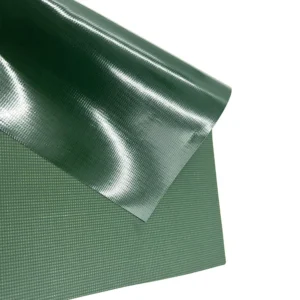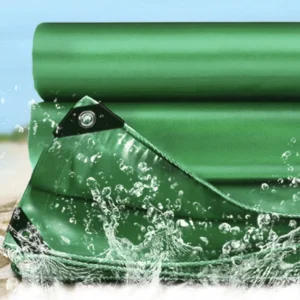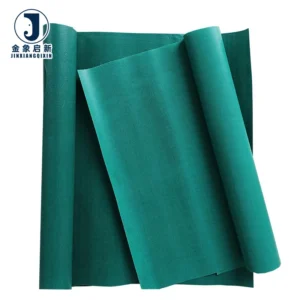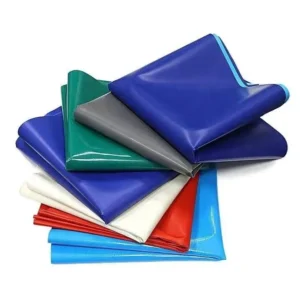
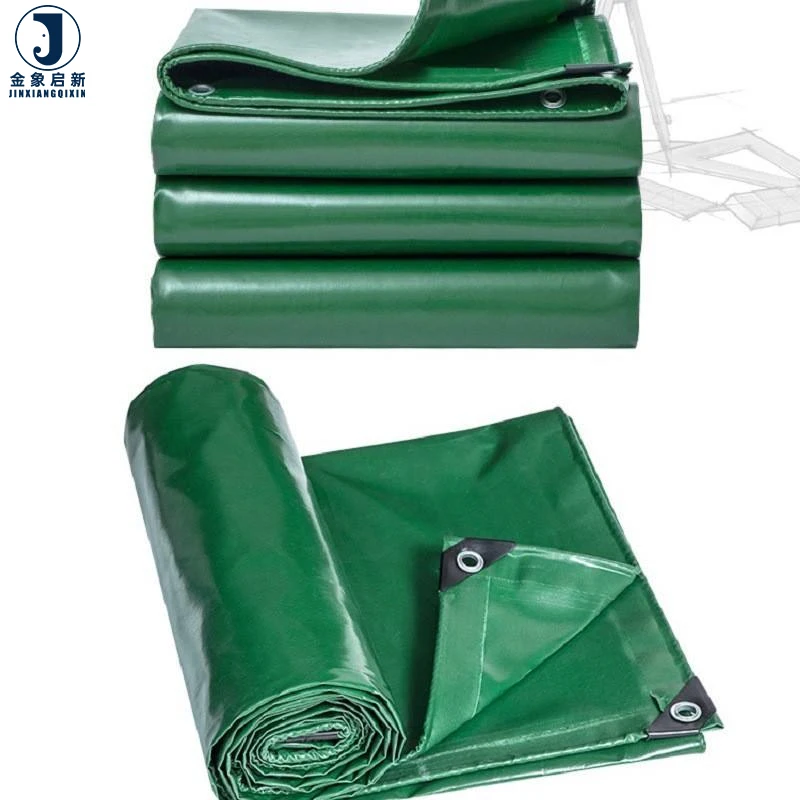
Material Consistency Control — every roll of PVC Coated Tarpaulin is checked against its stated coating weight and base fabric specification before leaving the production line, eliminating the mismatch between quotation and delivery that disrupts fabricator planning.
Technical Specifications
| Parameter | Value |
|---|---|
| Product Type | PVC Coated Tarpaulin |
| Material | PVC + High-strength polyester mesh fabric |
| Coating Technology | Laminated & Hot-melt Coating |
| Weight (GSM) | 350 gsm / 420 gsm / 500 gsm / 550 gsm / 600 gsm / 750 gsm |
| Total Thickness | 0.32 mm / 0.35 mm / 0.4 mm / 0.45 mm / 0.5 mm / 0.65 mm |
| Roll Size | 2 m × 75 m / 2.1 m × 50 m |
| Surface Finish | Glossy or Matte |
| Color Options | Blue, Red, Yellow, Light Blue, Grey (customised colours available) |
| Key Features | Waterproof, Cold Crack Resistance, Anti-Mildew, UV Resistance, Anti-Static (grade not stated — confirm requirement for your application) |
| Service Life | 3–7 years under normal conditions (source value — verify against application environment) |
| Certifications | ISO, CE |
Application Suitability
| Application | Exposure & Requirement |
|---|---|
| Truck awning and side curtain | Continuous flexing at fold points, road spray, UV exposure, weld seam integrity under tension |
| Cargo ship cover | Salt-laden moisture, heavy wind load, prolonged sun exposure, abrasion from shifting cargo |
| Tent and temporary structure cover | Repeated assembly and teardown, seam stress at pole contact points, weather resistance across seasons |
| Fish tank and pool liner | Permanent water immersion, chemical exposure from water treatment, puncture risk from substrate |
Why Coating Weight Verification Matters More Than the GSM Label
A quoted GSM only protects you when the coating adhesion and base fabric density are independently confirmed before the roll ships.
Technical buyers who specify PVC Coated Tarpaulin base fabric denier and weave coating weight know that a label reading 550 gsm tells you nothing about how that mass is distributed between the polyester mesh and the PVC layers. A roll that is heavy because of excessive filler in the coating will behave differently under tension than one that achieves the same weight through a denser base fabric. The result is that two rolls with identical GSM labels can show markedly different tear propagation and weld-line behaviour once they enter fabrication. [NEED_CITE: tensile and tear test methods for coated fabrics per ISO 1421]
How the Base Fabric and Coating Method Shape Performance
The high-strength polyester mesh base fabric provides the structural backbone of every PVC Coated Tarpaulin roll in this range. The denier and weave density of this mesh determine how load distributes across the material when it is tensioned over a frame or welded into a panel. Hot-melt coating penetrates the mesh interstices more thoroughly than laminated coating, producing higher adhesion between the PVC and the yarn, which directly influences how the material behaves at heat-welded seams during fabrication.
Coating Technology Choices and Their Fabrication Impact
Fabricators working with PVC Coated Tarpaulin base fabric denier and weave coating weight specifications need to understand the downstream effects of choosing laminated versus hot-melt coating. Laminated construction typically delivers a smoother surface suitable for printing and visual applications, while hot-melt coating produces stronger peel resistance at the coating-to-yarn interface. This distinction becomes critical when the finished product will experience repeated flexing or when weld seams carry structural load. [NEED_CITE: peel strength testing methods for coated textile laminates]
Reading GSM, Thickness, and Tensile Behaviour Together
Weight alone is an incomplete predictor of field performance. The 350 gsm grade at 0.32 mm thickness serves applications where flexibility and low roll weight are priorities, such as temporary tent covers or light-duty equipment wraps. Moving through the range, the 550 gsm / 0.45 mm and 600 gsm / 0.5 mm grades provide the balance of tear resistance and weld integrity that truck awning fabricators typically specify. At the upper end, the 750 gsm / 0.65 mm grade is directed at cargo ship covers and heavy-duty applications where puncture resistance and long-term weather exposure dominate the selection criteria. The relationship between GSM and thickness in this range reflects the coating density rather than added filler, which means tensile behaviour tracks proportionally with the stated weight grade.
What Happens When Specification and Delivery Do Not Match
A roll that arrives lighter than the material specification sheet stated does not just lose tensile margin — it changes the fabrication parameters that the workshop has already set. Weld temperatures calibrated for a 600 gsm material will burn through a lighter roll, and seam strength drops accordingly. Colour variation between rolls within the same shipment forces the fabricator to either reject stock or accept visible panel mismatches on the finished installation. Anti-UV or flame-retardant treatments that were specified but not verified by a test report leave the end user exposed to compliance failure at the inspection stage. [NEED_CITE: flame retardant classification standards for textile building materials]
Why Fabricators Source This Roll Stock Here
Three full production lines with 36 sets of professional equipment give this facility the capacity to maintain batch consistency across large-volume PVC Coated Tarpaulin orders, so roll-to-roll colour and weight stay within tolerance. A dedicated 10-person R&D team handles custom colour matching, width requests, and sample development within days rather than weeks. Every production stage includes in-process QA, and 100% pre-shipment inspection catches GSM deviations and surface defects before the roll is packed. The coating process control developed over nearly 30 years of focused production means adhesion strength is managed at the coating head, not left to chance. Material specification sheets are issued per roll, providing the traceability that distributors and fabricators need for their own quality records.
Documentation & Verification
- Material specification sheet stating GSM, base fabric type, and coating method per roll
- Test report for UV resistance and flame-retardant grades where applicable and requested
- Pre-shipment inspection record confirming weight and visual check on every roll
- ISO and CE certificates included in the shipping documentation package
- Roll packing list with batch and colour reference for full traceability
Fabrication, Handling & Storage
- Hot-melt coated grades require weld temperature calibration to coating thickness — test on an offcut before running production panels
- Store rolls horizontally on a flat rack to prevent permanent creasing across the polyester mesh base fabric
- Glossy surface rolls should be handled with clean cotton gloves to avoid fingerprint marks that show after installation
- Allow cold-stored rolls to reach ambient temperature before unrolling to prevent cracking of the PVC coating layer
- Cut panels with a minimum seam overlap suited to the GSM grade — heavier grades need wider overlaps for reliable weld adhesion
What We Need From Your Enquiry
To recommend the correct grade and coating method, share the end-use application, the environmental exposure the finished product will face, and any fire-safety or compliance requirements in your target market. Let us know the roll width and length you need, the annual volume, and whether you require custom colour matching or printed branding. If you are comparing laminated and hot-melt coating for a specific fabrication process, request samples of both to test on your own welding equipment before placing a bulk order.
Frequently Asked Questions
Q: What GSM grade suits truck side curtains versus pond liners?
A: Truck side curtains typically require a mid-to-heavy grade that balances flex endurance with weld seam strength, while pond liners prioritise puncture resistance and water immersion stability. The specific grade depends on trailer dimensions, load type, and water chemistry. Share your application details so we can recommend the appropriate weight and coating method from the available range.
Q: Can colour consistency be held across a full container of rolls?
A: Yes. Production runs for a single order are scheduled consecutively on the same line with the same colour formulation. Pre-shipment inspection includes a visual comparison of rolls within the batch. If your project is especially sensitive to panel-to-panel colour variation, request a colour reference sample to approve before production begins.
Q: What roll width and length options are available?
A: Standard roll sizes are 2 m × 75 m and 2.1 m × 50 m. Custom widths and lengths can be produced depending on the GSM grade and coating method selected. Share your required dimensions and quantity so we can confirm feasibility, minimum order, and lead time for your specification.
Q: Are test reports supplied for UV and flame-retardant claims?
A: Test reports are provided for UV resistance and flame-retardant grades where applicable and specified in your order. Available flame-retardant grades should be confirmed against the fire-safety standards required in your destination market. State the relevant standard in your enquiry so the correct treatment and documentation are arranged before production.
Q: What is the lead time for custom colour or printed rolls?
A: Custom colour and printed rolls require a sample approval step before bulk production proceeds. Lead time depends on the complexity of the colour match or print design, the GSM grade, and the order volume. Samples are typically developed within days of confirming the design brief, and the production schedule is confirmed once the sample is approved.