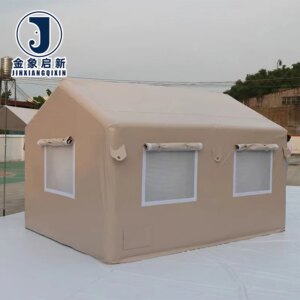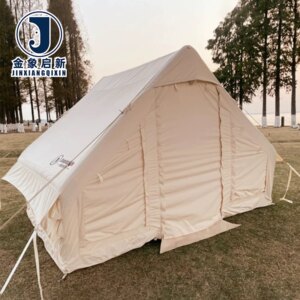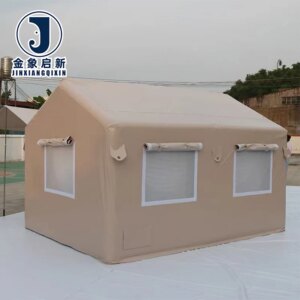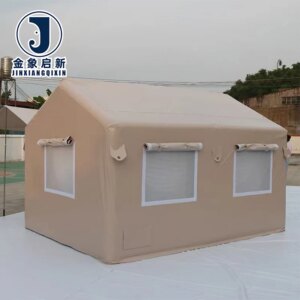
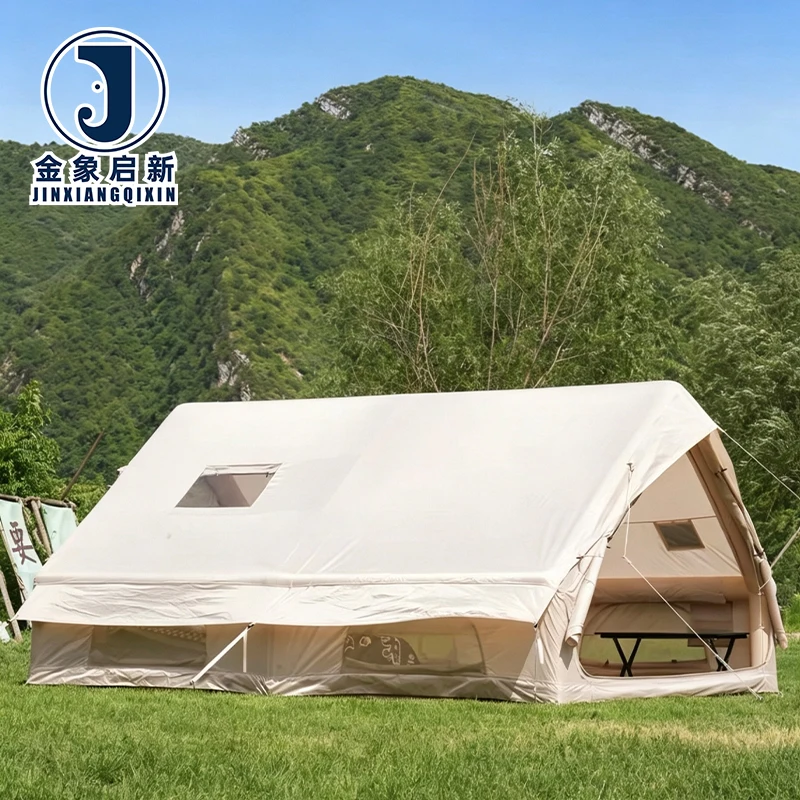
Coating Process Mastery — Deep control over PVC coating adhesion ensures heat-weld seams hold under cyclic inflation stress, critical for inflatable tent membrane integrity.
Technical Specifications
| Parameter | Value |
|---|---|
| Product Type | Inflatable Tent |
| Core Material | PVC Tarpaulin |
| Capacity | 8-10 Person |
| Deployment System | Quick Automatic Opening |
| Season Rating | Four-Season |
| Waterproof Rating | 3000mm water column |
| Fire-retardant Standard | EN 13501-1 |
| Key Features | Waterproof, UV-resistant, Tear-resistant, Fire-retardant, Anti-static |
| Raw Material | Virgin PVC resin (GB/T 5761-2006) |
| Thickness Tolerance | ±2% |
| Customization | OEM & ODM (size adjustments, Pantone color matching, logo printing, custom door/window configurations) |
| Quality Testing | 24-hour inflation testing for airtightness and structural stability |
| Standards | ISO 9001, ISO 14001, ISO 45001, CE, EN 13501-1, GB/T 5761-2006 |
Application Suitability
| Application | Exposure & Requirement |
|---|---|
| Commercial adventure tourism basecamps | Sustained air pressure, high-wind flexing, all-season weather, rapid deployment needs |
| Temporary workforce housing at remote sites | Extended outdoor exposure, temperature swings, fire safety compliance, heavy use cycles |
| Field research stations | Harsh environmental conditions, long-duration inflation, UV exposure, equipment protection |
| Event management temporary structures | Public safety fire codes, repeated setup and teardown, visual consistency across panels |
| Industrial camping facilities | Continuous occupancy loads, abrasion from ground contact, maintenance cleaning cycles |
Why Inflatable Tent Fabric Material Specification Demands More Than a GSM Number
A fabric’s weight alone does not predict how it will behave when inflated, flexed, and exposed to weather for months.
Technical buyers sourcing inflatable tent fabric material specification data often receive quotations listing only GSM. Yet two rolls at the same weight can differ dramatically in tensile strength, coating adhesion, and seam behaviour depending on the base fabric denier, weave density, and coating method used. A knife-coated PVC tarpaulin with a high-denier polyester base will outperform a calendar-rolled alternative at the same weight when subjected to the cyclic inflation loads an inflatable tent demands. Without inspecting the full material construction — base fabric, coating weight, and surface treatment — purchasing decisions rest on incomplete information [NEED_CITE: tensile and tear test methods for coated fabrics per ISO 1421].
Coating Adhesion and Seam Integrity Under Inflation Stress
The Inflatable Tent Fabric material specification must account for what happens at the weld line. Inflatable tent structures concentrate mechanical stress at seam junctions where panels meet and the membrane curves under internal air pressure. When coating adhesion is weak, the PVC layer delaminates from the polyester base at these flex points, and the welded seam splits before the body fabric shows any sign of failure. Knife-coated construction with controlled adhesion values ensures the coating and base fabric behave as a single unit during heat welding, producing seams that match the parent material strength.
Thickness Consistency Across the Roll for Uniform Air Retention
Manufacturing inflatable tents from rolls with variable thickness creates panels that inflate unevenly and stress asymmetrically. A thickness tolerance of ±2% across production batches means every cut panel holds its designed shape under pressure without localized bulging or under-inflated zones. This consistency is essential when fabricating large multi-chamber structures where one weak panel compromises the entire frame. The controlled coating process maintains uniform PVC deposition, ensuring each square metre performs identically whether it forms a load-bearing arch or a sidewall panel [NEED_CITE: coating weight uniformity standards for technical textile manufacturing].
Interpreting the Specification for Structural Performance
Base fabric denier and weave density establish the mechanical baseline that coating weight then builds upon. A higher denier polyester yarn resists tear propagation more effectively than a lighter yarn, and the weave count determines how load distributes across the fabric plane. The knife-coating method used here forces PVC into the weave interstices, creating a mechanical lock that supports both peel strength during heat welding and overall dimensional stability. Fire-retardant compliance to EN 13501-1 addresses the fire safety requirements enforced on commercial temporary structures in European and aligned markets. Available in flame retardant grades — confirm the specific grade required for your target market before placing an order. The virgin PVC resin sourced to GB/T 5761-2006 provides consistent plasticiser behaviour during fabrication, preventing the erratic melting points that recycled resin introduces at the weld line.
The Hidden Cost of Specification Misalignment
Ordering fabric based solely on price per kilogram and quoted GSM leads to field failures that surface only after the tent is inflated and occupied. Coating that is lighter than stated reduces waterproof performance and accelerates UV degradation. Rolls with unverified flame-retardant claims fail site inspections, forcing replacement mid-project and delaying handover. Colour variation between rolls in a single shipment becomes visible the moment adjacent panels are welded together on a large structure, triggering rejection and rework. Heat-weld parameters calibrated for one coating formulation tear through a different formulation, generating scrap and production downtime that erodes margins [NEED_CITE: EN 13501-1 fire classification for building materials and temporary structures].
Why Procurement Starts Here
Three full production lines and 36 sets of processing equipment deliver the volume required for container-load roll orders with reliable scheduling. A 10-person R&D team develops samples within days, matching Pantone references and testing weld parameters before bulk production begins. Every production stage carries dedicated QA/QC checkpoints, with 100% inspection before shipment catching thickness deviations, colour drift, and adhesion faults before rolls leave the facility. The 9,180 m² production operation focuses exclusively on coated fabric, building process knowledge specific to PVC tarpaulin behaviour rather than spreading capacity across unrelated product categories. Batch-specific quality records accompany each dispatch, providing traceability from raw resin lot to finished roll.
Documentation & Verification
- Material specification sheet confirming base fabric denier, coating method, and GSM for each roll
- Fire-retardant test report to EN 13501-1 matching the grade claimed on the quotation
- Pre-shipment inspection record including thickness tolerance verification at ±2%
- 24-hour inflation test documentation confirming airtightness and structural stability
- Roll packing list with colour reference and batch number for traceability
- Certificate of origin and customs documentation for cross-border shipment
Fabrication, Handling & Storage
- Heat-weld temperature and dwell time must be calibrated to the virgin PVC resin coating formulation for full seam strength
- Store rolls upright on pallets in a climate-controlled area to prevent permanent creasing in the PVC coating layer
- Cut panels should be welded within a controlled timeframe to avoid surface contamination affecting adhesion
- Use compatible PVC-based repair patches and solvent cement matching the knife-coated surface chemistry
- Plan panel layout to minimise off-cuts, accounting for the roll width against the tent chamber geometry
Moving Your Inquiry Forward
Specify the inflation pressure your tent design requires, the environmental conditions it will face, and the fire safety codes enforced in your target market. Provide the panel dimensions and annual roll volume so that width, colour consistency, and production scheduling can be confirmed against your timeline. Indicate whether Pantone-matched colour, logo printing, or custom door and window configurations are needed, and whether you require finished cut panels or full rolls for your own fabrication line. Requesting a sample roll with weld test pieces allows you to validate heat-weld parameters on your equipment before committing to a production order.
Frequently Asked Questions
Q: How does GSM relate to tensile and tear strength in inflatable tent membrane applications?
A: GSM measures total weight per square metre but does not isolate the contribution of base fabric versus coating. A high-denier polyester base with a lighter coating can outperform a heavier roll built on a low-denier base. The base fabric construction determines tensile and tear baseline; coating weight adds surface protection and weldability.
Q: What test standards verify UV and flame-retardant treatment claims on PVC tarpaulin?
A: Flame-retardant performance is tested to EN 13501-1 for European market compliance. UV resistance claims should be supported by accelerated weathering test reports specifying the exposure hours and methodology used. Always request the test report that corresponds to the specific batch being supplied rather than accepting a generic datasheet.
Q: Why do welded seams fail before the fabric, and how is seam strength specified?
A: Seam failure typically results from poor coating adhesion to the base fabric, inconsistent coating thickness at the weld zone, or incorrect heat-weld parameters. Knife-coated PVC with controlled adhesion values produces welds that approach parent material strength. Specify peel strength requirements and request weld test samples with each batch.
Q: What documentation accompanies each shipment of inflatable tent fabric?
A: Each dispatch includes a material specification sheet, batch-specific quality inspection report, fire-retardant test certificate where applicable, roll packing list with colour references, and certificate of origin. Pre-shipment inspection records confirm thickness tolerance and coating weight verification against the quoted specification before the rolls are loaded.