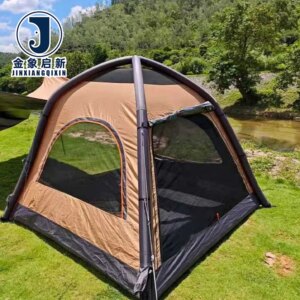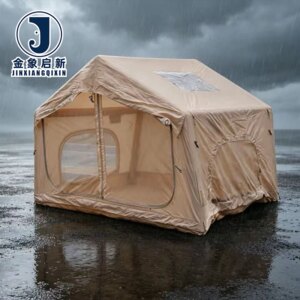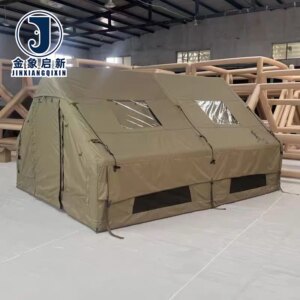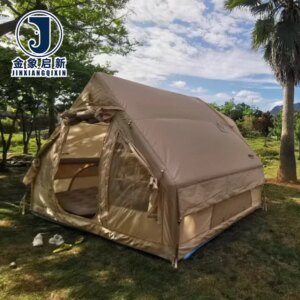
Coating Adhesion Control — Every roll of Inflatable Tent Fabric produced undergoes in-process thickness verification at ±0.1mm tolerance, ensuring the PVC coating bonds uniformly to the base fabric and delivers consistent tensile performance across the entire batch.
Technical Specifications
| Parameter | Value |
|---|---|
| Product Type | Inflatable Tent Fabric / PVC Tent |
| Core Material | PVC Tarpaulin |
| Waterproof Rating | Hydrostatic head ≥ 5000mm |
| Tensile Strength | ≥ 3000N/5cm |
| Fire Retardancy Standard | EN 13501-1 |
| UV Treatment | UV-resistant (test basis not stated) |
| Anti-Static | Stated (surface resistance or standard not stated) |
| Tear Strength | Tear-resistant (test basis not stated) |
| Fabric Thickness Tolerance | ±0.1mm |
| Key Features | Waterproof, flame retardant, UV-resistant, tear-resistant, anti-static |
| Customization | OEM & ODM, sample customization, pattern printing, custom dimensions, fabric thickness adjustments |
| Production Facility | 9,180 m² with 3 full production lines and 36 sets of processing equipment |
| R&D Team | 10 technicians |
| Standards | ISO9001, ISO14001, ISO45001, CE, EN 13501-1 |
Application Suitability
| Application | Exposure & Requirement |
|---|---|
| Disaster recovery temporary workspace | Continuous weather exposure, rapid deployment, fire safety compliance on site |
| Equipment storage during infrastructure projects | UV exposure, dust and moisture ingress, heavy material contact |
| Mobile command centers for logistics coordination | Repeated inflation cycles, temperature fluctuation, interior climate control |
| Industrial material handling space | Abrasion from equipment movement, chemical dust, mechanical puncture risk |
| Temporary personnel accommodation in controlled environments | Flame retardancy for occupancy safety, thermal insulation, waterproof integrity |
| Emergency response staging areas | Rapid assembly under adverse weather, verified fire-retardant certification for regulatory approval |
Why Flame-Retardant Certification Matters More Than the Claim Itself
Specifying Inflatable Tent Fabric without a named fire-retardant standard leaves project compliance to chance. This fabric carries EN 13501-1 classification, meaning it has been tested against a defined European reaction-to-fire standard rather than marketed on a generic "flame retardant" label.
Industrial emergency shelters and temporary workspaces operate under site safety regulations that demand documented fire performance. A fabric described only as "flame retardant" without a grade provides no basis for safety officers to approve deployment. [NEED_CITE: EN 13501-1 reaction to fire classification for construction products and building materials]. When the specification sheet names the standard, the procurement team can cross-reference it directly against local regulatory requirements before the order is placed, eliminating the risk of rejected shipments or failed site inspections.
Coating Weight and the Waterproof Barrier
The hydrostatic head rating of ≥ 5000mm on this Inflatable Tent Fabric is achieved through controlled PVC coating application across the base fabric. The coating fills the weave interstices completely, creating a continuous impermeable layer that prevents water penetration even under sustained hydrostatic pressure. For emergency shelters deployed in heavy rainfall or flood-adjacent zones, this rating translates to reliable interior dryness without secondary membrane installation. The consistency of coating weight across the roll is maintained through the ±0.1mm thickness tolerance enforced during production.
Tensile Performance Under Inflation Load
Inflatable structures place unusual demands on fabric because the material must sustain internal air pressure continuously while resisting external wind loads and handling stress. The tensile strength of ≥ 3000N/5cm provides the structural margin required for these combined forces. This rating is particularly relevant at seam junctions and valve surrounds where stress concentrates. [NEED_CITE: tensile and tear test methods for coated fabrics per ISO 1421]. The 10-person R&D team can adjust fabric thickness and coating formulation to match specific inflation pressure requirements for different shelter geometries.
Reading the Specifications Beyond the Numbers
Tensile strength of ≥ 3000N/5cm indicates the force required to break a 5cm strip of fabric, but real-world performance also depends on the base fabric weave density and yarn denier. A tightly woven base distributes load across more yarns, reducing the chance of localized failure at stress points. The PVC coating method — whether knife-over-roll, dip, or calender — directly affects peel strength between coating and substrate, which determines whether the fabric delaminates before it tears. Anti-static properties are stated for this Inflatable Tent Fabric, though the specific surface resistance value and test standard should be confirmed for environments with sensitive electronic equipment or combustible dust. UV-resistant treatment is applied, but the test basis and expected service life under direct sun should be requested as part of the sample evaluation process. Fire-retardant compliance to EN 13501-1 covers reaction to fire under European classification, which maps to specific end-use building and occupancy regulations in markets adopting EN standards.
When Specification Gaps Become Site Failures
The gap between a quoted specification and the fabric that arrives on site is where project risk concentrates. Rolls that arrive lighter than the stated coating weight will show reduced waterproof performance and lower tensile margins, often failing first at welded seams where the material flexes under inflation pressure. [NEED_CITE: common failure modes in coated technical fabrics under cyclic loading]. Fire-retardant treatment claimed without a batch-specific test report creates a documentation gap that site safety auditors will flag immediately, potentially halting operations until replacement material arrives. Thickness variation beyond the stated tolerance leads to inconsistent heat-sealing parameters, producing weak welds on some panels while others seal correctly — a defect that only reveals itself during pressure testing or, worse, in field deployment.
Procurement Verification Built Into the Supply Process
Every batch of Inflatable Tent Fabric ships with documentation that allows the receiving team to verify performance claims independently. The 100% pre-shipment inspection covers coating weight, tensile strength, and fire-retardancy metrics against the stated specification. The 3 full production lines and 36 sets of professional equipment provide the capacity to maintain specification consistency across large-volume orders without splitting production between different machines or shifts. Sample development is completed within days, allowing procurement teams to validate material properties before committing to bulk production. The R&D team of 10 technicians handles custom formulations where standard specifications need adjustment for particular inflation pressures or environmental conditions. In-process QA monitors coating thickness at ±0.1mm tolerance throughout each production run, catching deviations before they reach the finished roll stage.
Documentation & Verification
- Material specification sheet listing base fabric construction, PVC coating composition, and colour reference per batch
- EN 13501-1 flame-retardant test report supplied with each shipment for site compliance review
- Batch-specific inspection record covering hydrostatic head, tensile strength, and thickness measurements
- ISO9001, ISO14001, ISO45001, and CE certificates available for procurement file documentation
- Pre-shipment quality report with roll-by-roll coating weight verification against stated specification
- Third-party laboratory testing arranged on request for independent performance validation
Fabrication, Handling & Storage
- Heat-seal PVC-coated panels using temperature and dwell time parameters matched to the specific coating thickness of this Inflatable Tent Fabric
- Store rolls horizontally on racking to prevent permanent creasing in the PVC coating layer
- Allow cold-stored rolls to reach ambient temperature before unrolling to avoid coating crack at low flex points
- Use compatible PVC adhesive and primer for field repairs on coated surfaces
- Plan cutting layouts to minimize waste given the roll width and inflation panel geometry
What to Include in Your Specification Inquiry
Provide the intended deployment environment and any site-specific fire safety or regulatory standards that the shelter fabric must satisfy. Confirm the required roll width, annual volume, and whether you need raw fabric by the roll or finished panels cut to your inflatable structure design. If custom colour matching or printed branding is required, request a sample approval stage before bulk production begins. Specify any additional performance requirements such as verified anti-static grade or extended UV exposure data so the R&D team can formulate accordingly.
Frequently Asked Questions
Q: How is the flame-retardant grade EN 13501-1 verified and what test report is supplied per batch?
A: Each production batch of Inflatable Tent Fabric undergoes fire-retardancy testing aligned with EN 13501-1 classification requirements. A batch-specific test report documenting the result is included in the shipment documentation package, allowing your site safety team to verify compliance directly against local regulatory standards before deployment.
Q: What test basis supports the UV-resistance claim and how does it relate to outdoor service life?
A: UV-resistant treatment is applied during the PVC coating process. The specific test method and exposure duration data should be requested during sample evaluation to confirm suitability for your deployment climate. Our R&D team can provide accelerated weathering test results upon request for technical review.
Q: How is coating weight and fabric thickness consistency maintained across a bulk order?
A: In-process quality control monitors fabric thickness to ±0.1mm tolerance throughout production on all 3 lines. A pre-shipment inspection verifies coating weight per roll against the stated specification, and the inspection record ships with your order for receiving-side verification.
Q: What custom fabric formulations can the R&D team develop for specific inflatable structure requirements?
A: The 10-person R&D team can adjust coating thickness, PVC formulation blend, and base fabric selection to match specific inflation pressures, temperature ranges, or regulatory requirements. Sample development is completed within days, allowing material validation before bulk commitment.
Q: What tensile and tear strength standards apply to this PVC tent fabric, and how are results documented?
A: Tensile strength is rated at ≥ 3000N/5cm. The specific test standard used should be confirmed during the inquiry stage. Tear strength is classified as tear-resistant; the applicable test method and measured values are available on request for engineering approval and procurement documentation.