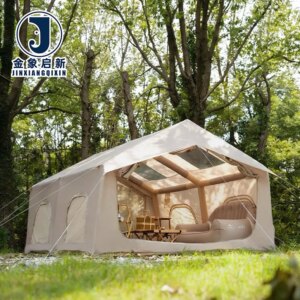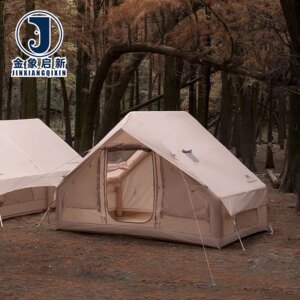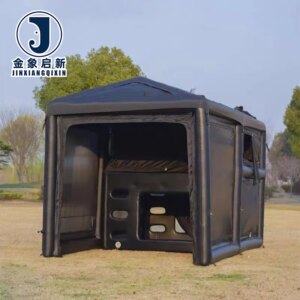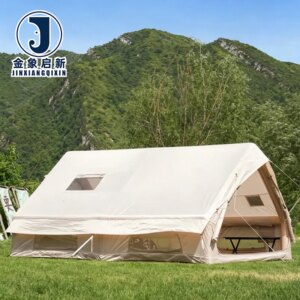
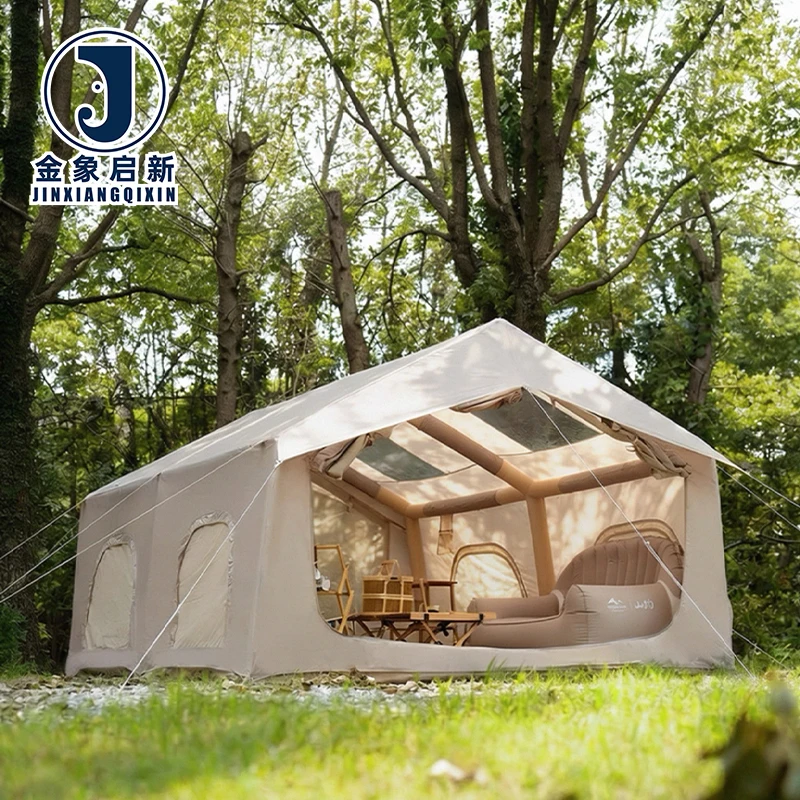
Precision Coating Control — Every roll of inflatable tent fabric is produced with verified coating weight and base fabric adhesion, backed by nearly 30 years of PVC coating process control on dedicated production lines.
Technical Specifications
| Parameter | Value |
|---|---|
| Product Type | Inflatable Tent |
| Core Material | PVC Tarpaulin |
| Coating Method | Knife Coated |
| Product Form | Inflatable structure, single layer construction |
| Waterproof | Fully waterproof coated construction |
| UV Resistance | UV-resistant treatment available — confirm test basis for your exposure requirement |
| Tear Resistance | Tear-resistant base fabric weave |
| Fire Retardancy | Fire-retardant treatment available — confirm grade required for your market |
| Anti-Static | Anti-static treatment available — confirm standard required for your application |
| Customization | OEM & ODM, sample customization, pattern printing |
| Certifications | ISO 9001, ISO 14001, ISO 45001, CE |
Application Suitability
| Application | Exposure & Requirement |
|---|---|
| Disaster relief emergency shelters | Rapid deployment, weather exposure, regulatory compliance for temporary habitation |
| Temporary site accommodation for infrastructure projects | Prolonged outdoor exposure, wind load on inflatable frame, repeated inflation cycles |
| Mobile storage solutions for outdoor events | UV exposure, rain ingress prevention, frequent assembly and teardown |
| Construction site temporary shelters | Abrasion from site environment, dust and moisture ingress, fire safety compliance on regulated sites |
Why "Fire-Retardant Inflatable Tent Fabric" Means Nothing Without a Grade
Specifying flame retardancy without naming the grade is a compliance risk, not a material property.
Technical buyers sourcing inflatable tent fabric for disaster relief or regulated construction sites regularly receive quotations that claim fire-retardant treatment without referencing a test standard. The fabric arrives, the site safety officer asks for the certificate, and the documentation does not match the claim. This gap between quotation language and verifiable performance causes project delays and failed inspections [NEED_CITE: fire classification standards for temporary structures vary by jurisdiction]. The inflatable tent fabric must be specified against the exact standard your destination market enforces — whether that is DIN 4102, NFPA 701, or a local building code for temporary accommodation.
Coating Adhesion and the Inflatable Structure Envelope
Inflatable tent fabric operates under constant internal pressure. The PVC coating must maintain full adhesion to the base fabric across every square metre of the envelope, because delamination at any point creates a failure path that propagates under cyclic inflation and deflation. Knife coating delivers a controlled coating weight with direct penetration into the base fabric weave, producing the adhesion strength that inflatable structures depend on for structural integrity.
Base Fabric Weave and Tear Propagation Under Wind Load
The base fabric construction determines how the inflatable tent fabric behaves when wind loads create point stress on the membrane. A tear that initiates at a seam or anchor point will propagate along the weave direction if the yarn density and denier are insufficient to arrest it [NEED_CITE: tensile and tear test methods for coated fabrics per ISO 1421]. For disaster relief shelters deployed in exposed terrain, the base fabric must be specified to resist tear propagation under the combined loading of internal inflation pressure and external wind forces.
Reading the Specification Sheet Beyond Total GSM
Total GSM alone does not predict how inflatable tent fabric will perform in the field. A heavy coating applied over a low-density base fabric produces high GSM but poor tear strength, because the coating carries the load without adequate yarn support. The relationship between base fabric denier, weave density, and coating weight determines the balance between tensile strength, tear resistance, and flexibility — all of which affect how the inflatable structure behaves during deployment and under sustained wind loading.
The Hidden Cost of Specifying on Price Per Kilogram Alone
When inflatable tent fabric is sourced on a price-per-kilogram basis without verifying the ratio of coating to base fabric, the delivered material may meet the quoted GSM but fail prematurely at stress points. Coating-heavy constructions with inadequate base fabric density show early cracking at fold lines and weld seams, particularly after repeated inflation cycles and exposure to temperature variation [NEED_CITE: coating-to-substrate ratio impact on coated fabric service life]. For disaster relief operations where shelter failure is not an option, the specification must define both base fabric construction and coating weight independently rather than relying on total GSM.
Why Source Inflatable Tent Fabric Through This Facility
Three full production lines with 36 sets of professional equipment support consistent coating weight control across bulk orders of inflatable tent fabric, maintaining batch-to-batch uniformity that matters when multiple shelters are deployed on a single site. The 10-person R&D team develops samples within days for custom requirements, allowing technical buyers to validate material properties before committing to production volume. Dedicated QA and QC inspection at every production stage, with 100% pre-shipment inspection, ensures that coating adhesion, base fabric integrity, and treatment verification are confirmed before dispatch rather than assumed.
Documentation & Verification
- Material specification sheet stating base fabric denier, coating weight, and total GSM per roll
- Test reports for fire-retardant grade and UV resistance matched to your target market standard
- Pre-shipment inspection record with batch-specific quality data for every roll shipped
- ISO 9001, ISO 14001, ISO 45001, and CE certificates covering manufacturing compliance
- Certificate of origin and customs documentation for cross-border shipment
Fabrication, Handling & Storage
- Hot-air welding parameters must be matched to the PVC coating thickness to prevent seam failure before the fabric body
- Store rolls horizontally on pallets to avoid permanent creasing that weakens the coating at fold lines
- Allow cold-stored rolls to reach ambient temperature before unrolling to prevent coating cracking
- Use compatible PVC adhesive for field repairs on single-layer inflatable membrane panels
- Plan cutting layout to minimize weld seams across high-stress zones of the inflatable frame
What to Include in Your Inquiry
Specify the deployment environment and expected wind exposure for the inflatable structures you are manufacturing, along with the fire safety standard enforced in your destination market. Indicate whether you require fabric in roll form for your own fabrication line, or need sample development to validate coating weight and base fabric construction before placing a bulk order. Confirm any colour or pattern printing requirements and the annual volume you need to support production planning.
Frequently Asked Questions
Q: How can I verify that the GSM on the quotation matches the delivered inflatable tent fabric?
A: Request a material specification sheet that states base fabric denier, coating weight, and total GSM separately. Our pre-shipment inspection record documents the measured weight per roll before dispatch, so you can cross-reference the delivered material against the agreed specification without relying on total GSM alone.
Q: Which fire-retardant grades are available, and how do I match them to my market?
A: Fire-retardant treatment is available in multiple grades, and the correct grade depends on the fire safety standard enforced in your destination market. Specify the standard you need — such as DIN 4102 or NFPA 701 — and we will provide the matching test report with your shipment documentation for site compliance verification.
Q: What is the test basis for UV resistance on this inflatable tent fabric?
A: UV-resistant treatment is available, and the test basis should be confirmed against the exposure conditions in your deployment region. Request the test report that corresponds to your expected outdoor service environment so that the specification is supported by documented performance data rather than general claims.
Q: How does the knife coated construction affect welding and seam strength for inflatable fabrication?
A: Knife coating produces a uniform coating layer with strong adhesion to the base fabric, which supports consistent hot-air welding results across the membrane surface. Welding parameters should be adjusted to the specific coating thickness to ensure the seam achieves strength comparable to the fabric body without burning through the coating.
Q: Can I request batch-specific test reports with my order?
A: Yes. Batch-specific quality documentation including material specification data, treatment verification, and pre-shipment inspection records are prepared for every production run. Confirm your documentation requirements at the inquiry stage so that all test reports and certificates are aligned with your compliance needs before dispatch.