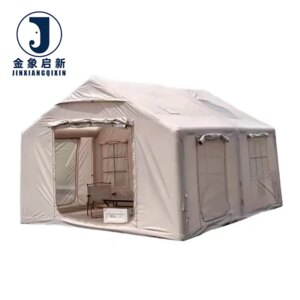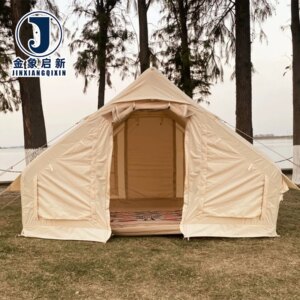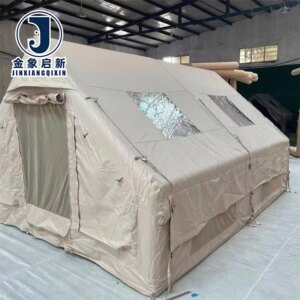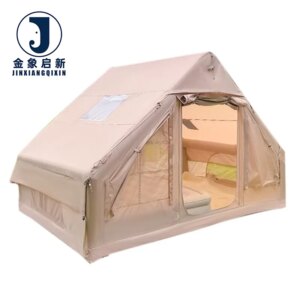
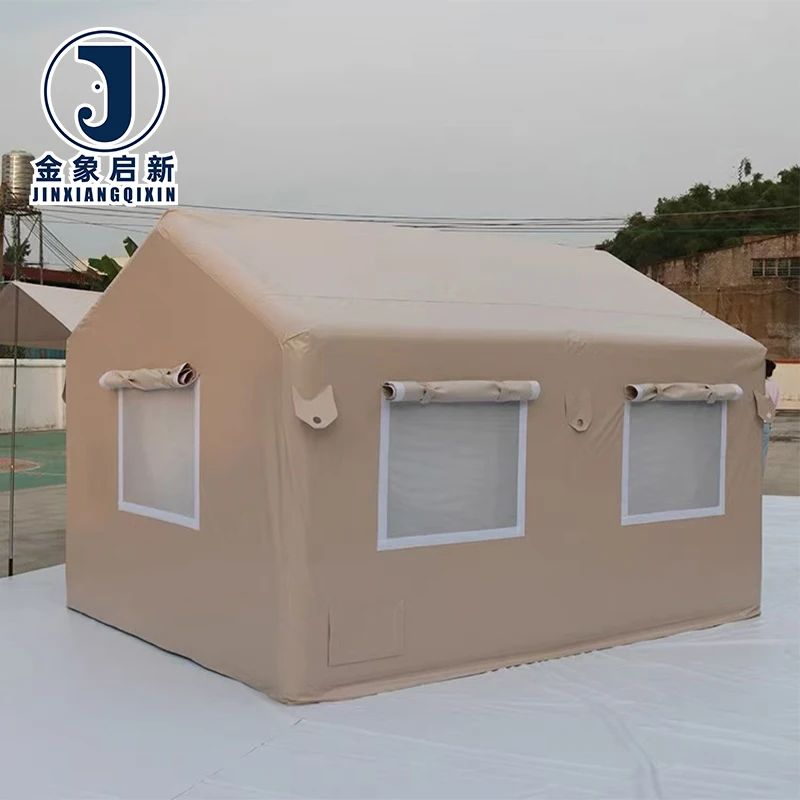
Deep Coating Process Control — three dedicated production lines maintain consistent PVC adhesion across every roll of inflatable fabric, ensuring weld strength matches the base material through repeated inflation cycles.
Technical Specifications
| Parameter | Value |
|---|---|
| Product Type | Inflatable Tent |
| Core Material | PVC tarpaulin |
| Waterproof | Fully waterproof coated construction |
| UV-Resistant | Available in UV-resistant grades — confirm the grade required for your market |
| Tear-Resistant | Available in tear-resistant grades — confirm test standard required for your project |
| Flame Retardant | Available in flame retardant grades — confirm the grade required for your market |
| Anti-Static | Available in anti-static grades — confirm surface resistance standard for your site |
| Season Rating | Four-season outdoor deployment |
| Opening Mechanism | Quick automatic opening (air-beam inflation) |
| Capacity | 8–10 Person |
| Customization | OEM & ODM, sample customization, pattern printing |
| Standards | ISO9001, ISO14001, ISO45001, CE |
Application Suitability
| Application | Exposure & Requirement |
|---|---|
| Temporary site offices on construction sites | Continuous UV exposure, wind loading, dust ingress, frequent relocation between phases |
| Equipment storage facilities at active job sites | Water ingress prevention, puncture resistance from ground debris, thermal cycling |
| Emergency response command centers | Rapid deployment within minutes, all-weather reliability, interior climate retention |
| Temporary event venues and exhibition shelters | High foot traffic abrasion at entry points, multi-day continuous inflation, aesthetic surface finish |
| Year-round outdoor industrial enclosures | Freeze–thaw cycles, sustained wind pressure on air beams, long-term UV degradation resistance |
Why Inflatable Tent Fabric Selection Decides Structural Survival
The air beam is only as reliable as the coated fabric that holds the pressure cycle after cycle.
Temporary shelters on active construction sites face a failure mode that most buyers never anticipate: the welded seams along air-beam junctions split long before the PVC membrane itself shows wear. When an Inflatable Tent manufacturer specifies fabric purely on price per roll, the coating adhesion often proves insufficient for the repeated stress of inflation and deflation across a four-season deployment window. We have seen inflatable structures fail at the heat-welded joints during their second season of use because the coating formulation did not bond deeply enough into the base fabric weave [NEED_CITE: tensile and tear test methods for coated fabrics per ISO 1421].
Coating Adhesion and the Inflation Cycle Problem
Inflatable structures demand a fundamentally different coating specification than static tarpaulin covers. Every inflation cycle applies internal pressure that stretches the PVC membrane, and every deflation compresses it — a mechanical fatigue pattern that standard truck cover fabric was never designed to endure. Our PVC tarpaulin base m*base fabric weave, locking the polymer into the yarn structure rather than sitting as a surface film. This approach gives the Inflatable Fabric manufacturer a material that maintains coating integrity across thousands of pressure cycles.
Four-Season Deployment and UV Formulation Choices
A shelter rated for four-season use encounters UV intensity that varies enormously between a summer construction site and a winter emergency response deployment. UV-resistant treatment is available in multiple grades, and the correct selection depends entirely on the target market’s latitude and expected service duration. We supply the material with UV treatment matched to the buyer’s stated exposure profile, confirmed by test data rather than a generic claim on the quotation [NEED_CITE: UV degradation test standards for PVC coated fabrics].
Reading Beyond the Spec Sheet for Inflatable Structures
The PVC tarpaulin used in inflatable air-beam construction must balance several competing requirements simultaneously. Tear resistance governs how a puncture propagates once the membrane is breached by site debris or sharp equipment edges. Waterproof performance in an inflatable shelter depends not just on the membrane but on the heat-welded seam integrity under sustained internal pressure. Flame retardant grades must be selected based on the specific fire safety code enforced at the deployment location — a grade accepted at one event venue may not satisfy the authority having jurisdiction at another [NEED_CITE: fire classification standards for temporary structures]. Anti-static treatment becomes a procurement requirement when inflatable enclosures house sensitive electronic equipment or operate in environments where static discharge poses ignition risk. Each of these properties interacts with the others: adding flame retardant chemistry can affect low-temperature flexibility, while heavy UV treatment loads may influence heat-weld temperature parameters during fabrication.
What Specification Shortcuts Cost in the Field
Selecting inflatable tent fabric on a generic GSM figure alone leads to a cascade of downstream failures. A lighter coating may pass initial waterproof testing but degrade under sustained UV exposure, leaving the air-beam membrane brittle by the second season. An Inflatable Tent sourced without verified flame retardant documentation can fail site safety inspection, forcing the contractor to decommission an entire temporary village before occupancy [NEED_CITE: temporary structure fire compliance requirements by jurisdiction]. Colour variation between production rolls becomes visible once multiple shelter units stand side by side at an event venue, triggering rejection and costly replacement. Most damaging is the heat-weld failure at beam junctions: when coating adhesion is inadequate, the seam splits under inflation pressure and the entire structure deflates within hours.
Why Technical Buyers Source Inflatable Fabric Here
Our coating process control is built on three full production lines with 36 sets of professional processing equipment, giving us direct command over coating weight and adhesion parameters for every inflatable fabric roll. The 10-person R&D team develops custom formulations when buyers require specific flame retardant grades or UV treatment levels not covered by stock specifications. Every production stage carries dedicated QA/QC oversight, with 100% pre-shipment inspection ensuring the roll leaving our facility matches the material specification sheet agreed at quotation. Sample development runs in days rather than weeks, allowing buyers to test heat-weld parameters and seam strength before committing to a bulk order. Pattern printing and custom sizing are handled in-house, eliminating the coordination failures that occur when printing is subcontracted after coating.
Documentation & Verification
- Material specification sheet stating PVC tarpaulin base fabric, coating weight, and treatment details for each roll
- UV and flame retardant test reports issued against the specific grades confirmed at order placement
- Pre-shipment inspection record covering coating adhesion, colour consistency, and dimensional accuracy
- ISO9001, ISO14001, ISO45001, and CE certificates available with every shipment
- Roll packing list with individual roll identification for traceability across the production batch
- Certificate of origin and customs documentation to support international shipment clearance
Fabrication, Handling & Storage
- Heat-weld temperature and dwell time must be set to match the specific PVC coating formulation supplied
- Air-beam seam reinforcement requires overlap width calculated against the stated coating adhesion strength
- Store rolls vertically on end-cores to prevent permanent creasing across the PVC tarpaulin coating surface
- Avoid storage in direct sunlight before fabrication to preserve the full UV treatment service life
- Clean only with PVC-compatible agents to prevent chemical attack on the coating and anti-static treatment
- Repair minor punctures with matching PVC patches heat-welded at the same temperature as original seams
What to Include in Your Enquiry
To specify the correct inflatable tent material for your project, provide the target deployment environment and expected continuous inflation duration. State the fire safety code or flame retardant grade required by the authority having jurisdiction at your site. Confirm whether you need rolls at standard width for your own fabrication, or pre-cut panels with pattern printing for direct assembly. Let us know if sample rolls are needed for heat-weld parameter testing before bulk production.
Frequently Asked Questions
Q: What fire safety certifications are available for this inflatable tent fabric?
A: The PVC tarpaulin is available in multiple flame retardant grades. We supply test reports against the specific standard you confirm for your market — such as local building codes or event safety regulations. Confirm the exact grade required by your site authority before ordering so we match the formulation and documentation to your compliance needs.
Q: How is UV resistance verified for extended outdoor deployment?
A: UV-resistant treatment is applied during the coating process and verified through testing matched to the grade you select. We provide test documentation confirming the treatment level applied to your production batch. The correct grade depends on your deployment latitude and expected exposure duration, which we confirm together during specification.
Q: What are the recommended heat-weld parameters for air-beam fabrication?
A: Optimal welding temperature and dwell time depend on the specific PVC coating formulation supplied. We recommend ordering sample material to establish your machine settings before full production. Our technical team provides baseline parameter guidance with the sample shipment, calibrated to the coating weight and treatment chemistry of your confirmed specification.
Q: Can dimensions and surface printing be customized for our inflatable shelter design?
A: OEM and ODM customization covers custom roll widths, cut panel sizes, and pattern printing directly onto the PVC surface. Sample development with your specified colour, print artwork, and dimensions is completed within days. Approval of the sample locks the specification for the production run, ensuring batch-to-batch consistency across your entire order.
Q: What documentation accompanies each shipment for quality verification?
A: Every shipment includes a material specification sheet, batch inspection record, relevant test reports for the grades ordered, ISO and CE certificates, and a detailed roll packing list. Certificate of origin and customs documentation are provided for international deliveries. Each roll carries individual identification linking it back to the production batch and inspection data.