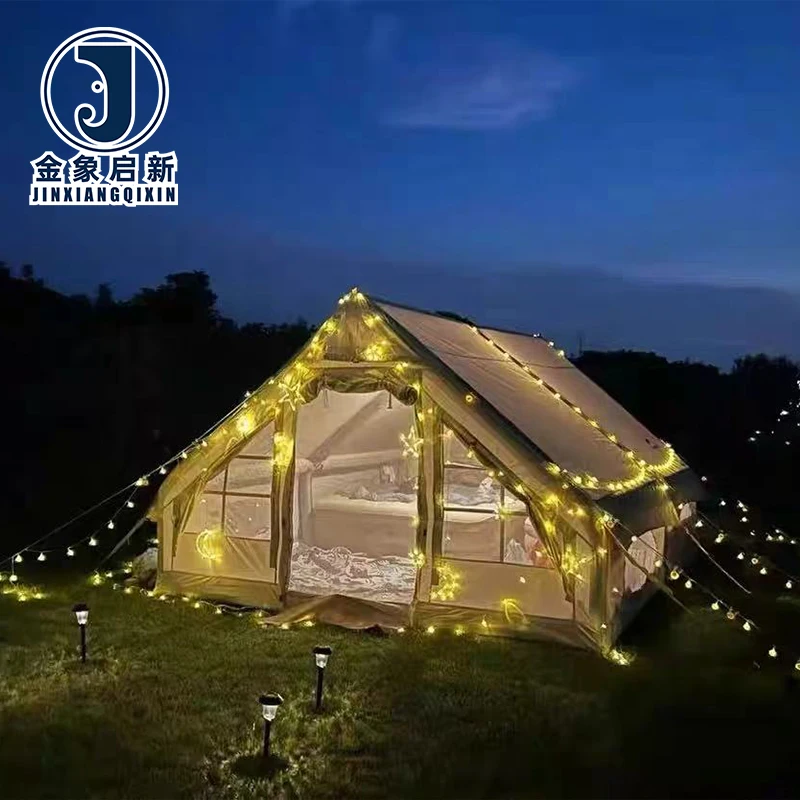
Coating Weight Control — verified GSM per roll with batch-specific coating formulation documentation for inflatable tent fabric procurement.
Technical Specifications
| Parameter | Value |
|---|---|
| Product Type | Inflatable Tent Fabric |
| Core Material | PVC tarpaulin |
| Coating Method | Knife coated |
| Waterproof Performance | Waterproof (grade not stated in source) |
| UV Resistance | UV-resistant (test basis not stated in source) |
| Tear Resistance | Tear-resistant (test basis not stated in source) |
| Fire Retardancy | Fire-retardant (grade not stated in source) |
| Anti-Static | Anti-static (surface resistance or standard not stated in source) |
| Customization | OEM & ODM, sample customization, pattern printing |
| Quality Standards | ISO9001, ISO14001, ISO45001, CE |
Application Suitability
| Application | Exposure & Requirement |
|---|---|
| Commercial inflatable camping tents | Repeated inflation cycles, seam stress at air chambers, outdoor weathering |
| Recreational shelter manufacturing | UV exposure during summer camping seasons, ground contact abrasion |
| Quick automatic opening tent assembly | Mechanical stress during automated unfolding, tear resistance at hinge points |
| B2B outdoor gear distribution | Batch consistency across production runs, documentation for end-market compliance |
What "Flame Retardant" Means Without a Grade Behind It
Inflatable tent fabric must specify the fire classification standard your market requires.
Technical buyers often receive material data sheets claiming flame retardancy without citing DIN 4102, NFPA 701, or M2 classifications. When inflatable camping tents ship to European campgrounds or Australian festival sites, local fire inspectors demand documentation tied to recognized standards — generic claims fail compliance audits. The inflatable tent fabric you specify should come with test reports showing which grade was achieved and under what conditions [NEED_CITE: fire classification standards for temporary structures and camping equipment].
Coating Formulation and Base Fabric Interaction
The PVC tarpaulin base fabric denier and weave density determine how the knife coating penetrates and bonds. Higher denier yarns create a more open weave that allows deeper coating penetration, improving peel strength at heat-welded seams. For inflatable tent structures where air chamber seams bear constant internal pressure, coating adhesion directly affects whether the weld line holds or delaminates under flex stress.
Treatment Chemistry and Performance Verification
UV-resistant and fire-retardant treatments are added during the coating process as stabilized additives or topical finishes. The effectiveness of these treatments depends on concentration, application method, and curing temperature. Without batch-specific test reports, buyers cannot verify whether the inflatable tent fabric meets the UV exposure duration or flame spread index their end customers require. Request documentation that ties treatment claims to measurable outcomes [NEED_CITE: UV stability test methods for PVC coated fabrics].
Why Coating Weight Alone Does Not Predict Tear Performance
A heavier GSM reading suggests more PVC mass per square meter, but tear resistance depends equally on base fabric construction. A 650 GSM fabric with low-density warp and weft yarns may tear more easily than a 550 GSM fabric woven with high-tenacity polyester yarns at tighter spacing. When evaluating inflatable tent fabric, request both GSM verification and base fabric denier specifications to understand the full strength profile.
Heat-Weld Seam Behaviour on Inflatable Structures
Inflatable tents rely on heat-welded seams to maintain air pressure across multiple chambers. The PVC coating must soften at welding temperature and fuse completely without burning through or leaving weak spots. Knife coated fabrics typically show better peel strength at weld lines compared to laminated constructions, because the coating penetrates the base fabric rather than sitting on top as a separate layer [NEED_CITE: peel strength test methods for heat-welded PVC seams per ISO 1421].
Knife Coating Versus Alternative Methods
Knife coating applies liquid PVC directly onto the moving base fabric, allowing precise control over coating weight and penetration depth. This method produces strong coating-to-fabric adhesion, which matters when inflatable tent chambers flex during inflation and deflation cycles. Laminated fabrics bond a pre-formed PVC film to the base fabric using adhesive, which can delaminate at seam edges under repeated stress. Calendered fabrics press PVC between heated rollers, offering lower cost but less consistent coating penetration.
The Cost of Undocumented Material Claims
When inflatable tent fabric arrives with UV resistance claimed but no test report attached, manufacturers face a choice: proceed with production and risk customer returns when tents degrade after one summer season, or halt production and request documentation that delays delivery schedules. Similarly, fire-retardant grades that do not match local campground regulations can result in entire product lines being pulled from retail shelves after compliance audits fail [NEED_CITE: product recall cases due to fire safety non-compliance in temporary structures].
Why Source Inflatable Tent Fabric From This Facility
Three full production lines with 36 sets of professional processing equipment support bulk capacity for commercial tent manufacturing runs. The 10-person R&D team handles material selection, coating formulation adjustments, and sample development for OEM specifications. Dedicated QA and QC staff conduct full-process quality inspection at every stage, from incoming raw material verification to pre-shipment sampling. ISO9001, ISO14001, ISO45001, and CE certifications document the quality management system rather than serving as marketing badges. Sample development within days allows engineering teams to validate weld parameters and coating performance before committing to mass production volumes.
Documentation & Verification
- Material specification sheet stating PVC tarpaulin base fabric denier, coating weight, and treatment chemistry
- Test reports for UV resistance and fire-retardant grades where applicable to your market requirements
- Pre-shipment inspection records with batch-specific GSM verification and coating adhesion sampling
- ISO and CE certification documentation supporting customs clearance and end-market compliance submissions
- Roll packing list with batch numbers traceable to production date and coating formulation records
Fabrication, Handling & Storage
- Heat-weld temperature and dwell time parameters must match the knife coated PVC formulation to achieve full seam fusion
- Store rolls upright on pallets to prevent flat spots that create weak lines when the inflatable tent fabric unrolls during cutting
- Allow cold-stored rolls to reach workshop temperature before unrolling to avoid coating crack at low-temperature brittleness points
- Use PVC-compatible cleaners that do not dissolve the UV-resistant or fire-retardant treatment additives from the coating surface
- Plan cutting layouts to minimize seam joints across high-stress air chamber areas where inflation pressure concentrates
Requesting Material Data for Your Inflatable Tent Project
Provide your target market regions so we can identify which fire-retardant grades and UV stability standards apply to your compliance requirements. Specify the inflatable tent chamber dimensions and expected inflation pressure to determine which base fabric denier and coating weight combinations suit your structural needs. Indicate whether you require roll stock for your own fabrication line or finished panels with pattern printing and custom sizing.
Frequently Asked Questions
Q: How is the base fabric denier and coating weight verified per batch?
A: Each production batch undergoes incoming raw material inspection for base fabric denier and weave density. Coating weight is measured per roll using standardized GSM sampling methods before dispatch. Pre-shipment inspection records document these values against your specification sheet requirements.
Q: What test standards apply to the UV-resistant and fire-retardant treatments?
A: Available treatments can be tested against standards relevant to your market, such as DIN 4102 for fire classification or ISO 4892 for UV exposure simulation. Confirm which standards your end-market regulators require, and request batch-specific test reports during the sample approval stage.
Q: How does PVC coating adhesion affect heat-weld seam performance on inflatable structures?
A: Knife coated PVC tarpaulin penetrates the base fabric weave, creating mechanical bonding that resists peel forces at welded seams. This matters for inflatable tent air chambers where internal pressure exerts constant stress on seam lines. Request peel strength test data for your specific welding equipment parameters.
Q: Can tensile and tear strength be reported against DIN or ISO standards on request?
A: Tensile and tear testing can be conducted per ISO 1421 or DIN 53354 methods upon request. Specify which standards your engineering team requires for structural calculations, and request test reports during sample development before mass production commitment.
Q: What material documentation is provided for customs and end-market compliance?
A: Documentation includes material specification sheets, test reports for claimed treatments, ISO and CE certificates, pre-shipment inspection records, certificates of origin, and customs support documents. Specify which compliance submissions your distribution network requires during the inquiry stage.