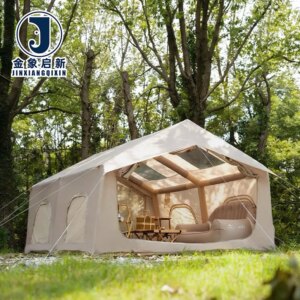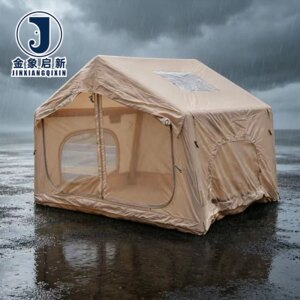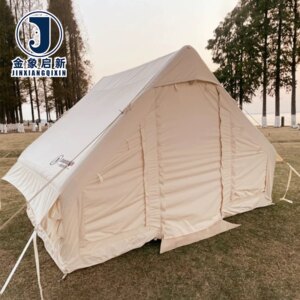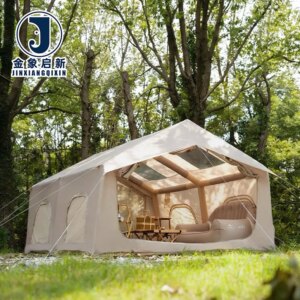
Coating Technology Depth — Nearly 30 years focused on coated fabric production, with controlled coating weight application verified through in-process QA at every stage.
Technical Specifications
| Parameter | Value |
|---|---|
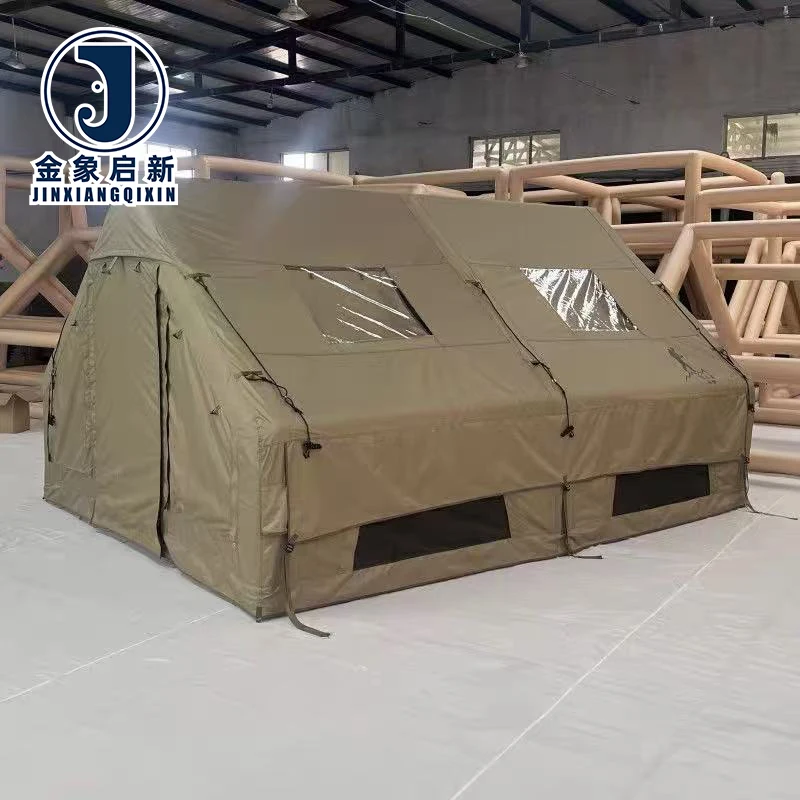
| Product Type | Inflatable Tent |
| Core Material | PVC Tarpaulin |
| Construction | Single layer inflatable structure |
| Key Features | Waterproof, tear-resistant, quick automatic opening |
| UV Resistance | Available in UV-resistant grades — confirm the grade required for your deployment duration (test basis not stated) |
| Seam Method | High-frequency welding, airtight construction |
| Customization | OEM & ODM — sample customization, pattern printing available |
| Pre-Shipment Testing | 24-hour inflation test per unit |
| Standards | ISO 9001, ISO 14001, ISO 45001, CE |
Application Suitability
| Application | Exposure & Requirement |
|---|---|
| Temporary site offices at remote construction projects | Prolonged solar exposure, wind loading, repeated inflation cycles, ground abrasion at base |
| Equipment storage in disaster recovery zones | Continuous water contact, debris impact, rapid deployment under adverse conditions |
| Mobile command centers for infrastructure maintenance | Interior climate control retention, frequent relocation, airtight seam integrity |
| Temporary warehousing during logistics operations | High internal volume demands, forklift proximity, sustained air pressure maintenance |
When "UV-Resistant" on the Label Has No Test Report Behind It
Specifying inflatable shelter fabric without verified UV test data is a procurement risk that surfaces only after months of field exposure.
Technical buyers sourcing Inflatable Tent Fabric PVC Tarpaulin for extended outdoor deployment regularly encounter material that claims UV protection on the quotation but provides no test basis to support the assertion. When the fabric degrades prematurely under solar load, the inflatable structure loses airtight integrity and the entire shelter fails in service. [NEED_CITE: UV degradation test methods for coated technical textiles per ISO 4892]
For disaster relief and remote site operations where the shelter must remain functional through an entire season or longer, the absence of documented UV performance means the buyer is accepting an unknown variable at the most critical point of the material specification. The coating formulation and stabilizer package determine whether the PVC tarpaulin maintains tensile strength and colour stability over time, and these properties require lab verification, not marketing claims.
Coating Weight and Base Fabric Relationship in Inflatable Structures
The airtight performance of an inflatable tent depends directly on how the PVC coating bonds to the base fabric. Coating weight determines the material’s ability to hold internal air pressure without micro-leakage through the weave structure. When specifying Inflatable Tent Fabric PVC Tarpaulin, the relationship between base fabric denier and coating thickness must be evaluated together — a heavier coating on a low-denier base will not compensate for inadequate substrate strength under sustained inflation pressure.
High-Frequency Welding for Airtight Seam Integrity
Unlike sewn-and-taped constructions, inflatable tent structures rely entirely on welded seams to maintain air pressure. High-frequency welding fuses the PVC coating layers at the molecular level, creating a joint that must match or exceed the base fabric strength. [NEED_CITE: high-frequency welding parameters for PVC coated fabrics] Every seam in an inflatable structure is a potential failure point, and the weld quality directly determines whether the shelter holds pressure through temperature fluctuations and mechanical stress during use.
Reading the Specification Sheet Beyond GSM
GSM alone tells you the weight per square metre but nothing about how that weight is distributed between base fabric and coating. A PVC tarpaulin with high coating weight and low base fabric density may feel substantial on the roll yet tear easily at stress concentrations around valve ports and anchor points. The base fabric denier, weave density, and yarn count determine tear propagation resistance — properties that matter considerably when an inflatable tent is subjected to wind gusts or accidental contact with sharp equipment on site. The coating method, whether knife-over-roll or calendered, influences peel strength and directly affects how well welded seams perform under repeated inflation and deflation cycles.
The Real Cost When Coating and Weld Specifications Are Wrong
When the coating weight is lower than the application demands, welded seams become the first failure point as the material flexes and the structure pressurises and depressurises through daily temperature swings. Buyers who specify Inflatable Tent Fabric PVC Tarpaulin without requesting batch-specific test data often discover the problem only after deployment, when seams separate under sustained inflation. [NEED_CITE: seam strength testing for inflatable coated fabric structures per ISO 1421] In disaster relief and remote site scenarios, a shelter that loses airtight integrity cannot serve its purpose, and replacement lead times leave operations exposed. Colour variation between production batches also becomes visible when multiple units are deployed side by side in a field camp or logistics staging area.
Why This Material Source Fits Technical Inflatable Applications
Deep process control over coating weight and adhesion, developed across nearly 30 years of continuous PVC tarpaulin production, means the coating applied to inflatable tent fabric is consistent from first roll to last in a bulk order. Three full production lines and 36 sets of professional processing equipment support high-frequency welding and custom sizing at volume. A 10-person R&D team develops pre-production samples for performance evaluation, allowing technical buyers to verify material behaviour before committing to a full order. Dedicated QA and QC staff conduct 100% inspection before shipment, including a 24-hour inflation test that confirms airtight seam integrity on every unit produced.
Documentation & Verification
- Material specification sheet stating coating weight, base fabric denier, and construction type per batch
- UV and flame retardant test reports where applicable grades are specified for the order
- 24-hour inflation test record confirming airtight seam performance before dispatch
- Dimensional verification report with weld seam strength data per production run
- Pre-shipment inspection record covering visual defects, surface finish, and colour consistency
Fabrication, Handling & Storage
- High-frequency weld parameters must match the PVC coating thickness to achieve full molecular fusion at seams
- Store rolls upright on pallets to prevent creasing that compromises coating integrity at fold lines
- Single layer inflatable construction requires careful valve port reinforcement at high-stress junction points
- Avoid dragging PVC tarpaulin sheets across abrasive ground surfaces during site deployment
- Clean with mild detergent only — solvent-based cleaners degrade the PVC coating surface layer
What to Include in Your Material Inquiry
Provide the deployment environment and expected duration of outdoor exposure so the appropriate UV-resistant grade can be matched to your application. Specify whether you require finished inflatable tent units with valve systems and anchor points, or roll stock for your own fabrication facility. If your target market has fire safety compliance requirements for temporary structures, state the applicable standard so the correct flame retardant grade is confirmed before sampling begins.
Frequently Asked Questions
Q: What UV test documentation ships with UV-resistant inflatable tent orders?
A: When UV-resistant grades are specified, the corresponding test report is included in the shipment documentation package. Buyers should confirm the specific UV exposure duration and climate classification required for their deployment region during the inquiry stage, so the correct grade is selected and tested before production begins.
Q: How are welded seams verified on inflatable tent structures before delivery?
A: Every completed inflatable unit undergoes a 24-hour inflation test before shipment, confirming that high-frequency welded seams hold air pressure without leakage. Inspection records documenting seam integrity and dimensional accuracy accompany each order for buyer review and project compliance filing.
Q: Can custom dimensions and pattern printing be sampled before bulk production?
A: Yes. The R&D team develops pre-production samples incorporating custom sizing, pattern printing, and any specified treatment grades. Buyers evaluate sample performance including weld quality and surface finish before approving bulk production, reducing specification risk on large orders.
Q: What flame retardant grades are available for inflatable shelter fabric?
A: Flame retardant PVC tarpaulin is available in multiple grades suited to different market requirements. Buyers should confirm the specific fire classification standard applicable in their target region during the inquiry, so the correct grade is sourced and verified with the appropriate test report before production.
Q: How is coating weight verified on each production batch?
A: Dedicated QA staff verify coating weight against the stated specification during in-process quality checks. Batch-specific inspection records document actual measured values alongside base fabric denier data, ensuring the material delivered matches the technical requirements agreed at the sampling stage.