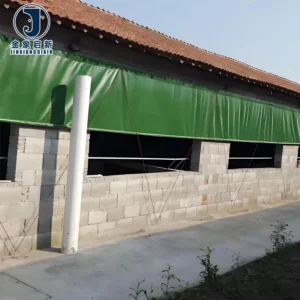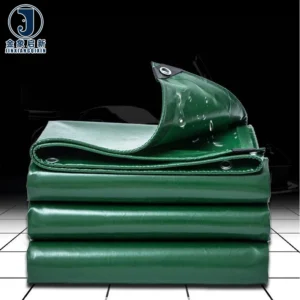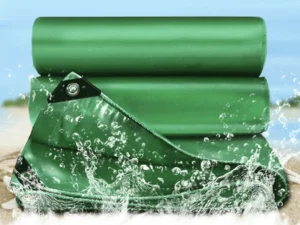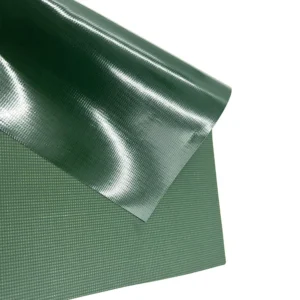
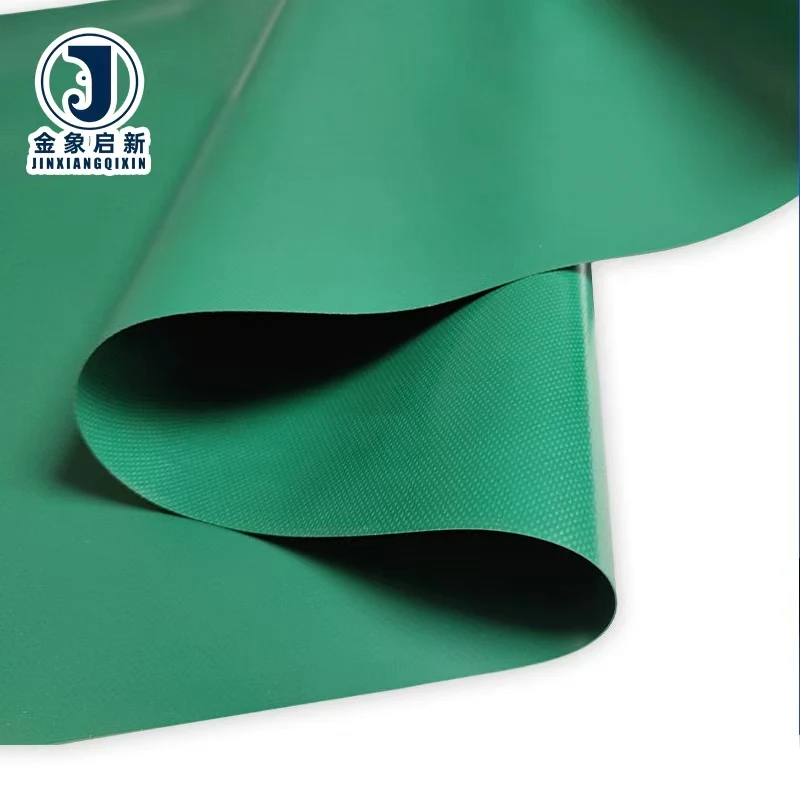
Coating Weight Control — every roll of 510 gsm PVC coated tarpaulin is held to the stated coating weight through in-process QA and pre-shipment weight verification, ensuring the material you receive matches the specification sheet.
Technical Specifications
| Parameter | Value |
|---|---|
| Product Type | PVC Coated Tarpaulin Roll |
| Weight | 510 GSM |
| Base Fabric Denier | 500D × 1000D |
| Base Fabric Material | Polyester |
| Mesh Count (Density) | 30 × 19 |
| Total Thickness | 0.38 mm |
| Coating Material | PVC (double-side) |
| Tensile Strength — Warp | 2050 N (test standard not stated) |
| Tensile Strength — Weft | 1900 N (test standard not stated) |
| Brittle Temperature | ≤ -50 to -60 °C |
| Softening Temperature | ≥ 80 °C |
| Melting Point | 212 °C |
| Key Features | Water resistant, UV treatment available, flame retardant grades available (grade and test basis not stated — confirm the grade required for your market) |
| Edge Finishing | High-temperature heat-sealed seamless edge wrapping |
| Packaging | Roll packing, bale packing, carton |
Application Suitability
| Application | Exposure & Requirement |
|---|---|
| Truck and trailer side curtains | Constant flexing at hinges, road debris abrasion, wind-load tension on eyelets, prolonged UV exposure |
| Tent and awning fabric by the roll | Repeated folding and unfolding, rain pooling on horizontal spans, heat-seam joining at panels |
| Machine and equipment covers | Contact with oils and coolants, workshop UV from skylights, abrasion from removal and reinstallation |
| Construction structure membranes | Tension loads across unsupported spans, thermal cycling between day and night, wind-driven rain ingress |
| Carriage and container roof covers | Standing water, UV degradation over seasons, tie-down tension at reinforced corners |
What 510 GSM Actually Tells You — And What It Hides
GSM is a starting point for material selection, not a guarantee of field performance.
A 510 GSM label on a quotation can mean very different things depending on the base fabric denier, mesh count, and how the PVC coating is applied. I have reviewed roll stock where the stated GSM was technically correct but nearly all the weight sat in the coating layer, leaving a thin base fabric that tore easily at eyelet points and failed under tension. When technical buyers specify PVC coated tarpaulin for converting into truck curtains or tension structures, the relationship between yarn count, weave density, and coating weight determines whether the fabric performs or whether it splits at the first flex cycle. [NEED_CITE: relationship between GSM, denier and tensile performance in coated polyester fabrics]
How 500D × 1000D Denier Shapes the Load Path
The base fabric of this PVC coated tarpaulin uses a 500D × 1000D polyester construction, where the warp yarns are 500 denier and the weft yarns are 1000 denier. This asymmetric denier arrangement directs higher tensile capacity along the weft, which typically runs across the shorter span in side curtain and awning panels. The 30 × 19 mesh count sets the spacing between yarns, and together with the PVC coating penetration, it governs how load transfers from one yarn to the next before a tear propagates. For fabricators welding panels into large-format covers, the weft-dominant strength profile should align with the primary tension axis in the cutting layout.
Coating Adhesion and Seam Integrity Under Thermal Stress
PVC coating weight directly affects how the material behaves during high-frequency or hot-air welding. At 510 gsm, the coating layer has enough thickness to form a consistent molten pool at the weld interface, but not so much that the heat must penetrate an excessive depth before reaching the base fabric. The heat-sealed seamless edge wrapping on this roll stock reduces the risk of delamination starting at cut edges, which is where most seam failures originate in converted tarpaulin products. When welding parameters are set correctly for this coating thickness, the weld line holds comparable strength to the parent fabric. [NEED_CITE: weld strength testing methods for PVC coated fabrics per ISO 1421]
Reading the Specification Sheet: Denier, Density and Strength Together
Tensile values of 2050 N warp and 1900 N weft should be understood alongside the 500D × 1000D denier and 30 × 19 mesh count rather than in isolation. A higher GSM with a looser weave can produce similar tensile numbers but will perform differently under puncture and tear because the yarns have more room to shift before engaging. The 0.38 mm total thickness at 510 gsm reflects a balanced ratio between base fabric and coating, which means the material can be folded and rolled without the coating cracking at the fold line — a practical concern for tent manufacturers who fold panels repeatedly before installation. The brittle temperature of ≤ -50 to -60 °C and softening temperature of ≥ 80 °C define the operational envelope: in cold-climate deployments the fabric remains flexible, while in hot climates the coating retains structural integrity below its softening threshold.
When the Wrong Specification Reaches the Production Floor
Selecting roll stock based on GSM alone, without verifying base fabric denier and mesh count, leads to problems that surface only after conversion. Welded seams on under-specified fabric fail at flex points because the coating separates from a loosely woven base under repeated stress. Flame retardant grades claimed without a test report result in rejected site inspections where the contractor cannot produce documentation matching the project specification. Batch colour variation between rolls becomes visible only after panels are installed side by side on a truck or awning frame, forcing rework at the installer’s cost. [NEED_CITE: weld delamination failure modes in PVC coated polyester tarpaulins]
Why Technical Buyers Source This Fabric Here
Dedicated coating weight process control means the 510 gsm you specify is the weight that ships, verified per roll before dispatch. The 10-person R&D team develops samples within days when you need to confirm weld compatibility, colour match, or surface finish before committing to a full order. Three full production lines with 36 sets of professional equipment provide the capacity to maintain batch consistency across large orders, so roll-to-roll properties stay uniform. Every roll undergoes 100% pre-shipment inspection against the material specification sheet. ISO and CE certified production supports documentation requirements for regulated markets.
Documentation & Verification
- Material specification sheet stating 510 GSM, 500D × 1000D denier, 30 × 19 mesh count and 0.38 mm thickness
- Test report for UV and flame retardant grades — confirm standard and rating before order placement
- Pre-shipment inspection record verifying roll-to-roll weight consistency and coating adhesion
- Roll packing list with individual roll identifiers for traceability
- Certificate of origin and customs documentation for international shipment
Fabrication, Handling & Storage
- Set hot-air weld temperature and speed for the 0.38 mm thickness; verify peel strength on a test strip from the same roll before production runs
- Cut panels with the 1000D weft aligned to the primary tension axis to use the higher weft tensile capacity
- Store rolls upright on their cores in a dry, shaded area to prevent flat spots on the coating surface
- Allow rolls shipped in cold weather to reach workshop temperature before unrolling to avoid coating micro-cracking
- Use the heat-sealed edge wrapping as the starting reference edge for panel layout to minimize waste at cut lines
Before You Request a Quote
Provide the end-use application and the environmental exposure conditions — UV hours, temperature range, chemical contact — so we can confirm whether the standard 510 gsm construction or a treated variant fits your requirement. Specify the roll width and total metreage needed, along with any colour reference or surface finish preference. If your market requires flame retardant or anti-static certification, state the target standard so we include the matching test report with the quotation.
Frequently Asked Questions
Q: How is the 510 GSM weight verified during production?
A: Coating weight is controlled through the production line process parameters and checked at intervals during each roll. A pre-shipment inspection verifies the final GSM against the specification sheet before the roll is released for dispatch. This ensures the material arriving at your facility matches the weight stated on your order confirmation.
Q: What does the 500D × 1000D denier mean for converting this fabric?
A: The asymmetric denier — 500D warp and 1000D weft — gives higher tensile strength along the weft direction. Fabricators should orient the weft along the primary load axis when laying out panels for truck side curtains or tensioned structures. The 30 × 19 mesh count provides adequate yarn density for consistent weld adhesion across the panel surface.
Q: How does the PVC coating thickness affect heat-seam welding?
A: At 510 gsm with 0.38 mm total thickness, the coating layer provides a consistent molten interface during hot-air or high-frequency welding. Too little heat causes poor adhesion; too much burns through to the base fabric. We recommend running test welds on a sample cut from the same production roll to dial in speed and temperature before full production.
Q: What flame retardant grades are available for this construction?
A: Flame retardant treatment is available in various grades, but the specific standard and rating depend on your market requirements. We provide the applicable test report — for example DIN 4102, NFPA 701, or other regional standards — once you confirm the classification needed. Request the grade early so test documentation ships with your order.
Q: How does PVC coated polyester compare to PE woven tarpaulin for the same application?
A: PVC coated polyester delivers substantially higher tensile and tear resistance than PE woven fabric at comparable weight, along with better weld adhesion for fabricated panels. PE woven is lighter and lower in cost for short-term covers, but for truck curtains, awnings and structural membranes where the fabric must survive repeated handling and long-term UV exposure, PVC coated polyester is the standard choice.