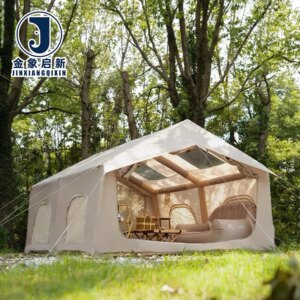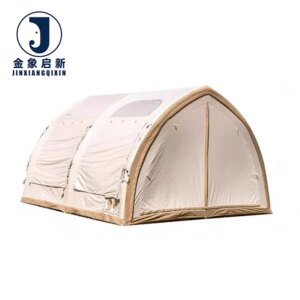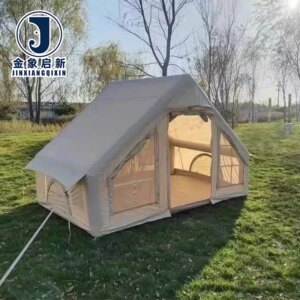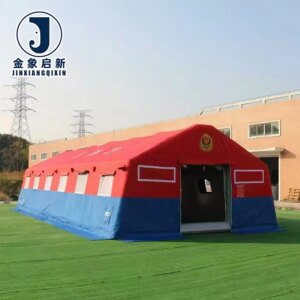
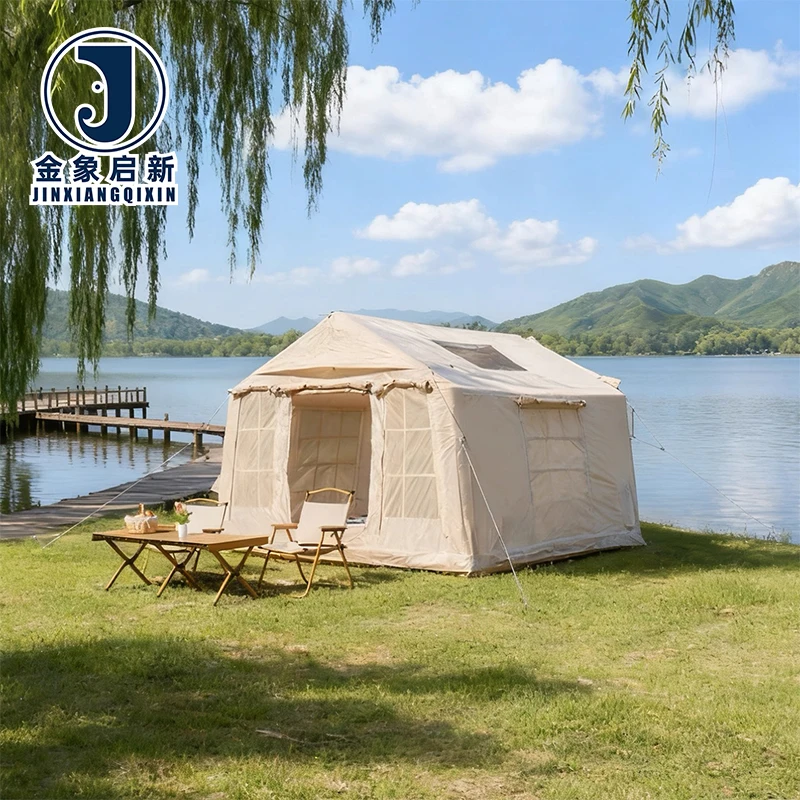
Coated Fabric Control — Nearly 30 years of PVC coating process expertise applied to inflatable tent membrane production, ensuring adhesion consistency and verified treatment performance across every roll.
Technical Specifications
| Parameter | Value |
|---|---|
| Product Type | Inflatable Tent Fabric / Inflatable Tent |
| Core Material | Waterproof PVC Fabric |
| Waterproof Rating | waterproof (grade not stated in source) |
| UV Treatment | UV-resistant (test basis not stated in source) |
| Flame Retardant Grade | fire-retardant (grade not stated in source) |
| Anti-Static | anti-static (standard not stated in source) |
| Tear Resistance | tear-resistant (test basis not stated in source) |
| Customization Service | OEM & ODM (sample customization, pattern printing, material selection, product design) |
| Certifications | ISO9001, ISO14001, ISO45001, CE |
Application Suitability
| Application | Exposure & Requirement |
|---|---|
| Commercial glamping site operations | Continuous outdoor weather exposure, repeated inflation/deflation cycles, guest-facing aesthetic standards |
| Outdoor exhibition and event shelters | Rapid deployment demands, public fire safety compliance, UV exposure during multi-day installations |
| Construction and mining welfare facilities | Site dust and debris abrasion, anti-static requirements in sensitive zones, temporary structure safety codes |
| Equipment storage enclosures | Moisture ingress prevention, wind load flexing, long-term UV degradation resistance |
What "Flame Retardant" Means Without a Test Report Behind It
A claimed fire-retardant inflatable tent fabric is only as reliable as the documentation that accompanies it.
Event operators and facility managers have encountered situations where inflatable structures passed visual inspection but failed when the local fire marshal requested certification paperwork. The inflatable tent fabric PVC coated manufacturer you select must provide verifiable test reports aligned with your market’s regulatory framework, not just a data sheet claiming compliance. When a material arrives on site without the fire safety documentation required by local building or event codes, the entire installation can be shut down before a single guest or worker steps inside [NEED_CITE: fire safety classification requirements for temporary membrane structures]. The cost of that delay extends far beyond the material itself.
Coating Adhesion and Membrane Integrity Under Inflation Pressure
Inflatable tent structures depend entirely on the bond between the PVC coating and the base fabric. When internal air pressure flexes the membrane continuously, any weak point in coating adhesion becomes a failure origin. Our production process controls coating weight and curing parameters at each stage, maintaining consistent adhesion across the full width of the inflatable tent fabric PVC coated manufacturer output. This matters because a delaminated section does not just leak air — it compromises the structural rigidity of the entire inflatable frame.
Treatment Verification for UV and Fire Performance
UV-resistant and fire-retardant treatments are available in multiple grades, and the right specification depends on your deployment environment and local regulations. We supply inflatable tent fabric with treatment documentation you can audit, so you confirm the exact grade required for your market before committing to bulk production. Anti-static formulations are also available for inflatable structures deployed in environments where static discharge poses a risk [NEED_CITE: anti-static testing standards for PVC coated fabrics in industrial settings]. Request the specific test basis that matches your compliance requirement.
Reading the Base Fabric and Coating Relationship
The tear resistance of an inflatable tent membrane is not determined by coating weight alone. The base fabric denier and weave density establish the structural skeleton, while the PVC coating protects that skeleton from moisture, UV, and abrasion. A heavier coating on a loosely woven base will still tear easily along the warp or weft. Conversely, a tightly woven high-denier base with insufficient coating will abrade quickly at fold points during repeated inflation cycles. Understanding this relationship helps you specify the right balance rather than selecting on a single number. Surface finish — whether glossy or matte — also affects how the membrane handles field cleaning and how well printed branding adheres over time.
The Hidden Cost of Specifying on Appearance Alone
Selecting inflatable tent material based on colour match or surface finish without verifying the underlying coating adhesion and treatment grades leads to field failures that are expensive to diagnose. A membrane that looks correct on delivery can delaminate at the weld lines after a season of thermal cycling, or fade unevenly across panels that came from different production batches [NEED_CITE: coating adhesion failure modes in inflatable membrane structures]. Batch-to-batch colour variation is particularly costly when multiple tents are installed side by side at a commercial glamping site, making inconsistencies visible to guests.
Why Source Inflatable Tent PVC Fabric From This Facility
Three full production lines and 36 sets of professional processing equipment support bulk capacity with controlled lead times, so your inflatable tent fabric PVC coated manufacturer order ships on schedule. A 10-technician R&D team handles material selection, sample development, and pattern printing customisation specific to inflatable membrane requirements. Dedicated QA/QC runs at every production stage with 100% inspection before dispatch, catching adhesion or colour deviations before they reach your facility. ISO 9001, ISO 14001, ISO 45001, and CE certifications back the quality management system. Custom width and length runs are supported without prohibitive minimums, letting you match roll dimensions to your fabrication layout.
Documentation & Verification
- Material specification sheet stating base fabric type, coating method, and treatment grades for your inflatable tent application
- Independent laboratory test reports for UV resistance and flame retardant properties where applicable
- ISO 9001, ISO 14001, ISO 45001 and CE certificates provided with each shipment
- Pre-shipment inspection record documenting coating adhesion, colour consistency, and dimensional accuracy
- Roll packing list with gross and net weights for container loading planning
- Certificate of origin and customs documentation for international dispatch
Fabrication, Handling & Storage
- Hot-air welding temperature and speed should be calibrated to the specific PVC coating thickness before production runs begin
- Store rolls upright on pallets in a shaded, ventilated area to prevent compression creasing of the coated surface
- Allow cold-stored rolls to reach ambient temperature before unrolling to avoid coating micro-cracking at fold lines
- Use PVC-compatible cleaners only; solvent-based products can degrade the coating adhesion on the inflatable tent membrane
- Plan panel cutting layout to minimise transverse welds across high-stress inflation zones of the tent structure
Before You Request a Quote
Provide the intended deployment environment, expected inflation cycle frequency, and the fire safety or anti-static standards your local jurisdiction requires. Specify whether you need rolls at a particular width for your own fabrication line, or cut-to-size panels with welded seams. If colour consistency across multiple units is critical, indicate the total quantity and whether pattern printing or branding is part of the specification so we can confirm batch matching capability.
Frequently Asked Questions
Q: How do I verify the flame-retardant grade meets my local fire safety regulations?
A: Share your target market and the specific fire classification standard required — such as DIN 4102, NFPA 701, or a local building code reference. We then confirm whether the available fire-retardant grade aligns with that requirement and provide the corresponding independent laboratory test report with your shipment documentation for inspection by local authorities.
Q: What UV-resistance test documentation can you provide for the inflatable tent fabric?
A: UV-resistant treatment is available with test documentation upon request. Tell us the expected outdoor exposure duration and climate zone for your installation, and we will supply the relevant test basis so you can assess whether the treatment level matches your service life expectations before committing to a production run.
Q: How does the OEM and ODM customization process work for inflatable tent fabric?
A: The process starts with your application requirements covering material selection, dimensions, and treatment grades. Our 10-technician R&D team develops samples for your approval, including pattern printing and colour matching if required. Once you approve the sample, bulk production proceeds with in-process QA checks at every stage before final pre-shipment inspection.
Q: How is batch-to-batch colour and coating consistency controlled across large orders?
A: Each production run follows controlled coating formulation and curing parameters with dedicated QA/QC checkpoints. For orders spanning multiple batches, we maintain reference samples and conduct side-by-side colour comparison before dispatch. This ensures panels from different rolls install without visible variation when placed adjacent on the same inflatable tent structure.
Q: What welding parameters should I use when fabricating inflatable tent seams from this PVC fabric?
A: Welding temperature, speed, and pressure must match the specific coating type and thickness of the fabric you receive. We recommend running test welds on sample pieces first to dial in your equipment settings. The seam should be tested for peel strength before full production begins, as improper heat settings can cause the weld to fail before the fabric itself under inflation pressure.