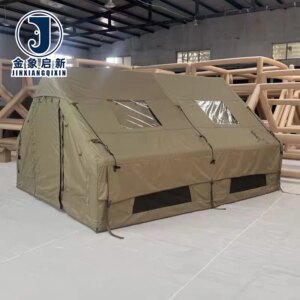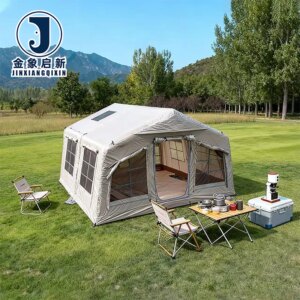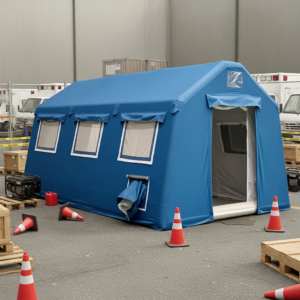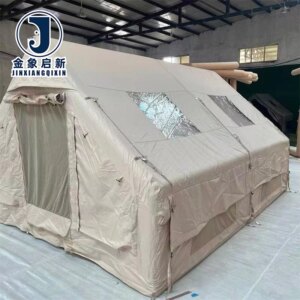
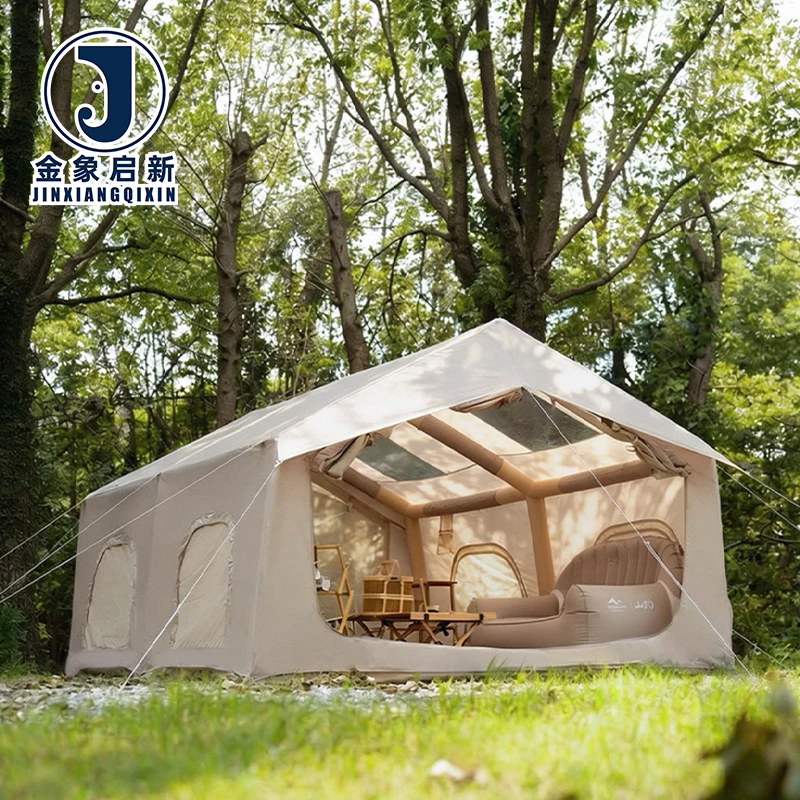
Coating Expertise Applied — Our PVC inflatable tent fabric benefits from 30 years of coating process control, ensuring consistent adhesion and hydrostatic performance across every production run.
Technical Specifications
| Parameter | Value |
|---|---|
| Product Type | Inflatable Tent |
| Core Material | PVC tarpaulin |
| Coating Material | PVC (proprietary coating technology) |
| Key Performance | Waterproof, UV-resistant, tear-resistant |
| Tear Strength Test Reference | 300N per ISO 13934-1 |
| Temperature Range | -20°C to 60°C |
| Construction | Single-layer |
| Customization Service | OEM & ODM (sample customization, pattern printing, dimensions, color, reinforcement locations) |
| Quality Control System | Full-process inspection with 24-hour pressure retention testing before shipment |
| Standards | ISO 9001, ISO 14001, ISO 45001, CE |
Application Suitability
| Application | Exposure & Requirement |
|---|---|
| Commercial outdoor events | High foot traffic, rapid deployment, wind loads requiring structural air-tightness |
| Temporary exhibition spaces | Indoor/outdoor transition, lighting rigging loads, frequent assembly and teardown |
| Emergency response command centers | Extreme weather exposure, continuous inflation, critical reliability under stress |
| Industrial site temporary facilities | Dust, chemical splash, heavy equipment proximity, long-term UV exposure |
| Four-season camping shelters | Sub-zero temperatures, snow loads, sustained hydrostatic pressure from rain |
Why Air Retention Fails Before the Fabric Does
When sourcing inflatable structures, the most costly failure is rarely the fabric tearing — it is the air leakage at seams and valves that compromises the entire shelter. A PVC inflatable tent fabric manufacturer must engineer the material to support sustained internal pressure without delamination or micro-cracking at the weld lines.
Inflatable tents operate under constant positive pressure. If the coating adhesion is weak or the base fabric stretches unevenly under load, the welded seams become the failure point long before the fabric itself reaches its tensile limit [NEED_CITE: tensile and tear test methods for coated fabrics per ISO 1421]. I have seen heavy-grade coated rolls fail at the weld line because the coating formulation did not match the thermal profile required for high-frequency welding. The result is a structure that loses pressure overnight, leaving occupants exposed and operators facing warranty claims.
Coating Formulation for Sustained Inflation
Inflatable tent fabric demands a PVC coating that remains flexible under continuous pressure while resisting creep over extended deployment periods. The proprietary coating technology used here is formulated to maintain dimensional stability from -20°C to 60°C, a range validated through temperature cycling tests. This thermal stability ensures the fabric does not become brittle in winter conditions or soften excessively under summer sun, both of which accelerate air loss at critical junctions.
Weave Architecture and Tear Propagation
The tear-resistant weave structure, tested to 300N per ISO 13934-1, addresses the specific failure mode of inflatable shelters: a puncture or cut that propagates under internal pressure. Unlike static tarpaulin applications where a tear may remain localized, an inflated structure places the entire membrane under tension. A tear in this context can unzip rapidly [NEED_CITE: ISO 13934-1 tensile testing standard for textiles]. The base fabric construction is engineered to arrest tear propagation, buying time for field repair before structural collapse occurs.
Reading the Specification Sheet Beyond GSM
GSM alone tells a buyer very little about how a PVC inflatable tent fabric will perform under inflation pressure. A 650 GSM fabric with a loose weave and thin coating may weigh the same as a tightly woven, heavily coated alternative, yet offer substantially lower tear strength and poorer weld adhesion. What matters is the relationship between base fabric denier, mesh count, and coating weight — and how those three variables interact during the thermal welding process. The hydrostatic pressure resistance exceeding industry standards, as claimed for this fabric, is a function of coating thickness and uniformity, not merely total weight. Buyers should request the coating weight separate from the base fabric weight to understand where the mass actually sits in the composite structure.
The Hidden Cost of Weld-Line Failures
Specifying fabric without considering the welding process is a decision that surfaces only after deployment. When the coating formulation is incompatible with the heat-sealing parameters used by the fabricator, the welded seams become the weakest point in the structure. I have observed inflatable shelters where the seam peeled under moderate wind load while the surrounding fabric remained undamaged — a failure mode that traces directly to coating adhesion properties. For commercial operators running event rentals or emergency response fleets, a seam failure means a stranded structure, a dissatisfied client, and a replacement cost that far exceeds the price differential of specifying a welding-compatible fabric from the outset [NEED_CITE: common failure modes in inflatable membrane structures].
Why Procurement Teams Source This Fabric
The 10-person R&D team handles material selection and sample development, enabling buyers to validate coating compatibility with their specific welding equipment before committing to bulk production. Three full production lines and 36 sets of professional processing equipment provide the capacity to maintain batch consistency across large orders — a critical factor when multiple inflatable units must match in colour and performance. The 24-hour pressure retention test on every inflatable structure before shipment catches air-leak defects that visual inspection alone would miss. Full OEM and ODM capability covers dimensions, colour, pattern printing, and reinforcement locations, allowing fabricators to receive material pre-configured for their assembly process rather than adapting generic stock. Every batch ships with a specification sheet detailing coating parameters, enabling the fabricator to dial in welding temperature and dwell time with precision.
Documentation & Verification
- Material specification sheet detailing coating weight, base fabric denier, and hydrostatic test results per batch
- ISO 9001, ISO 14001, ISO 45001, and CE certificates included with every shipment
- Tear strength test report referencing ISO 13934-1 with actual measured values
- Temperature cycling validation data for the -20°C to 60°C range available on request
- Raw material certificates of analysis provided for traceability and compliance audits
Fabrication, Handling & Storage
- Calibrate high-frequency welding temperature to the PVC coating formulation — test weld samples before full production runs
- Store rolls horizontally on padded racks to prevent creasing that weakens the coating at fold lines
- Allow fabric to acclimate to ambient temperature before unrolling in cold conditions to avoid coating micro-cracking
- Use PVC-compatible adhesive and patch kits for field repairs — solvent-based cements may degrade the coating matrix
- Plan cutting layouts to minimize weld seams across high-stress zones where internal pressure concentrates load
- Clean with mild, non-abrasive detergent — harsh solvents compromise the UV-stabilized additive layer
How to Specify Your Inflatable Fabric Requirement
To move from inquiry to sample efficiently, provide the intended deployment environment including expected wind loads and temperature extremes. State whether you require raw rolls for in-house fabrication or finished panels with reinforcement at valve and anchor points. If your end market has specific fire safety or anti-static requirements, confirm the applicable standard so we can verify grade availability before sampling.
Frequently Asked Questions
Q: How is the waterproof rating tested and verified before shipment?
A: Hydrostatic pressure resistance is tested against industry-standard methods to confirm waterproof integrity under sustained water exposure. Each production batch undergoes inspection, and test results are documented in the batch-specific quality report shipped with your order. The 24-hour pressure retention test on finished inflatable structures further validates that the fabric maintains air-tight performance under continuous inflation.
Q: What UV resistance test basis supports the anti-UV claim?
A: UV-stabilized additives are integrated into the fabric matrix to minimize degradation under continuous sunlight exposure. The specific test method and exposure duration are documented in the material specification sheet. Buyers operating in high-UV environments should request the test data to confirm the fabric meets their regional exposure requirements before placing bulk orders.
Q: What customization options are available for dimensions, color, and printing?
A: Full OEM and ODM services cover custom dimensions, color matching, pattern printing, and reinforcement placement at valve and anchor points. Sample customization is available for specification validation before full production runs. The R&D team works directly with buyers to develop fabric configurations that match specific welding equipment and assembly processes.
Q: How does the 24-hour pressure retention test ensure structural integrity?
A: Every inflatable structure undergoes continuous inflation for 24 hours before shipment, monitored for pressure drop that indicates seam leakage or coating defects. This test catches failures that visual inspection alone cannot detect, ensuring the PVC inflatable tent fabric performs reliably under sustained internal pressure in field conditions.
Q: How can buyers request batch-specific test data and certificates?
A: Batch-specific quality inspection reports detailing waterproof rating, tensile strength, and UV resistance results are included with every order. Raw material certificates of analysis are available on request for compliance audits and traceability requirements. Contact the technical team with your order reference to obtain the complete documentation package.