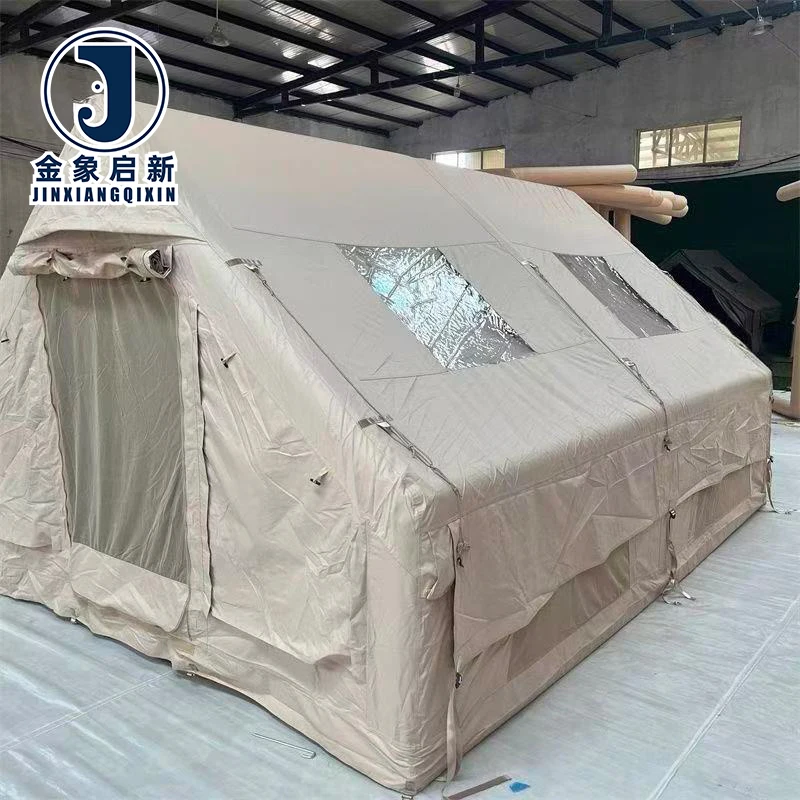
Technical Specifications
| Parameter | Value |
|---|---|
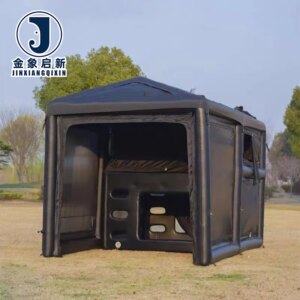
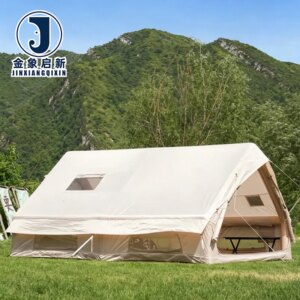
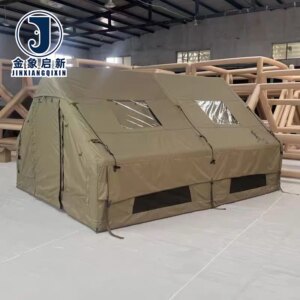
| Product Type | Inflatable Tent |
| Core Material | PVC Tarpaulin |
| Key Performance | Waterproof, UV-resistant (test basis not stated), Tear-resistant |
| Capacity | 6-8 Person |
| Season Rating | 4 Season |
| Opening Mechanism | Automatic Opening |
| Customization Service | OEM & ODM (sample customization, pattern printing) |
| Standards | ISO9001, ISO14001, ISO45001, CE |
Application Suitability
| Application | Exposure & Requirement |
|---|---|
| Commercial Outdoor Events | High-frequency deployment, rapid setup/teardown, weather exposure, crowd safety compliance |
| Construction Site Temporary Housing | Continuous UV and rain exposure, dust, mechanical abrasion from site equipment |
| Industrial Camping Operations | Remote deployment, temperature fluctuation, long-term structural load on welded seams |
| Recreational Facilities | Repeated inflation/deflation cycles, user contact, surface wear and cleaning chemicals |
Why Batch Colour Variation Ruins Multi-Unit Inflatable Tent Orders
Colour drift between rolls in a single production run is invisible until the tents are erected side by side — by then, rework is already overdue.
When a buyer sources inflatable tent PVC tarpaulin for a fleet of event structures or a construction camp, the specification sheet usually confirms a Pantone or RAL reference. What it rarely documents is the allowable delta-E tolerance between rolls. I have reviewed shipment batches where the first roll cut cleanly to spec, but the third roll showed a visible shift under daylight — a shift that passed in-factory lighting but failed at the installation site. For manufacturers producing multiple inflatable tent units from one order, this inconsistency forces selective cutting, wasted panels, and delayed assembly schedules. [NEED_CITE: colour measurement standards for coated textiles]
Coating Adhesion and Inflatable Structure Integrity
The performance of an inflatable tent depends entirely on the bond between the PVC coating and the base polyester fabric. When internal air pressure pushes outward continuously, any delamination at the coating interface propagates rapidly along the seam line. Our custom inflatable tent PVC tarpaulin production controls coating weight and adhesion at each stage of the line, so the coating does not separate from the substrate under sustained inflation pressure or repeated folding during transport.
Welded Seam Behaviour Under Cyclic Inflation
Inflatable structures undergo constant pressure cycling — inflated for use, deflated for transport, then inflated again. Each cycle flexes the welded seams at the tube junctions. The weld must outlast the fabric, not the other way around. Our R&D team, comprising 10 technicians, develops heat-seal parameters matched to the specific GSM and coating formulation of the inflatable tent fabric, ensuring the welded joint retains structural continuity through repeated deployment. [NEED_CITE: high-frequency welding test methods for PVC-coated fabrics]
How Base Fabric Construction Dictates Tear Propagation
The tear resistance of PVC tarpaulin used in inflatable tent manufacturing is governed not by coating thickness alone, but by the denier of the polyester yarns and the weave density of the base fabric. A heavier coating adds puncture resistance but cannot stop a tear once it reaches the substrate. The base fabric’s warp and weft count determines whether a small puncture stays localised or runs across the panel. Selecting the correct base fabric construction — matched to the intended deployment environment — is where material specification decisions have the greatest impact on field service life. Manufacturers sourcing Inflatable Tent Fabric manufacturer supply should verify both the base fabric denier and the coating weight independently rather than relying on total GSM alone.
The Hidden Cost of Undocumented UV Treatment
UV-resistant treatment is frequently stated on quotation documents without a corresponding exposure test. When inflatable tent fabric is deployed in open-air commercial events or remote construction camps, the coating surface faces continuous solar radiation. Without verified test data backing the UV claim, buyers cannot predict when surface chalking, colour fading, or coating embrittlement will begin. The consequence is premature panel replacement and warranty disputes — costs that far exceed the price difference between a documented and an undocumented UV treatment specification. [NEED_CITE: accelerated weathering test standards for PVC tarpaulin]
Verified Process Control for Inflatable Tent Fabric Supply
Three full production lines and 36 sets of professional processing equipment enable stable output volumes, which means multi-roll orders for inflatable tent manufacturing maintain consistent coating weight and colour across the entire batch. The dedicated QA and QC team inspects at every production stage, with 100% pre-shipment inspection covering surface defects, coating uniformity, and dimensional accuracy. OEM and ODM customisation — from sample development to pattern printing — is handled in-house, eliminating the coordination gaps that arise when coating, printing, and cutting are subcontracted separately. Each batch ships with documentation traceable to its production run.
Documentation & Verification
- Material specification sheet confirming GSM, base fabric denier, and PVC coating weight per roll
- UV test report provided where applicable, referencing the exposure standard used
- Pre-shipment inspection record covering waterproof integrity and surface consistency
- ISO9001, ISO14001, ISO45001, and CE certificates included with each shipment
- Batch colour reference documented against the agreed colour standard for traceability
- Roll packing list detailing quantity, dimensions, and net weight per unit
Fabrication, Handling & Storage
- Heat-seal temperature and dwell time must match the PVC coating formulation to prevent seam delamination
- Store rolls horizontally on pallets to avoid permanent creasing in the coated surface
- Use compatible PVC adhesive for field repairs on punctured inflatable tube sections
- Avoid dragging cut panels across abrasive ground during on-site tent assembly
- Clean with mild detergent only; solvents may degrade the PVC coating surface layer
- Allow adequate ventilation during storage to prevent condensation between wrapped roll layers
What We Need to Quotation Accurately
To provide a specification and sample that matches your inflatable tent production requirements, we need the intended deployment environment and expected inflation cycle frequency, the target market and any fire-safety or UV performance standards your end users require, the fabric width and annual volume you plan to source, and whether you need raw roll stock or custom-cut panels with pattern printing. If colour consistency across rolls is critical for your product line, state the acceptable tolerance range so we can confirm it before production begins.
Frequently Asked Questions
Q: How is the GSM stated on the quotation verified when the rolls arrive?
A: Each roll is weighed and measured before dispatch as part of the 100% pre-shipment inspection. The inspection record documents actual GSM against the quoted value. On arrival, buyers can cross-check using the same method — weighing a known-area sample cut from the roll. Any discrepancy triggers a documented review against the batch production record.
Q: What test basis supports the UV-resistant treatment claim on this inflatable tent fabric?
A: UV-resistant treatment is available in different grades depending on the target market and expected outdoor exposure duration. We provide test reports referencing the specific accelerated weathering standard used for your batch. Buyers should confirm which UV performance level their end-use application requires so the correct treatment grade is specified before production.
Q: How is roll-to-roll colour consistency controlled across a single bulk order?
A: Colour is monitored at the coating stage against the agreed reference standard using calibrated measurement equipment. Each roll in the order is compared to the master sample before it is released for packing. For orders where multiple inflatable tent units will be installed adjacent to each other, we recommend confirming the acceptable colour tolerance at the sampling stage.
Q: What are the lead times and minimums for OEM custom width and pattern printing?
A: Lead times depend on the customisation scope — standard widths and colours ship faster than custom-printed or non-standard width orders. Sample development for custom requirements is typically completed within days. Minimum order quantities vary by specification complexity. Confirm your required width, print design, and volume at the inquiry stage so we can provide an accurate schedule.
Q: What QA checks ensure welded seams outlast the fabric in inflatable structures?
A: Welded seam integrity is verified through peel-strength testing during production, ensuring the bond between coating layers meets the structural demands of continuous inflation pressure. The QA team checks seam consistency at tube junctions and high-stress points. Heat-seal parameters are matched to the specific PVC coating formulation so the joint does not become the failure point during repeated inflation cycles.