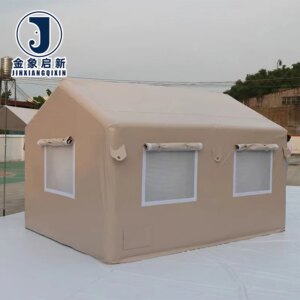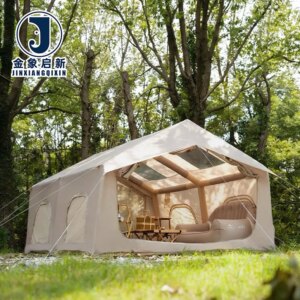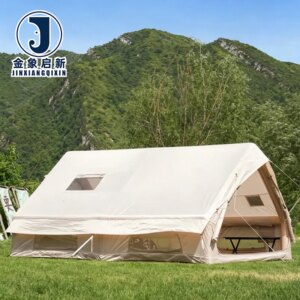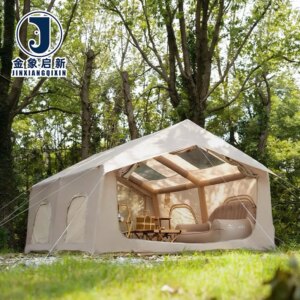
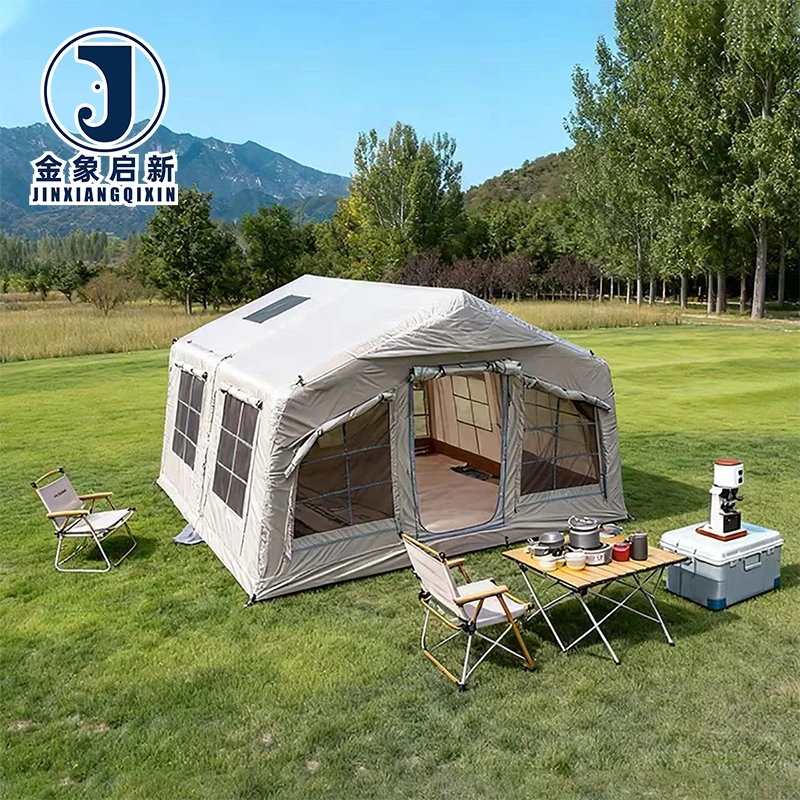
Process-Controlled Coating — Three full production lines and 36 sets of processing equipment support strict control over PVC coating weight and adhesion on every roll of inflatable tent fabric we produce.
Technical Specifications
| Parameter | Value |
|---|---|
| Product Type | Inflatable Tent |
| Core Material | PVC tarpaulin |
| Coating Material | PVC |
| Layer Structure | Single-layer PVC tarpaulin |
| Waterproof | Yes |
| UV Treatment | Available — confirm the grade required for your market (test basis not stated) |
| Flame Retardant | Available in flame retardant grades — confirm the grade required for your market (grade not stated) |
| Anti-Static | Available — confirm the standard required for your site (standard not stated) |
| Tear Resistance | Yes (test standard not stated) |
| Season Rating | 4-season |
| Opening Mechanism | Quick automatic inflatable opening |
| Customization | OEM & ODM: size adjustments, pattern printing, material thickness modifications |
| Quality Control | Full-process inspection; 24-hour pressure testing before shipment |
| Certifications | ISO 9001, ISO 14001, ISO 45001, CE |
Application Suitability
| Application | Exposure & Requirement |
|---|---|
| Commercial glamping resorts | Year-round weather exposure, sustained inflation pressure, guest safety compliance, repeated seasonal deployment |
| Outdoor event venues | Rapid inflate-and-deflate cycles, UV exposure during multi-day events, transport and storage between sites |
| Temporary hospitality facilities | Waterproof integrity under continuous occupancy, fire-retardant compliance for public assembly, thermal insulation in 4-season use |
| Temporary outdoor field facilities | Quick deployment under variable weather, anti-static requirements in sensitive environments, resistance to ground abrasion |
Why "Waterproof" and "Fire-Retardant" Mean Nothing Without Documented Grades
A coating claim without a test report is a liability waiting to surface on your first site inspection.
Technical buyers sourcing inflatable tent fabric know the frustration: the supplier’s quotation states UV resistance and flame retardancy, but when the local fire marshal or glamping site auditor asks for documentation, there is nothing to present. Across the coated fabric industry, generic performance claims are common, yet the regulatory and insurance requirements at commercial sites demand specificity [NEED_CITE: fire classification standards for temporary structures and inflatable assemblies]. A 4-season inflatable tent deployed at a commercial glamping resort must satisfy the exact flame retardant grade and anti-static standard the jurisdiction enforces, not a vague assurance.
Single-Layer PVC Tarpaulin: Coating Adhesion Under Inflation Pressure
In an inflatable tent, the fabric is not merely a weather barrier; it is a structural membrane holding internal air pressure across large unsupported spans. The single-layer PVC tarpaulin construction used in this inflatable tent fabric relies on consistent coating adhesion to prevent delamination when the membrane flexes under wind load or temperature-driven pressure changes. Our coating process controls the PVC compound application across the full fabric surface, ensuring the bond between coating and base fabric remains intact through repeated inflation and deflation cycles.
Coating Consistency and Waterproof Integrity Across the Full Membrane
Waterproof performance on an inflatable tent depends on uniform coating weight across every square meter of the membrane. A thin spot in the PVC coating becomes the first point of water ingress during sustained rain, and on a commercial glamping site, a single leak inside an occupied unit is a guest complaint and a reputational cost. The 24-hour pressure testing protocol we apply before shipment verifies that seam integrity and coating continuity hold under sustained inflation, catching defects that visual inspection alone would miss [NEED_CITE: tensile and tear test methods for coated fabrics per ISO 1421].
Understanding Base Fabric and Coating Weight as a Combined System
The structural performance of inflatable tent fabric is determined by the interaction between base fabric construction and PVC coating weight, not by either parameter in isolation. A heavier coating does not compensate for a loosely woven base fabric, because tear propagation follows the yarn structure once the coating is breached. Conversely, a dense base fabric with insufficient coating will abrade at the surface and lose its waterproof barrier over time. For commercial inflatable tent applications, the specification must address both the base fabric denier and weave density and the PVC coating compound formulation together. UV-resistant and fire-retardant additives are integrated into the PVC compound during coating, meaning their effectiveness depends on the coating being applied at the correct weight to carry the required additive loading throughout the membrane thickness.
The Hidden Cost of Specifying on Price Instead of Coating Weight
When buyers select inflatable tent fabric based on the lowest per-square-meter cost, they often receive material where the coating weight has been reduced to hit that price point. The consequence appears months into operation: seams begin to separate under sustained inflation pressure, UV degradation accelerates because the additive loading in a thinner coating is insufficient, and fire-retardant performance falls below the grade the site requires. For a commercial glamping operator, the cost of replacing a failed inflatable tent mid-season — including guest relocation, site downtime, and reputational damage — far exceeds the savings on the original fabric purchase [NEED_CITE: common failure modes in PVC-coated inflatable structures].
Why Source Inflatable Tent Fabric Through This Facility
Our 10-technician R&D team handles material selection, thickness modification, and sample development specific to inflatable tent construction, so OEM buyers can validate the fabric against their inflation pressure and structural design before committing to production. Dedicated QA and QC staff inspect every production stage, with 100% pre-shipment inspection and 24-hour pressure testing confirming seam and membrane integrity on each unit. The facility’s three full production lines and 36 sets of professional processing equipment support bulk orders with consistent coating weight roll-to-roll, which matters when a glamping resort deploys dozens of identical inflatable units and expects uniform appearance and performance. ISO 9001, ISO 14001, ISO 45001, and CE certifications govern the manufacturing process, providing the audit trail that commercial operators and their insurers require.
Documentation & Verification
- Material specification sheet stating base fabric type, PVC coating compound, and coating weight per roll
- Test reports for UV resistance and flame-retardant grades when specified in the purchase order
- Pre-shipment inspection record including 24-hour pressure test results for each inflatable unit
- ISO 9001, ISO 14001, ISO 45001, and CE certificates covering the manufacturing process
- Roll packing list with batch traceability for multi-roll inflatable tent fabric orders
Fabrication, Handling & Storage
- Heat welding parameters must match the PVC coating compound and single-layer thickness to achieve full seam fusion
- Store rolled inflatable tent fabric vertically on end-caps to prevent permanent creasing in the PVC coating
- Avoid dragging the coated surface across abrasive ground during on-site deployment to protect the waterproof barrier
- Clean the PVC coating with mild detergent only; solvents degrade the coating and compromise flame-retardant additives
- Allow fabric to reach ambient temperature before unrolling in cold conditions to prevent coating micro-cracking
What to Include in Your Inquiry
Provide the intended deployment environment, including typical wind loading and temperature range, so we can recommend the appropriate PVC coating weight and base fabric construction for your inflatable tent design. Specify the fire-retardant grade and anti-static standard required by your local jurisdiction or site operator, along with any color or pattern printing requirements. Confirm whether you need finished inflatable tent units or fabric by the roll for your own fabrication line, and whether a pre-production sample is needed to validate heat welding parameters.
Frequently Asked Questions
Q: How is the PVC coating weight verified, and how does it relate to tensile and tear strength?
A: Coating weight is measured during production and verified at pre-shipment inspection against the stated specification. Tensile and tear strength depend on both the base fabric weave and the coating compound; a heavier coating alone does not guarantee higher strength. We document the measured coating weight on the inspection record accompanying each shipment so buyers can confirm the material matches their specification.
Q: What test basis supports the UV-resistance and flame-retardant claims?
A: UV-resistant and fire-retardant additives are integrated into the PVC coating compound during manufacturing. Where specific grades are required, we supply test reports documenting the classification achieved. Buyers should confirm the exact standard their market or site demands — such as a specific fire classification for temporary structures — before placing the order so the correct compound formulation is applied.
Q: How does single-layer PVC tarpaulin perform under sustained inflation pressure?
A: The single-layer PVC tarpaulin construction is engineered for airtight inflatable chambers, with coating adhesion controlled to resist delamination under continuous air pressure. Each unit undergoes 24-hour pressure testing before shipment, verifying that seams and membrane surfaces hold without leakage. This protocol catches construction defects that would otherwise surface only after deployment at the commercial site.
Q: What customization options are available, and how is batch-to-batch color consistency maintained?
A: OEM and ODM customization covers size adjustments, material thickness modifications, and pattern printing on the PVC surface. Color consistency across rolls within the same production batch is maintained through controlled compound mixing and coating application. For large deployments requiring multiple rolls of identical color, we recommend ordering the full quantity in a single production run to minimize shade variation.
Q: What documentation accompanies each shipment?
A: Every shipment includes a material specification sheet, pre-shipment inspection record with pressure test results, roll packing list, certificate of origin, and relevant ISO and CE certificates. Test reports for UV resistance and flame-retardant grades are provided where applicable and specified in the purchase order, giving commercial operators the documentation their site auditors and insurers require.