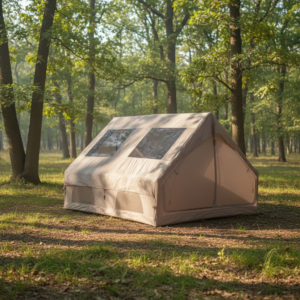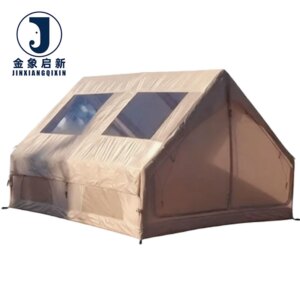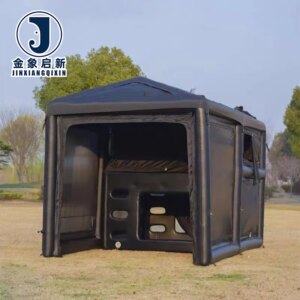
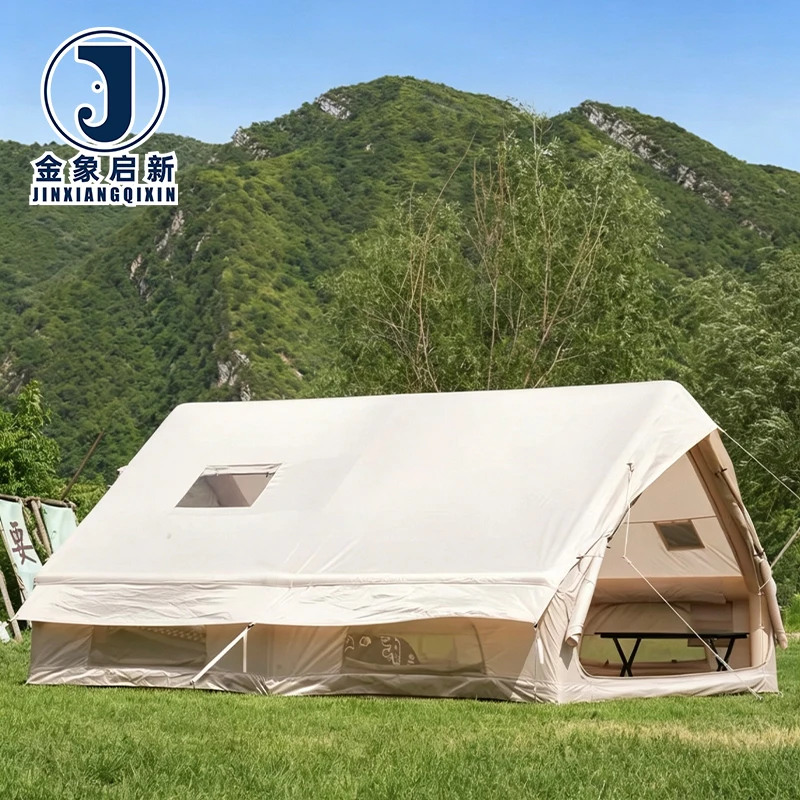
Coating Adhesion Mastery — Every roll of PVC inflatable tent fabric undergoes in-process peel testing to ensure heat-welded seams hold as long as the base material itself.
Technical Specifications
| Parameter | Value |
|---|---|
| Product Type | Inflatable Tent |
| Core Material | PVC tarpaulin |
| Key Performance | Waterproof, UV-resistant (test basis not stated), tear-resistant |
| Product Forms | 2-3 Person Quick Automatic Opening Four-Season Waterproof Outdoor Air Tent |
| Customization Service | OEM & ODM, sample customization, pattern printing |
| Production Facility Area | 9,180 m² |
| Production Lines | 3 full production lines |
| Processing Equipment | 36 sets of professional processing equipment |
| R&D Team Scale | 10 technicians |
| Certifications | ISO 9001, ISO 14001, ISO 45001, CE |
Application Suitability
| Application | Exposure & Requirement |
|---|---|
| Outdoor event management shelters | Repeated inflation cycles, wind loading, public safety compliance |
| Commercial camping ground facilities | Constant UV exposure, guest turnover abrasion, seasonal storage |
| Construction site auxiliary shelters | Dust ingress, equipment impact, multi-season weather cycling |
| Mobile field operations enclosures | Rapid deployment demands, transport abrasion, variable terrain anchoring |
| Outdoor exhibition booths | Visual branding consistency, frequent assembly and teardown |
| Equipment storage facilities | Moisture ingress prevention, long-term static load on seams |
Why Welded Seams Fail Before the Fabric Does on Inflatable Structures
Seam failure on inflatable tent fabric almost always traces back to inconsistent coating weight and poor adhesion at the weld interface.
When an inflatable structure flexes under wind load or internal pressure changes, the welded seams bear concentrated stress. If the PVC coating weight varies across the roll width, the heat-welding temperature that works in one section produces a weak bond in another. Manufacturers of inflatable and membrane structures regularly see seam delamination within the first season of commercial deployment — not because the base fabric tore, but because the coating did not fuse uniformly during fabrication [NEED_CITE: weld adhesion test methods for PVC coated fabrics per ISO 1421].
As a PVC Inflatable Tent Fabric manufacturer, we control coating weight at every stage of the production line, giving fabricators a predictable welding window across the entire roll.
Coating Weight Control and Its Effect on Weldability
The reliability of a heat-welded seam on inflatable tent fabric depends directly on how evenly the PVC coating sits on the base fabric. Uneven coating creates cold spots during welding where the material does not reach fusion temperature, producing seams that peel apart under cyclic inflation loads. Our three production lines maintain coating consistency through continuous weight monitoring, so fabricators working with our PVC Inflatable Tent Fabric can set welding parameters once and trust them across the full roll length.
Batch-to-Batch Colour Matching for Multi-Roll Orders
When an inflatable tent manufacturer orders several rolls for a large structure or a series of matching units, visible colour drift between rolls creates rejects at the fabrication stage. Colour variation shows up most clearly on curved inflatable panels where adjacent sections meet at seams. We manage pigment dosing and mixing under controlled conditions to hold colour within a tight tolerance band, reducing the risk that finished inflatable structures show panel-to-panel shade differences once inflated on site [NEED_CITE: colour fastness and batch consistency standards for coated technical textiles].
How Base Fabric Construction Affects Inflatable Panel Strength
The denier of the yarn and the weave density of the base fabric determine how the material distributes stress around valve holes, corner welds, and anchoring points. A loosely woven base allows tear propagation once a puncture starts, while a tightly woven substrate arrests tear spread and keeps the inflatable chamber pressurised. The PVC tarpaulin we produce uses a base fabric selected to balance tear resistance with the flexibility needed for repeated folding, inflation, and deflation cycles that commercial inflatable tents endure.
Specifying the Wrong Coating Grade and What It Costs
A PVC Inflatable Tent Fabric that lacks the correct UV treatment for the deployment climate will show surface chalking and loss of flexibility over time, leading to micro-cracks at fold lines. Similarly, fabricators who receive material without verified waterproofing at the coating level face water ingress complaints from end users — problems that surface only after the tent has been deployed in rain. Sourcing from a PVC Inflatable Tent Fabric manufacturer that provides test documentation for each claimed property eliminates this guesswork and protects your reputation with commercial buyers [NEED_CITE: UV degradation mechanisms in plasticised PVC coatings].
Why Procurement Teams Choose This Production Facility
Our 10-technician R&D team handles material selection, pattern printing, and custom sizing specific to inflatable tent applications, developing samples within days so you can validate weld parameters and colour before committing to full production. Three full production lines with 36 sets of professional equipment give us the capacity to deliver multi-roll orders on schedule without sacrificing the coating consistency your fabrication process depends on. Every roll undergoes 100% inspection before dispatch, and our ISO 9001, ISO 14001, ISO 45001, and CE certifications are included in shipment documentation for your compliance records.
Documentation & Verification
- Material specification sheet stating base fabric type, coating weight, and colour reference for each roll
- UV and waterproofing test reports provided where applicable to the ordered grade
- Pre-shipment inspection record confirming 100% visual and dimensional check before dispatch
- ISO 9001, ISO 14001, ISO 45001, and CE certificates included with every shipment
- Roll packing list with individual roll weights and dimensions for receiving verification
- Certificate of origin and customs documentation prepared for international dispatch
Fabrication, Handling & Storage
- Set heat-welder temperature based on sample welds before processing full PVC tarpaulin rolls
- Store rolls vertically on end caps to prevent flat-spot creasing on the coating surface
- Avoid dragging rolls on unprotected concrete to prevent abrasion damage to the outer PVC layer
- Use compatible PVC welding tape for field repairs on inflatable panel seams
- Allow material to acclimatise to workshop temperature before unrolling to prevent coating stiffness cracking
- Plan cutting layouts to minimise offcut waste across the available roll width
Starting Your Inflatable Fabric Specification
To move forward, share your intended deployment climate, the inflation mechanism you use, and the panel dimensions your design requires. If your market demands specific UV treatment or fire performance grades, confirm the standard your end users must meet. We will prepare a material sample for your weld testing and colour approval before production begins.
Frequently Asked Questions
Q: How is coating adhesion and weld strength verified on inflatable tent fabric?
A: We run in-process peel and weld tests during production to confirm that the PVC coating bonds consistently across the roll width. Each batch is checked for coating weight uniformity, which directly determines whether your heat-welding parameters produce reliable seams. Pre-shipment inspection records document these checks for your quality files.
Q: What UV treatment test basis is available for prolonged outdoor exposure?
A: UV-resistant treatment is available for our PVC inflatable tent fabric. The specific test basis depends on the grade ordered and the exposure duration your application requires. Confirm the UV performance standard your market demands, and we will supply the matching test documentation with your shipment.
Q: How is batch-to-batch colour consistency maintained across multiple rolls?
A: Pigment dosing and mixing are controlled at each production run to hold colour within a defined tolerance. We run visual comparison checks against approved reference standards before dispatch. For large orders spanning multiple production batches, we sequence rolls to minimise any residual shade variation across your cutting plan.
Q: What custom sizing, printing, and sample development options are supported?
A: Our 10-technician R&D team supports OEM and ODM requirements including custom roll widths, cut sizes, and pattern printing. Samples are developed within days so you can verify material behaviour under your welding and inflation processes before authorising full production.
Q: What documentation accompanies each shipment for regulatory and procurement compliance?
A: Every shipment includes a material specification sheet, pre-shipment inspection record, roll packing list, ISO 9001, ISO 14001, ISO 45001, and CE certificates, plus a certificate of origin. Test reports for UV or other treatments are included where applicable to the grade ordered.