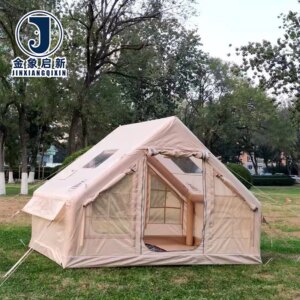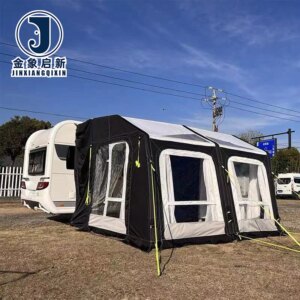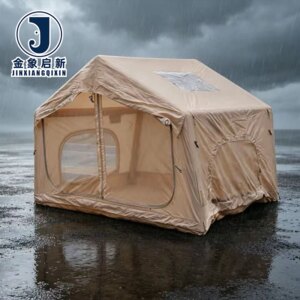
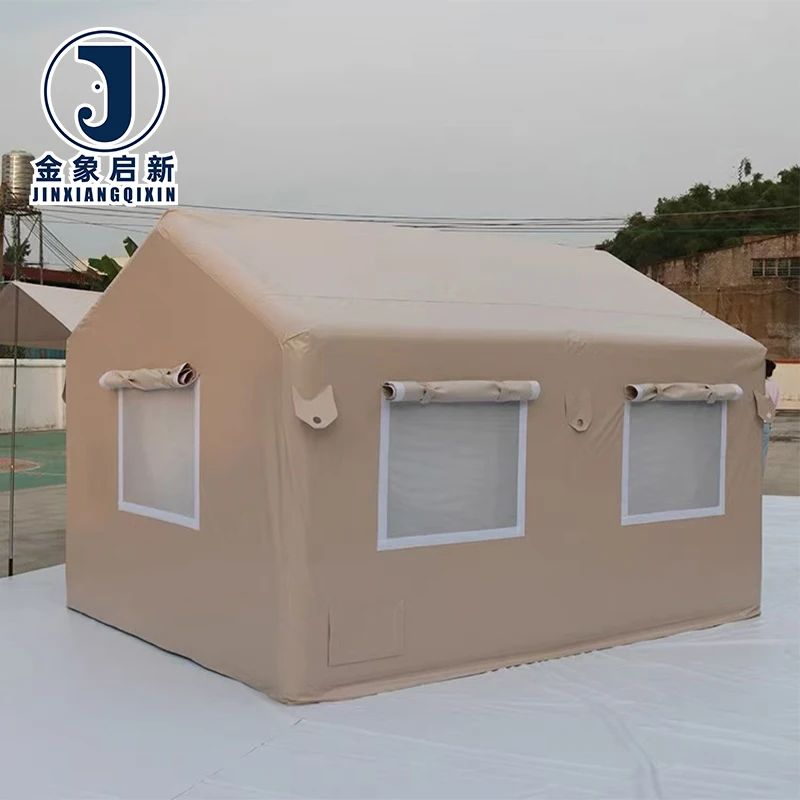
Material Consistency Control — batch-to-batch colour and coating weight verified across every roll of inflatable tent fabric before it leaves the production line, ensuring your commercial shelters install with uniform appearance and performance.
Technical Specifications
| Parameter | Value |
|---|---|
| Product Type | Inflatable Tent |
| Core Material | PVC tarpaulin |
| Key Performance Features | Waterproof, UV-resistant, tear-resistant, fire-retardant, anti-static |
| Capacity | 8-10 Person |
| Deployment Feature | Quick Automatic Opening |
| Season Rating | Four-Season |
| Customization | OEM & ODM with sample customization and pattern printing |
| Quality Standards | ISO9001, ISO14001, ISO45001, CE |
Application Suitability
| Application | Exposure & Requirement |
|---|---|
| Temporary site offices at construction sites | Wind loading, daily temperature cycles, frequent inflation and deflation |
| Equipment storage facilities on remote sites | UV exposure, precipitation, dust ingress, mechanical contact from stored machinery |
| Emergency response command centers | Rapid deployment demand, all-weather reliability, interior climate control compatibility |
| Temporary event venues | High visual standards, public occupancy fire safety codes, repeated assembly cycles |
| Year-round outdoor industrial shelters | Four-season temperature extremes, sustained solar radiation, snow load on inflated structure |
Why "Flame Retardant" Inflatable Tent Fabric Needs a Grade Behind the Claim
Fire safety compliance for inflatable shelters depends on the test standard recognised in your destination market, not a generic label.
Inflatable tent fabric sits in a difficult position: buyers sourcing for commercial events or mining sites see "flame retardant" on the quotation but arrive at a site audit with no test report the inspector accepts. Without a grade referenced to a specific standard — whether NFPA 701 for the North American market, DIN 4102 B1 for European construction sites, or M2 for French public venues — the claim holds no weight at the compliance checkpoint [NEED_CITE: DIN 4102 fire classification for building materials]. Manufacturers who coat without documenting the additive package leave buyers exposed to rejection, rework, or worse, a safety incident traced back to material that did not perform as assumed.
Coating Formulation and Surface Performance Options
The PVC tarpaulin core used in this inflatable tent fabric supports a range of surface treatments that address the specific hazards commercial and industrial inflatable shelters encounter in the field. Waterproof performance, UV-resistant additives, tear-resistant base fabric construction, fire-retardant grades and anti-static treatment are all configurable — each available in grades appropriate to your end market and the environment where the structure will operate. A four-season inflatable camping tent deployed in Scandinavian winters faces different demands than an emergency command center pitched in the Middle East, and the coating formulation must reflect that divergence. OEM and ODM services allow pattern printing and sample customization so the finished fabric matches both performance requirements and visual branding specifications before mass production begins.
Production Capacity and Batch Consistency for Roll Orders
Tent and inflatable manufacturers buying fabric by the roll need assurance that roll number one and roll number fifty will behave identically on the welding table and look identical once the structure is inflated side by side. Three full production lines and thirty-six sets of professional equipment provide the throughput to fulfil container-scale orders while maintaining tight control over coating weight and colour consistency. A dedicated ten-person R&D team handles material selection, custom sizing and sample development, giving buyers the ability to lock specifications through approved samples before committing to production runs [NEED_CITE: tensile and tear test methods for coated fabrics per ISO 1421]. This matters especially when an inflatable tent fabric order spans multiple widths or colours destined for different shelter configurations.
How Base Fabric and Coating Weight Interact to Define Real Strength
GSM alone tells a partial story. The tensile and tear performance of PVC inflatable tent fabric depends on the interplay between base fabric denier, weave density, and the weight of PVC coating applied to each surface. A heavier coating adds abrasion resistance and improves weld integrity but also increases roll weight and stiffness, which can complicate inflation dynamics in cold conditions. The base fabric’s warp and weft density determines how a tear propagates once initiated — a tight weave arrests tear spread more effectively than a loose one, regardless of total GSM. Coating adhesion to the base fabric, governed by the coating method and curing parameters, dictates whether the PVC layer delaminates under the flexing stress that occurs every time the inflatable structure inflates and deflates. Selecting the correct balance requires testing against the actual deployment conditions rather than relying on a single weight figure.
The Cost of Selecting Inflatable Fabric Without Verifying Roll Data
A buyer who confirms an order based on quoted GSM and treatment claims without reviewing pre-shipment inspection data risks several downstream failures. Colour variation between rolls becomes visible only after the inflatable tent panels are welded and inflated together, at which point rework means cutting new panels and absorbing the material loss. Coating weight that arrives lighter than specified reduces weld strength at the seams — precisely where the structure flexes most during inflation and under wind load. Fire-retardant treatment claimed without a supporting test report surfaces as a compliance failure during site inspection, potentially shutting down an event or halting a construction project until replacement material arrives [NEED_CITE: fire safety inspection requirements for temporary structures on commercial sites]. These are not hypothetical scenarios; they recur across the inflatable fabric supply chain when verification steps are skipped.
What This Manufacturing Process Delivers for Inflatable Fabric Buyers
Nearly three decades of focused coated fabric production means the coating weight and adhesion parameters for PVC inflatable tent material are controlled through established process knowledge rather than trial and error. Three production lines running in parallel allow bulk orders to be fulfilled within typical multi-week lead times without sacrificing the dedicated QA/QC inspection that runs at every stage. The ten-person R&D team develops samples within days for custom width, colour, and pattern printing requirements, compressing the approval cycle before mass production. One hundred percent pre-shipment inspection means every roll is checked against the agreed specification before packing, not spot-sampled after the container is loaded. ISO and CE certified production provides the documentation framework that technical buyers and fabricators need for their own compliance files.
Documentation & Verification
- Material specification sheet stating GSM, base fabric construction, coating type, and colour reference for each roll
- Test report for UV-resistant and flame-retardant grades where applicable — request before order confirmation
- Pre-shipment inspection record showing 100% inspection results for weight, colour, and coating integrity
- Roll packing list with individual roll identifiers for traceability from production batch to delivery
- Certificate of origin and customs documentation supporting international shipment clearance
Fabrication, Handling & Storage
- Hot-air welding temperature and speed should be calibrated to the specific PVC coating weight and surface finish of each roll
- Store rolls vertically on padded racks to prevent flat-spot deformation that affects inflation panel cutting accuracy
- Allow cold-stored PVC inflatable tent fabric rolls to acclimatise before unrolling to avoid coating micro-cracking
- Match pattern printing registration to the confirmed sample before running full production on custom-branded rolls
- Clean welded seams with PVC-compatible solvent only; aggressive cleaners degrade the coating adhesion layer
Before You Request a Quotation
Provide the end-use environment — temperature range, expected wind exposure, and whether the inflatable structure will be permanently sited or repeatedly deployed and packed. Specify the fire-retardant grade or test standard required by your destination market so the correct additive package is formulated from the outset. Indicate whether you need roll stock in standard widths for your own cutting operation or custom-sized panels with pattern printing applied at the factory. Confirming these parameters at the inquiry stage shortens the sample development cycle and eliminates specification mismatches before production begins.
Frequently Asked Questions
Q: How is GSM verified on arrival and what documentation supports the quoted weight?
A: Every roll undergoes weight verification during the 100% pre-shipment inspection, and the results are recorded in the inspection report shipped with your order. The material specification sheet included with documentation states the target GSM, base fabric construction, and coating details so you can cross-reference on receipt.
Q: What flame-retardant test standard and grade apply to this inflatable tent fabric?
A: Fire-retardant grades are available and configured to match the standard required in your market — such as NFPA 701, DIN 4102, or M2. Specify the target compliance standard at inquiry stage so the correct formulation is applied and a supporting test report is issued with your shipment documentation.
Q: How is batch colour consistency controlled across multiple rolls in one order?
A: Colour is matched against an approved sample under controlled lighting before production begins, and every roll is checked during 100% pre-shipment inspection. This process prevents the visible variation that occurs when panels from different rolls are welded together and inflated side by side.
Q: What custom width, length and pattern printing options are available, and what are the minimums?
A: Custom widths, roll lengths, and pattern printing are available through OEM and ODM services, with samples developed within days for approval before mass production. Minimum quantities depend on the specific customisation requested — confirm your requirements during the inquiry for a tailored quotation.
Q: What is the sample development process and lead time before mass production?
A: Submit your application details, target specifications, and any pattern printing requirements. The R&D team develops a sample for your review, allowing you to lock colour, coating weight, and surface finish. Production begins only after written sample approval, ensuring the bulk order matches the confirmed standard.