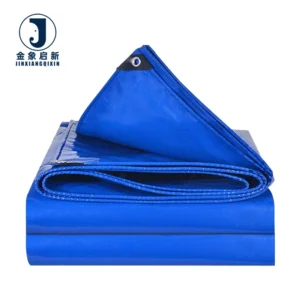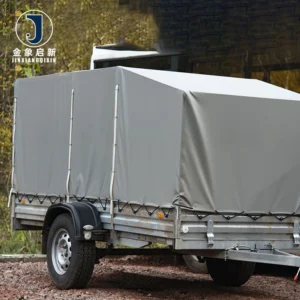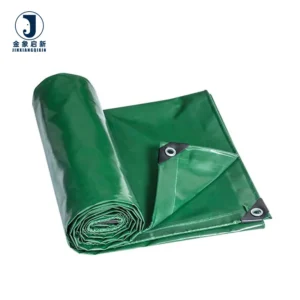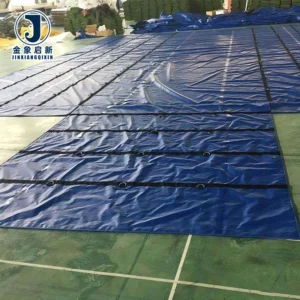
Precision Coating Weight Control — Every roll undergoes dedicated QA/QC at each production stage with 100% inspection before shipment, ensuring the GSM on the material specification sheet matches the physical fabric delivered to your warehouse.
Technical Specifications
| Parameter | Value |
|---|---|
| Product Type | Fire Retardant Waterproof PVC Tarpaulin |
| Material | 100% high toughness polyester yarn with PVC coating |
| Coating Method | Lamination technology and hot melt coating technology |
| Base Fabric Denier (Medium) | 500D |
| Base Fabric Denier (Heavy-duty) | 1000D |
| Base Fabric Denier (Super heavy) | 500D–2000D |
| Weight (Medium) | 400–500 g/m² |
| Weight (Heavy-duty) | 700–1000 g/m² |
| Weight (Super heavy) | 1100–1500 g/m² |
| Thickness (Medium) | 0.35–0.45 mm |
| Thickness (Heavy-duty) | 0.70–1.0 mm |
| Thickness (Super heavy) | 1.2–1.5 mm |
| Tensile Strength (Medium, N/5cm) | Warp 1500–2000 / Weft 1200–1800 |
| Tensile Strength (Heavy-duty, N/5cm) | Warp 2000–2500 / Weft 1800–2200 |
| Tensile Strength (Super heavy, N/5cm) | Warp 2500–3000 / Weft 2200–2800 |
| Flame Retardant Grade | B1 (stated in source heading — verify against your market fire code) |
| Anti-Static | Available (surface resistance or standard not stated in source) |
| Anti-Mildew | Mold proof |
| Cold Resistance | Cold resistant cracking |
| Waterproof | Yes |
| Color Fastness | Best color fastness (qualitative claim from source) |
| Outdoor Weather Resistance | 3–5 years (source value — verify against manufacturer catalog) |
| Welding Tear Strength | Excellent (qualitative claim from source) |
| Certifications | ISO, CE |
Application Suitability
| Application | Exposure & Requirement |
|---|---|
| Warehouse cover | Permanent outdoor weathering, wind load on large spans, B1 flame retardant compliance for stored goods |
| Construction site protection | Abrasion from tools and debris, frequent repositioning, flame retardant requirement near hot work |
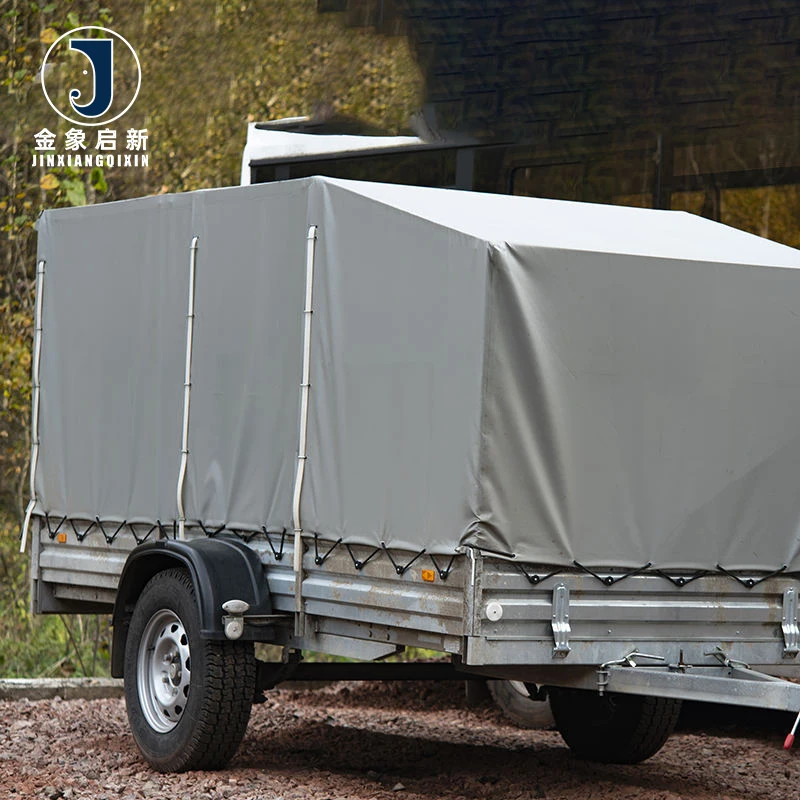
| Truck tarpaulin | Constant flexing during transit, road debris impact, tie-down tension at flex points |
| Industrial pipe canopy | Long-term UV exposure, chemical contact from pipe condensation, tensioned membrane stress |
| Tensioned structural fabric | Sustained biaxial tension, wind uplift cycles, fire code compliance for public structures |
| Engineering protective cloth | Temporary or semi-permanent covering of equipment, puncture risk from sharp edges |
Why Coating Adhesion Matters More Than GSM on the Quotation
The weld line fails before the fabric does — and adhesion quality is the variable most often missing from a supplier’s spec sheet.
Technical buyers regularly receive PVC coated tarpaulin rolls where the quoted GSM checks out on the scale, yet the coating delaminates at the heat-welded seam during fabrication. I have seen heavy-grade coated rolls fail at the weld line while the base fabric remained intact, because the lamination bond was never tested for peel strength. The gap between a stated PVC coated tarpaulin specification and the physical behaviour of the roll on the fabrication table is where most project failures originate. [NEED_CITE: peel strength test methods for coated fabrics per ISO 2411]
Base Yarn Denier and Its Direct Effect on Tensile Performance
The progression from 500D through 1000D to 2000D polyester yarn is not simply a thickness change — it restructures the load path through the base fabric. At 500D in the medium weight class, the warp tensile strength reaches 1500–2000 N/5cm, which suits flat warehouse covers and light truck tarps where biaxial loading is moderate. The 1000D base in heavy-duty grades lifts that figure to 2000–2500 N/5cm in the warp direction, giving PVC coated tarpaulin rolls the margin needed for side curtains that flex thousands of times per journey.
Coating Technology and What It Means for Fabrication
Lamination technology bonds the PVC film to the polyester base under heat and pressure, producing a distinct coating-to-yarn interface. Hot melt coating technology drives liquid PVC into the weave, filling interstices and creating a mechanical lock. The choice between them affects how the roll behaves on the hot wedge welder: hot melt coatings typically allow wider temperature windows during welding, while laminated structures may demand tighter control to avoid delamination at the bond line. [NEED_CITE: comparative adhesion behaviour of lamination versus hot melt PVC coating processes]
Reading the Weight-to-Strength Relationship Correctly
A common mistake in specifying PVC coated tarpaulin is treating GSM as a standalone strength indicator. The 400–500 g/m² medium class achieves its tensile values through a 500D yarn at a specific knit density, not through extra coating mass. The super heavy class at 1100–1500 g/m² uses up to 2000D yarn with a correspondingly thicker PVC layer, yielding 2500–3000 N/5cm warp strength. The coating weight and the base fabric denier must be evaluated together — a high GSM driven entirely by thick PVC with low-denier yarn will crack under flex fatigue long before a lower-GSM fabric with higher-denier yarn fails.
What Happens When Flame Retardant Claims Lack Documentation
Warehouse covers and construction site barriers frequently require B1 fire classification. When a PVC coated tarpaulin roll arrives on site without a test report linking the material to the B1 grade per DIN 4102, the entire installation can be rejected at inspection. I have reviewed projects where the contractor sourced material described only as "fire retardant" with no standard cited, and the local fire authority refused to accept it. The cost of replacing an installed membrane is multiples of the original material spend. [NEED_CITE: B1 fire classification requirements per DIN 4102 for temporary structures]
Why Material Transparency Reduces Procurement Risk
Our three full production lines and 36 sets of professional equipment allow each weight class — medium, heavy-duty, and super heavy — to run on dedicated coating lines with in-process GSM verification. The 10-person R&D team develops samples within days when you need a specific denier, colour, or treatment combination confirmed before committing to a production run. Dedicated QA/QC checkpoints at coating, curing, and winding stages catch adhesion or weight deviation before the roll reaches packing. Every pre-shipment inspection is recorded roll by roll, so the documentation you receive traces back to the specific batch. Custom widths and colours are produced on the same lines as stock grades, meaning batch consistency does not degrade when you move to a non-standard specification.
Documentation & Verification
- Material specification sheet listing GSM, base denier, coating method, and colour reference per roll
- Test report for flame retardant grade — confirm the grade required for your market before ordering
- Pre-shipment inspection record with per-roll GSM and dimensional verification before dispatch
- ISO and CE certificates included with shipment for compliance and customs clearance
- Roll packing list with individual roll numbers traceable to production batch records
- Certificate of origin provided for trade documentation where applicable
Fabrication, Handling & Storage
- Hot wedge welding temperature windows differ between lamination and hot melt coated rolls — request the recommended range for your grade
- Store rolls upright on a flat surface to prevent edge crushing that affects unrolling tension on heavy-duty grades
- Allow super heavy rolls at 1.2–1.5 mm thickness to acclimatise before unrolling in cold conditions to avoid coating stiffness cracks
- Clean welded seams with neutral pH detergent only — aggressive solvents attack the PVC surface on both glossy and matte finishes
- Plan cutting layouts to minimise cross-grain seams on 1000D and 2000D base fabric where tensile differential is most pronounced
- Reinforce tie-down points with additional PVC patches heat-welded to the base fabric before eyelet installation
Requesting a Specification That Matches Your Project
Tell us the application, the exposure conditions, and the fire or anti-static compliance your local authority requires. Specify whether you need roll stock by the container load or cut-to-size panels with welded hems. If colour consistency across multiple rolls is critical, request a production sample before the full run enters coating. We will respond with a material specification sheet, available lead time, and a test report aligned to the grade you need.
Frequently Asked Questions
Q: How is GSM verified and how can I conduct arrival inspection against the spec sheet?
A: We record GSM at multiple points during coating and again at pre-shipment inspection for every roll. On arrival, you can cut a measured sample from the roll edge, weigh it on a calibrated scale, and compare against the material specification sheet included in the shipment documentation. Any deviation should be flagged with photographic evidence and the roll number from the packing list.
Q: What is the relationship between base fabric denier and tensile strength?
A: The denier of the polyester yarn — 500D, 1000D, or up to 2000D — determines the load-bearing capacity of the base fabric before any PVC coating is applied. Higher denier yarns yield higher warp and weft tensile values, measured in N/5cm. The coating adds weight and waterproofing but does not compensate for a weak base weave under sustained tension.
Q: What test basis supports the B1 flame retardant grade?
A: The B1 grade is stated as a product classification. You should confirm which test standard your local fire authority accepts — DIN 4102 is common in European markets, but other jurisdictions may require NFPA 701 or a different protocol. Request the corresponding test report before production and verify it references the specific formulation being supplied.
Q: What is the difference between lamination and hot melt coating in terms of weldability?
A: Lamination technology bonds a pre-formed PVC film to the polyester base under heat and pressure, creating a distinct layer interface. Hot melt coating technology drives liquid PVC into the yarn interstices for a mechanical bond. Hot melt coatings generally tolerate a wider welding temperature window, while laminated rolls may require more precise heat control to avoid delamination at the seam.