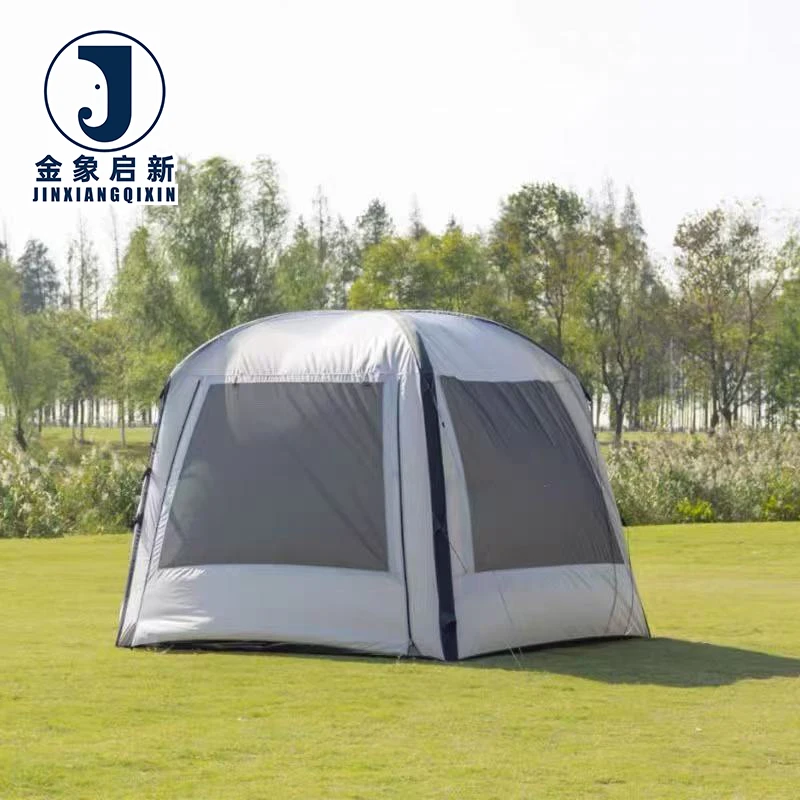
Process-Controlled Coating — every roll of inflatable tent fabric undergoes dedicated QA checks at each coating stage to verify adhesion, weight consistency, and surface finish before leaving the line.
Technical Specifications
| Parameter | Value |
|---|---|
| Product Type | Inflatable Tent Fabric |
| Core Material | PVC tarpaulin |
| Product Form | Automatic Inflatable |
| Capacity | 3-5 Person |
| Waterproof | Fully waterproof coated construction |
| UV-Resistant | Available in UV-resistant formulation — confirm test basis for your target market |
| Tear-Resistant | Reinforced PVC coated fabric construction |
| Fire-Retardant | Available in flame retardant grades — confirm the grade required for your market |
| Anti-Static | Available in anti-static treatment — confirm the standard required for your application |
| Customization | OEM & ODM including sample customization and pattern printing |
| Quality Control | Full-process inspection with dedicated QA & QC staff |
| Certifications | ISO 9001, ISO 14001, ISO 45001, CE |
Application Suitability
| Application | Exposure & Requirement |
|---|---|
| Construction site field offices | Continuous UV exposure, wind loading, rapid setup and teardown, compliance documentation required on site |
| Logistics staging areas | Heavy equipment movement, weather protection for materials, frequent inflation and deflation cycles |
| Emergency response command posts | Deployment in unprepared terrain, all-weather operation, minimal personnel for setup, regulatory fire compliance |
| Outdoor event management | Public occupancy fire safety requirements, branding and wayfinding signage, repeated seasonal use |
| Equipment and material shelters | Puncture and abrasion from stored items, moisture ingress prevention, dimensional stability across temperature swings |
What "Fire-Retardant Inflatable Tent" Means Without Documentation Behind It
A fire-retardant claim on a quotation carries no weight on a job site unless it is backed by a test report matched to the jurisdiction’s building code.
Procurement teams sourcing PVC inflatable tent aftermarket supplier options regularly encounter product listings that state flame resistance without specifying the grade or the test method behind it. Site inspectors in construction and mining operations require documentation tied to recognized standards, and a generic claim fails the audit. When inflatable tent fabric arrives without a batch-specific test report, the entire deployment can be halted until compliance is verified — costing days of downtime [NEED_CITE: fire classification standards for temporary structures and inflatable buildings].
Base Fabric Integrity and Coating Adhesion
The structural performance of any inflatable shelter starts with the base fabric. The PVC tarpaulin used in this inflatable tent fabric is produced on a controlled coating line where adhesion between the woven substrate and the PVC compound is monitored throughout the run. When adhesion is insufficient, delamination begins at stress concentrations — typically around inflation ports, door openings, and corner seams — well before the fabric itself reaches its tensile limit. A PVC inflatable tent aftermarket supplier must demonstrate process control over this interface, not merely quote a material weight.
Treatment Verification Before the Order Ships
Fire-retardant, anti-static, and UV-resistant treatments are available across the inflatable tent fabric range, but the specific grade and test basis must be confirmed against your project requirements before production begins. A mining contractor in Western Australia faces different compliance obligations than a European event organizer. The R&D team develops pre-production samples with the requested treatment package so you can verify performance in your own testing environment before committing to a bulk order. This eliminates the risk of receiving material that passes a generic lab test but fails the specific standard your site inspector enforces [NEED_CITE: tensile and tear test methods for coated fabrics per ISO 1421].
Reading the Specification Sheet Beyond Surface Claims
GSM alone does not predict how inflatable tent fabric will behave under inflation pressure and wind loading. The relationship between base fabric denier, weave density, and coating weight determines the real-world tear propagation resistance and seam holding strength. A lighter coating over a high-density woven base can outperform a heavier coating on a loose weave when it comes to puncture resistance at the ground contact zone. The material specification sheet provided with each order breaks down these components individually, so buyers can compare on engineering merit rather than a single headline number. Surface finish — whether glossy or matte — further influences cleaning behaviour in dusty site conditions and affects the adhesion of printed branding or identification markings.
The Hidden Cost of Unverified Material Claims
When inflatable tent fabric arrives on site with a flame-retardant claim that cannot be backed by documentation, the shelter cannot be occupied until an independent test is arranged. This delay cascades through project schedules, particularly in emergency response and disaster relief scenarios where the tent is the critical path for establishing a command post. Similarly, batch-to-batch inconsistency in coating weight or colour becomes visible when multiple units are deployed side by side at a logistics staging area, undermining professional presentation and requiring selective replacement that was never budgeted for [NEED_CITE: DIN 4102 fire classification for building materials]. Weld seam failure is another consequence of poorly matched material — when the coating compound and welding temperature are not aligned, the seam degrades before the fabric does, typically at the inflation tube junction where flexing is most concentrated.
Why Source This Fabric Through a Controlled Production Line
Nearly 30 years of PVC coated fabric production have refined the coating process control that directly affects inflatable tent material performance — consistent adhesion, verified coating weight, and reliable treatment application across every roll. Three full production lines equipped with 36 sets of processing equipment provide the capacity to deliver volume orders on schedule while maintaining batch-to-batch uniformity. A 10-person R&D team handles material selection, custom formulation, pattern printing development, and sample preparation, typically delivering samples within days for custom inflatable tent fabric requirements. Dedicated QA and QC staff conduct inspections at every production stage, with 100% pre-shipment verification against the purchase specification. ISO 9001, ISO 14001, ISO 45001, and CE certifications underpin the management systems governing these processes.
Documentation & Verification
- Material specification sheet detailing base fabric denier, coating type, and treatment package for each inflatable tent fabric order
- Batch-specific quality inspection report with coating weight verification recorded before dispatch
- Test reports for fire-retardant and UV-resistant grades supplied where applicable to the ordered specification
- Pre-shipment inspection record documenting roll-by-roll verification against agreed parameters
- Certificate of origin and customs documentation included for international inflatable tent fabric shipments
Fabrication, Handling & Storage
- Hot-air welding parameters must be matched to the PVC coating compound — request recommended temperature and dwell settings before fabrication
- Store rolls upright on pallets in a shaded, ventilated area to prevent compression marks on the PVC tarpaulin surface
- Avoid dragging inflatable tent fabric across unprepared ground during deployment to protect the coating from puncture and abrasion
- Use PVC-compatible cleaners only — solvent-based products can degrade the coating surface and compromise fire-retardant treatment
- When packing down after use, ensure the fabric is fully dry to prevent mould growth between folded PVC tarpaulin layers
- Reinforce high-stress junctions at inflation ports and door openings with additional welded patches during fabrication
Requesting a Quotation That Matches Your Project
Provide your deployment environment details — climate zone, expected wind loading, and any fire or anti-static compliance standards enforced at the site. Specify whether you require rolls of inflatable tent fabric for in-house fabrication or finished units with custom dimensions and pattern printing. If colour consistency across multiple units is critical, request a pre-production sample with the exact batch formulation before authorizing full production. Confirming these details upfront ensures the quotation reflects your actual compliance and performance requirements.
Frequently Asked Questions
Q: What fire-retardant and anti-static certifications come with the inflatable tent fabric?
A: Fire-retardant and anti-static treatments are available in multiple grades. The specific test report and grade documentation are supplied with each shipment based on the treatment package selected. Confirm your local jurisdiction’s requirements before ordering so the correct grade is applied and documented.
Q: Can the inflatable tent dimensions and structure be customized?
A: Full OEM and ODM customization is available, covering dimensions, material thickness, pattern printing, and structural modifications. The R&D team develops a pre-production sample within days so you can validate the design before bulk production begins.
Q: What documentation is included with each inflatable tent fabric shipment?
A: Every order ships with a material specification sheet, batch-specific inspection report, and applicable test reports for treatments ordered. ISO and CE certificates, pre-shipment inspection records, and certificates of origin are also provided for compliance auditing.
Q: How is batch-to-batch consistency controlled across large inflatable tent fabric orders?
A: Dedicated QA and QC staff inspect at every production stage across all three production lines. Coating weight, colour, and treatment application are verified per roll, with results recorded in the batch inspection report supplied before dispatch.
Q: What is the sample development process before committing to mass production?
A: Submit your application requirements, target compliance standards, and any colour or printing specifications. The R&D team produces a sample reflecting the exact material and treatment configuration, typically within days, allowing you to test and approve before the full order enters production.