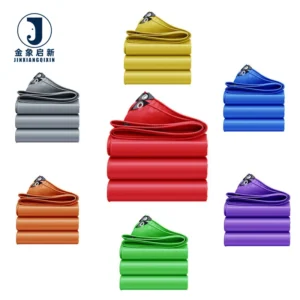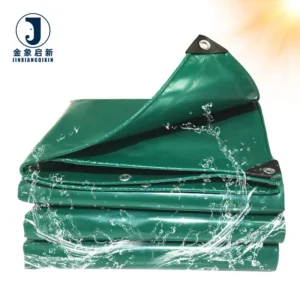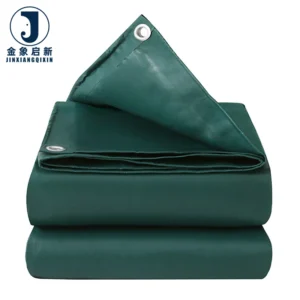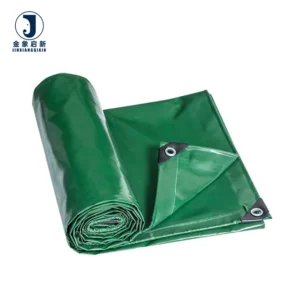
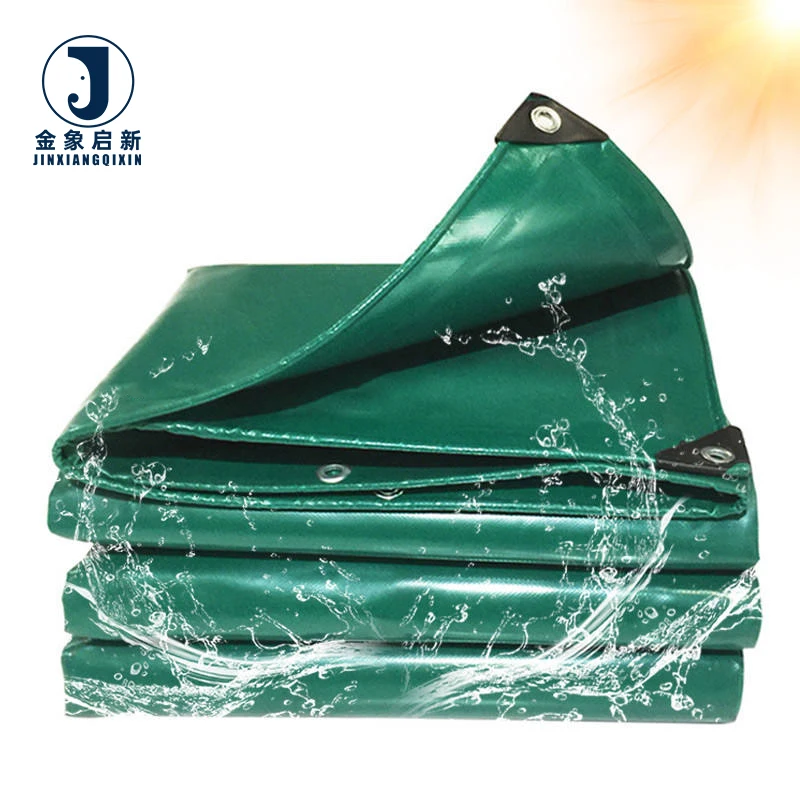
Deep process control over coating weight — Every roll of PVC coated tarpaulin material is verified against its stated GSM, base fabric denier, and coating adhesion before it leaves the production line.
Technical Specifications
| Parameter | Value |
|---|---|
| Product Type | PVC Coated Tarpaulin Roll |
| Weight (GSM) | 350, 400, 420, 500, 600, 650, 750, 900 |
| Base Fabric Denier | 500D×840D, 500D×1000D, 1000D×1000D, 1000D×1300D, 1300D×1300D, 1000D×2000D |
| Mesh Count | 30×19, 20×20, 30×15 |
| Coating Material | PVC (knife coated) |
| Total Thickness | 0.29mm (350 GSM) to 0.65mm (900 GSM) |
| Width | 2m, 2.1m (varies by grade) |
| Tensile Strength Warp | 1650 N to 3900 N (varies by grade, test standard not stated) |
| Tensile Strength Weft | 1600 N to 3500 N (varies by grade, test standard not stated) |
| Flame Retardant | Available in flame retardant grades — confirm the grade required for your market |
| UV Treatment | Claimed — test basis not stated, request test report |
| Anti-Mildew | Claimed |
| Finish | Glossy or matte finish available |
| Welding Options | High frequency hot melt, hot air welding, sewing |
| Printing | Printable, customised |
| Eyelet & Hem Options | 3cm aluminium alloy eyelet, reinforced corners, 5mm rope hem, heat-sealed edge wrapping |
| Colour | Customisable |
| Certification | ISO, CE |
Application Suitability
| Application | Exposure & Requirement |
|---|---|
| Truck side curtain | Constant flexing at load points, road spray abrasion, UV exposure, tensile demand at tie-down zones |
| Trailer top cover | Standing water, wind uplift stress, thermal cycling across seasons |
| Outdoor event tent (block-out) | Full sun exposure, repeated assembly and disassembly, light blocking requirement |
| Awning and canopy | Permanent UV exposure, wind load on seams, surface dirt accumulation |
| Inflatable structure | Internal air pressure load, seam integrity under continuous stress, puncture risk during transport |
| Construction membrane | Wind-driven rain, chemical contact from fresh concrete, puncture from site debris |
| Pond and reservoir liner | Permanent water immersion, UV exposure at waterline, soil chemistry contact |
Why GSM Alone Does Not Define PVC Coated Tarpaulin Material Properties and Tensile Strength
Tensile performance is a product of base fabric denier, weave density, and coating weight — not GSM by itself.
A buyer who specifies material only by grams per square metre is missing the structural input that actually resists tearing and flex fatigue. Two rolls can carry the same GSM yet differ substantially in tensile capacity because one uses a higher-denier yarn with fewer ends per inch, while the other packs lighter yarns more densely. The PVC coating adds weight but contributes little to load-bearing once the base fabric yields. Technical buyers who have reviewed field failures consistently find that seam and fabric failures correlate with denier specification gaps rather than GSM shortfalls [NEED_CITE: relationship between base fabric denier and tensile performance in coated fabrics per ISO 1421].

Base Fabric Denier as the Structural Backbone
The denier of the polyester base yarn — ranging from 500D×840D up to 1000D×2000D across the available grades — determines how much load the PVC coated tarpaulin can carry before the fabric itself deforms. A 1000D×2000D base at 900 GSM delivers warp tensile values reaching 3900 N, while a 500D×840D base at 350 GSM sits around 1650 N. The specification choice here must match the peak stress the finished product will face in service, not simply the weight tolerance stated on a purchase order.
Coating Weight, Adhesion and Seam Behaviour
The knife-coated PVC layer contributes waterproofing, surface durability, and weld receptivity — but its bond to the base fabric governs whether a welded seam holds or delaminates under flex. Coating weight increases through the 350 to 900 GSM range correlate with thicker total profiles from 0.29mm to 0.65mm. Heavier grades absorb more heat during high-frequency welding, requiring adjusted dwell times to achieve full adhesion without scorching. Hot air welding on lighter grades demands tighter temperature control to avoid base fabric damage [NEED_CITE: high-frequency versus hot-air welding parameters for PVC coated polyester fabrics].
Reading the GSM-to-Denier Mapping for Specification Accuracy
| GSM Grade | Representative Denier | Typical Use Profile |
|---|---|---|
| 350–420 | 500D×840D / 500D×1000D | Light covers, temporary shelters, indoor barriers |
| 500–600 | 1000D×1000D / 1000D×1300D | Truck side curtains, awnings, event tents |
| 650–750 | 1000D×1300D / 1300D×1300D | Trailer tops, membrane structures, heavy-duty covers |
| 900 | 1000D×2000D | Inflatable structures, high-tension membrane applications |
Selecting the correct PVC coated tarpaulin material properties depends on matching the tensile strength requirement of the application to both the GSM and the denier, not to GSM alone. A membrane structure under continuous wind load demands high warp tensile values that only a heavy denier base can deliver, regardless of how much coating weight sits on top.

The Hidden Cost of Specifying Weight Without Denier
When a fabricator sources material by GSM without confirming the underlying denier, the finished product can pass initial inspection yet fail prematurely at the points where load concentrates. Welded seams on undersized base fabrics show delamination before the coating surface shows wear. Tensile test results on arrival may meet the GSM-based expectation while the tear propagation resistance falls short because the yarn count is lighter than assumed [NEED_CITE: coated fabric tear propagation test methods and base fabric correlation]. This mismatch is rarely caught at goods-in inspection because standard receiving checks measure weight per square metre, not denier under a microscope.
Why Material and Coating Data Belongs on the Purchase Order
Deep process control across coating weight and base fabric selection — Three full production lines and dedicated QA at each stage mean the denier, mesh count, and coating adhesion are confirmed per roll, not assumed from a product family range.
The 10-person R&D team develops samples within days when a technical buyer needs to confirm weld behaviour or tensile performance on a specific GSM grade before committing to production volume. Pre-shipment inspection records verify that the roll weight matches the quoted GSM and that the base fabric denier matches the specification sheet, closing the gap between what was ordered and what arrives. ISO and CE certification frameworks govern the documentation trail, and test reports for flame retardant and UV treatments are available where the grade has been confirmed against the buyer’s market requirement.
Documentation & Verification
- Material specification sheet stating exact GSM, base fabric denier, mesh count, and coating type per roll
- Test report for flame retardant grade — confirm the classification standard required in your market
- UV treatment test basis documented when anti-UV grades are specified for outdoor service
- Pre-shipment inspection record verifying GSM and base fabric denier against purchase order
- ISO and CE certificates supplied with the shipment documentation package
- Roll packing list with batch reference for colour consistency traceability
Fabrication, Handling & Storage
- High-frequency welding on 650–900 GSM grades requires extended dwell time to achieve full PVC fusion at the seam
- Hot air welding on 350–420 GSM grades demands lower temperature settings to protect the lighter base fabric denier
- Store rolls upright on core to prevent flat-spot creases that weaken the coating bond at fold lines
- Heat-sealed edge wrapping and reinforced corners must be specified at order to match the finished panel dimensions
- Surface cleaning with mild detergent preserves the PVC coating without degrading flame retardant or anti-mildew treatments
- Aluminium alloy eyelets at 3cm diameter distribute tie-down load across the base fabric weave without pull-through
What to Provide When Requesting a Quotation
Share the application and the peak mechanical stress the fabric will face — whether that is wind uplift on a membrane, flex cycling on a side curtain, or internal pressure on an inflatable. State the GSM grade or the tensile strength requirement you have calculated, along with the width and roll length needed for your fabrication layout. If your market requires a specific flame retardant classification or UV test standard, name it explicitly so the correct treatment grade is confirmed before production begins.
Frequently Asked Questions
Q: How can I verify the GSM of the PVC coated tarpaulin on arrival matches my order?
A: Cut a measured sample from the roll and weigh it against the stated GSM on your material specification sheet. The pre-shipment inspection record supplied with your order documents the per-roll verification performed before dispatch. If the result falls outside tolerance, the batch reference on the packing list enables traceability back to the production run for resolution.
Q: Which flame retardant grade applies to my market, and can it be tested?
A: Flame retardant classifications vary by region — M2 for France, B1 per DIN 4102 for Germany, NFPA 701 for the United States. Confirm the grade required by your local regulation or project specification. Once confirmed, a test report for the applicable standard can be supplied with the shipment documentation.
Q: How do I choose between high-frequency and hot air welding for my GSM grade?
A: Heavier grades from 650 to 900 GSM respond well to high-frequency hot melt welding, which produces consistent seam integrity through full-thickness PVC fusion. Lighter grades from 350 to 420 GSM are better suited to hot air welding with controlled temperature to avoid base fabric damage. Sample welds are available to confirm the correct method before bulk fabrication.
Q: Will colour be consistent across all rolls in my order?
A: Batch colour consistency is verified during pre-shipment inspection. Rolls produced in the same run are matched against the confirmed colour reference. The packing list carries the batch reference so you can trace each roll. If you require side-by-side visual confirmation before dispatch, request a pre-shipment photo set showing multiple rolls unrolled together.
Q: What test basis supports the anti-UV claim on this fabric?
A: Anti-UV treatment is applied during the coating process, but the specific test basis and exposure rating vary by grade. Request the UV test report for your selected GSM grade to confirm the treatment level matches your expected outdoor service conditions. This documentation is available for grades where UV stabilisation has been specified at the time of order.